What’s Inside
- Zero-VOC Formulas Are The Foundation Of All Nursery Wall Painting Ideas
- The Two-Week Ventilation Window
- The Eggshell Finish Requirement
- Calming Cool Tones For Better Sleep
- Earthy And Saturated Trends For 2026
- Skipping Overly Stimulating Bright Colors
- Sampling Paint Colors Correctly
- Creating A Serene Ombre Accent Wall
- Dynamic Geometric Accent Walls
- Traditional Interactive Chalkboard Walls
- The Clear Chalkboard Coating Trick
- Magnetic Primer For Functional Play
- Stencils Over Hand-Painted Murals
- High-Quality Removable Wall Decals
- Matching Textiles Before Paint
- Using Light Reflectance Value (LRV)
- Two-Tone Scalloped Borders For Unique Nursery Wall Painting Ideas
I spent three days last November scraping dried, peeling mint green paint off a textured wall because I ignored basic prep. If you want nursery wall painting ideas that actually work, learn from my mistakes. I thought I could skip sanding the glossy finish underneath. I was wrong. The new paint flaked off like dry skin the second I bumped it with a crib leg. I ended up starting over at 3 AM with a metal putty knife, a spray bottle of water, and a lot of regret. Designing a baby’s room should be fun, but the physical work is tedious if you don’t know the rules. You’re dealing with safety requirements, off-gassing timelines, and finishes that need to withstand sticky toddler hands. Over the last few years of consulting, I’ve seen every paint disaster possible. I’ve also found exactly what works. Let’s look at the formulas, techniques, and designs that hold up.
1. Zero-VOC Formulas Are The Foundation Of All Nursery Wall Painting Ideas

I’m very specific about paint formulas. You can’t just grab whatever is on sale at Walmart. VOCs (Volatile Organic Compounds) off-gas for months. The sharp, chemical smell gives me a headache within ten minutes. I use ECOS Paints’ Lullaby collection. It costs $69 per gallon, but the safety rating justifies the price. Benjamin Moore Eco Spec and Clare Paint are also excellent zero-VOC, low-odor options. AFM Safecoat works well if you have severe chemical sensitivities. Natural brands like The Real Milk Paint Company use plant oils and mineral clays instead of synthetic binders. The total cost for a standard 10×12 room usually hits around $140 for two gallons, which covers two coats perfectly. Always check the label for the zero-VOC certification, not just “low-VOC,” because the standards for the latter are surprisingly loose.
2. The Two-Week Ventilation Window

Even with zero-VOC formulas, you need a strict timeline. I learned this the hard way when I painted a client’s room three days before her scheduled induction. The room still smelled distinctly wet and chalky. You need to paint the nursery at least two weeks before the baby’s arrival. Experts actually recommend finishing any painting at least 8 weeks prior to your due date. This gives the walls ample time for complete off-gassing. I set up two large Lasko box fans I bought at Costco for $45 each, pointing them directly out the open windows. Keep the windows open daily for that entire two-week window. The cross-breeze physically pushes the lingering paint moisture out of the drywall. If you live in a humid climate, run a dehumidifier alongside the fans. The paint needs to cure, not just dry to the touch.
3. The Eggshell Finish Requirement

Flat paint looks beautiful in photographs. It hides drywall imperfections perfectly. It’s also a nightmare for a child’s room. I painted my son’s room in a flat finish and tried to wipe a small smudge off the wall with a damp cloth. The water left a permanent dark ring, and the friction actually removed the paint pigment. You need an eggshell finish for nursery walls. Little Crown Interiors recommends eggshell because it offers a soft sheen, is durable, and is significantly easier to clean than flat paint. It has just enough gloss to repel light stains but not so much that it glares under the ceiling light. For trim, doors, and baseboards, you need a satin or semi-gloss finish. A quart of Benjamin Moore Regal Select in semi-gloss costs about $28 and provides a hard shell that resists chipping.

Delta Children Nursery Storage 48 Piece Set
A dependable everyday pick — Delta Children Nursery Storage 48 Piece Set – Easy Storage/Organizatio pulls in 17 ratings at 4.5 stars. Not flashy, just solid.
4. Calming Cool Tones For Better Sleep

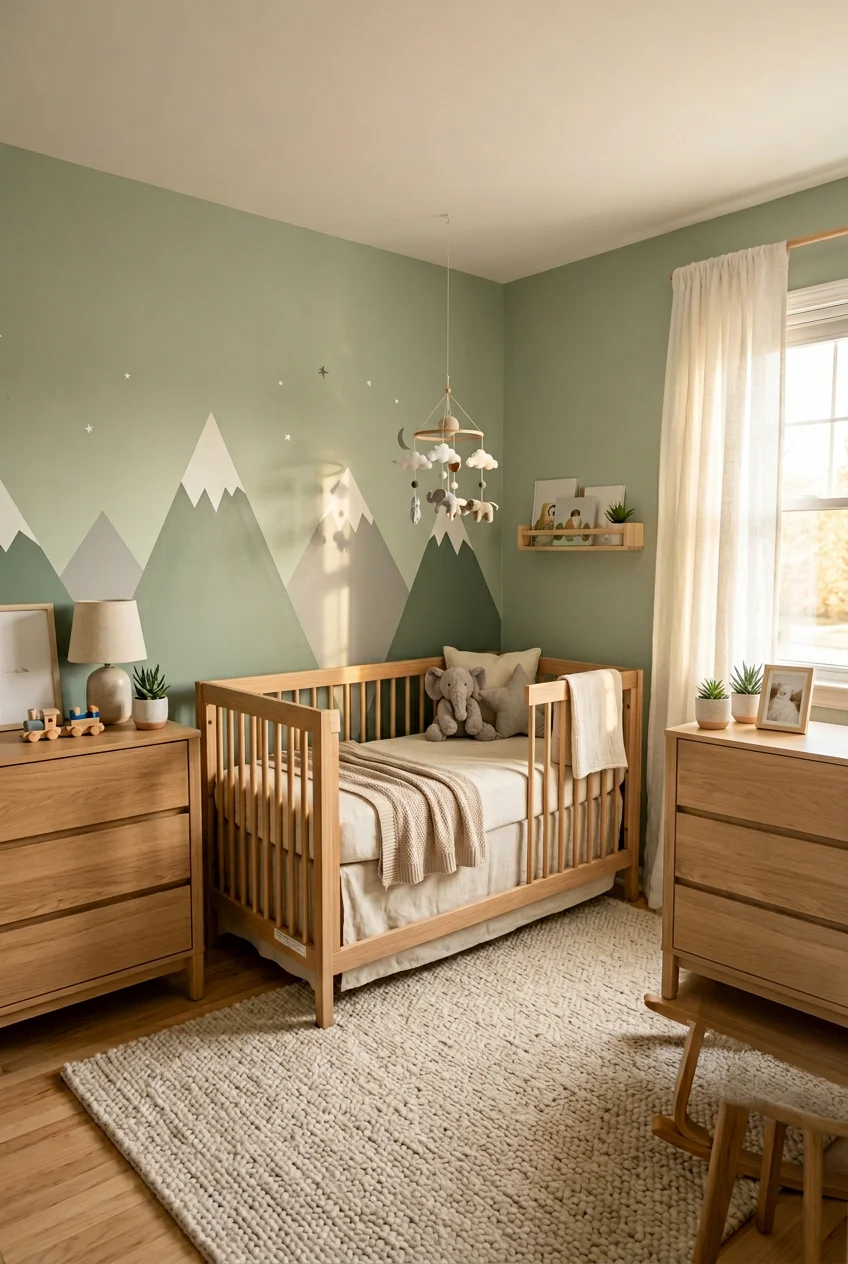
Sleep experts and interior designers agree on color psychology for a practical reason. Pale blues and greens actually lower heart rates and reduce physical stress. I frequently use Benjamin Moore’s Lido Green. It’s a soft sage that doesn’t pull too yellow under warm artificial light. It reminds me of the muted green color of a Sprouts reusable grocery bag after it goes through the wash. When you use cool tones, you create a restful atmosphere that helps induce sleep. Warm colors feel energetic. Cool colors recede, making the walls feel further away and the room feel quieter. If you want a blue, avoid anything with a gray undertone if the room faces north. North-facing light is already cool and bluish. It makes gray-blues look like cement. Stick to clear, soft blues with a hint of warmth.
5. Earthy And Saturated Trends For 2026

Current trends for 2026 are shifting heavily away from stark grays. We aren’t doing the sterile look anymore. There’s a return to warm, earthy, and saturated hues. Sage green, muted olive, warm terracotta, clay, and even deeper shades like chocolate brown are taking over. These colors create a cozy, grounded feel. I recently painted a nursery accent wall in a deep terracotta that looked exactly like crushed red brick. It cost $75 for a gallon of Sherwin-Williams Emerald paint, and the coverage was thick enough that I only needed one coat. Earthy tones work beautifully because they transition well as the child grows. A chocolate brown wall behind a crib looks incredibly rich when paired with cream linen curtains. If a full room of olive green feels too dark, use it strictly below a chair rail. You might also like: 16 Toddler Room Ideas You Need to See
6. Skipping Overly Stimulating Bright Colors

I made a massive error in 2018 when I let a client talk me into painting a nursery wall electric blue. Bold, saturated reds, electric blues, or very bright yellows can severely overstimulate infants. These high-energy colors increase alertness and can potentially lead to irritability, disrupting fragile sleep patterns. The electric blue room felt buzzing with energy, even with the lights off. We had to prime over it with two coats of Kilz Original primer, which smells terrible and costs $24 a gallon, just to hide the blue before repainting it a soft cream. If you want cheerful colors, use muted pastels or softer versions of these hues. Reserve the bright, saturated colors for small, easily changeable accents. A bright yellow throw pillow provides enough visual interest without turning the entire room into a high-stress environment. You might also like: 20 Stunning Childcare Nursery Room Ideas Worth Trying This Year

Criusia Drawer Organizer Clothes
If you want something that just works, Criusia Drawer Organizer Clothes is a safe bet (1 reviews, 4.5 stars).
7. Sampling Paint Colors Correctly

You can’t trust a tiny paper paint chip under the fluorescent lights of a hardware store. Paint colors look drastically different in your home due to your specific natural lighting. You must purchase actual sample pots. They usually cost around $5 to $10 for a small 8-ounce container. Paint large swatches on multiple walls in the nursery. I require my clients to paint squares that are at least 1 foot by 1 foot. You need to observe these painted squares at different times of day. A color that looks perfectly beige at noon might look fleshy and pink by 4 PM when the sun sets. I once bought what I thought was a soft gray at a Kroger hardware section, painted the whole wall, and realized it looked lavender at night. Always test the paint directly on the drywall. You might also like: 20 Charming Small Nursery Ideas to Transform Your Space
8. Creating A Serene Ombre Accent Wall

An ombre wall features a gradient of two to three shades from the same color family. It adds depth and a calming, dreamy effect to a flat room. For a soft transition, choose very similar shades on the same paint card. I apply the lightest shade to the top half of the wall using a standard 9-inch roller. Then, I apply the darkest shade to the bottom half. The trick happens in the middle. While both paints are still completely wet, I use a clean, damp 3-inch synthetic brush to blend the section using wide, criss-cross strokes. You have to work fast. If the paint starts to dry, it pills up and looks textured. I recommend adding a paint extender like Floetrol, which costs $12 for a quart, to slow down the drying time.
9. Dynamic Geometric Accent Walls

For a modern and playful look, a geometric accent wall is highly effective. You need to use Frog Tape Delicate Surface. I specifically recommend the 1.88-inch width because it creates visible negative space between the shapes. Standard blue painter’s tape often bleeds. A common technique involves drawing a horizontal line exactly 42 inches up from the floor with a 4-foot level. You use this as your starting point for 45-degree angles or vertical stripes. After you apply the tape firmly, you must seal the tape edges. You do this by painting a very thin coat of your base wall color directly over the tape line. This fills any microscopic gaps. I peel the tape off while the final coat of accent paint is still slightly tacky. If you wait until it’s 100% dry, the tape rips the paint.

Beautiful Wooden Baby Closet Dividers Set of 7
A dependable everyday pick — Beautiful Wooden Baby Closet Dividers Set of 7 – Double-Sided Organize pulls in 11 ratings at 4.5 stars. Not flashy, just solid.
10. Traditional Interactive Chalkboard Walls

Incorporating a fun and changeable element like a chalkboard wall gives a toddler a designated place to draw. Rust-Oleum Chalkboard Paint costs around $10 per 30-ounce can. You can apply it directly onto a smooth wall for a traditional black or green chalkboard finish. I painted a 4-foot by 4-foot square in my niece’s room. You need to prep the wall first by sanding it completely smooth with 120-grit sandpaper. If you paint chalkboard paint over heavy wall texture, the chalk catches on the bumps and looks terrible. It takes two solid coats, applied with a high-density foam roller, to get an opaque finish. Once the paint is fully dry, you must take a piece of standard white chalk, turn it on its side, and rub it over the entire painted surface. Then wipe it off with a dry felt eraser.
11. The Clear Chalkboard Coating Trick

If a giant black square feels too heavy for your nursery design, there’s a better alternative. You can use Rust-Oleum Clear Chalkboard Coating. It costs about $17 for a quart. You paint this transparent, matte finish directly over any existing paint color to create a writeable surface. I used this over a pale peach wall, and you couldn’t even tell it was a chalkboard until someone picked up a piece of chalk. The application is tricky. It has a milky appearance when wet and dries clear, but you have to apply it in very thin, even coats. If it pools or drips, it dries with a cloudy yellow tint. You must allow exactly 3 full days for curing before you let a child use chalk on it. I tried testing it after 24 hours once, and the chalk gouged the wall.
12. Magnetic Primer For Functional Play

For a truly interactive element, you can apply magnetic primer before your topcoat. Rust-Oleum Magnetic Primer costs around $20 per quart can. It turns any standard wall into a magnetic surface. This allows for changeable art, educational games, or displaying photos without pushing thumbtacks into the walls. The primer is incredibly thick, almost like liquid lead, and it smells very strong, so wear a respirator mask. You need to stir it for a solid ten minutes because the heavy iron dust settles at the bottom. You must apply at least three thick coats of magnetic primer for a strong enough hold. I tested it with cheap plastic alphabet magnets I found at Target for $4.99. After the dark gray primer dries, you paint right over it with two coats of your chosen zero-VOC nursery paint.

Criusia Over the Door Organizer
A dependable everyday pick — Criusia Over the Door Organizer pulls in 218 ratings at 4.5 stars. Not flashy, just solid.
13. Stencils Over Hand-Painted Murals

Hiring a professional muralist costs upwards of $800 in most cities. If a full hand-painted mural feels daunting or too permanent, use reusable wall stencils. Brands like Designer Stencils and Nakleo Kids Collection offer a massive range of patterns. You can find everything from repeating geometric designs to large woodland animals. They are easy to apply and remove with basic painter’s tape. This allows for intricate designs without the cost of a professional artist. Plus, they can be easily painted over later. I use a dense foam stencil roller and barely any paint. The biggest mistake people make is overloading the roller. You want the roller almost dry to the touch. If you use too much paint, it bleeds under the plastic edges and ruins the crisp lines. A good woodland stencil kit usually runs about $45 online.
14. High-Quality Removable Wall Decals

For patterns, quotes, or images that can be updated in five minutes, consider high-quality, removable wall decals. Companies like The Simple Stencil and Innovative Stencils offer a vast selection of designs. You can get personalized name quotes or massive watercolor nature scenes that look hand-painted. They are easy to apply and won’t damage the drywall paper. I recently installed a 6-foot tall birch tree decal set. It cost $110 and took me 45 minutes to rub onto the wall using the included plastic smoothing tool. The matte vinyl material blends into the eggshell paint finish. When you want to remove them, just heat the vinyl slightly with a standard hair dryer on the low setting. The adhesive softens, and you can peel the entire tree off the wall without leaving a sticky residue mark behind.
15. Matching Textiles Before Paint

A very common and costly mistake is selecting your paint color first. People walk into a hardware store, pick a cute pink, paint the room, and then spend six months trying to find curtains that match. With thousands of paint colors available, it’s significantly easier to match your paint to your chosen textiles. You need to buy your crib bedding, curtains, and rugs first. These items have very limited color options. Once you have the physical rug in your house, take it to the paint store. I once carried a heavy 5×7 wool rug into a Trader Joe’s just because I wanted to see how the colors looked in their natural daylight near the front windows before I took it to the paint shop next door. You can always custom-tint paint to match a thread in a blanket. Trust me on this.

SNSLXH 5 Pack Stackable Closet Storage Basket
A dependable everyday pick — SNSLXH 5 Pack Stackable Closet Storage Basket pulls in 4 ratings at 4.5 stars. Not flashy, just solid.
16. Using Light Reflectance Value (LRV)

A lesser-known technical tip is to consider a paint color’s Light Reflectance Value, or LRV. You will find this number on the back of almost every paint chip. It operates on a scale from 0 to 100. Higher LRV numbers indicate lighter colors that reflect more light, making a small room feel airier. Lower LRV numbers mean darker colors that absorb light. This is particularly useful in rooms with limited natural light or small windows. If you have a dark room, you need a paint with an LRV of 65 or higher. I painted a basement nursery with a color that had an LRV of 30. It felt like a cave. I had to repaint it with Benjamin Moore’s White Dove, which has an LRV of 85.38. The difference was immediate and striking.
17. Two-Tone Scalloped Borders For Unique Nursery Wall Painting Ideas

If you want unique nursery wall painting ideas that don’t require expensive tools, try a two-tone scalloped border. You literally only need a standard 9-inch paper plate and a pencil. You paint the top half of the wall a light color and the bottom half a darker color. Instead of a straight line dividing them, you use the edge of the paper plate as a tracing template to draw repeating semi-circles along the dividing line. I bought a pack of cheap, firm paper plates at Whole Foods for $3.99. I cut one in half, placed a level across the straight edge, and traced the curve with a pencil. You then fill in the scallops carefully with a 1-inch angled brush. It takes patience and a steady hand. I tried rushing this last spring and the scallops looked lopsided. No exaggeration.
I’ve spent years testing different nursery paint techniques, and the biggest takeaway is simply taking your time with the prep work. Don’t rush the drying times, don’t skip the samples, and definitely don’t buy cheap tape. If you put in the effort on the front end, you won’t be scraping peeling paint off the wall at 3 AM like I was. Save this post, pin your favorite ideas, and start gathering your fabric swatches before you even look at a paint deck.
Frequently Asked Questions
How long before the baby arrives should I paint the nursery?
You should paint the nursery at least two weeks before the baby arrives, though experts recommend eight weeks. This allows time for complete off-gassing and proper ventilation, even if you use zero-VOC paint formulas.
What is the best paint finish for a nursery wall?
An eggshell finish is the best choice for nursery walls. It provides a soft sheen that is durable and easy to wipe clean, unlike flat paint which absorbs moisture and stains easily.
Are zero-VOC paints completely safe for babies?
Zero-VOC paints lack volatile organic compounds that cause harsh off-gassing, making them much safer than traditional paints. However, they still require proper ventilation and curing time to ensure the room is completely odor-free.
How do I test nursery paint colors accurately?
Always buy small sample pots and paint swatches that are at least 1 foot by 1 foot directly on the wall. Observe the dried patches at different times of day to see how natural and artificial lighting changes the color.
