What’s Inside
- Embrace Biophilic Design with Muted Nature Murals
- Opt for Geometric Color-Block Mountains
- Utilize Projector Tracing for DIY Murals
- Consider Removable Wallpaper Murals for Flexibility
- Consider the Ceiling as the Fifth Wall
- Embrace Color Drenching for a Modern Vibe
- Incorporate Textured Walls with Limewash
- Design for Sensory Engagement with Subtle Textures
- Avoid Overly Themed or Bright Saturated Rooms
- Plan Mural Placement and Size Carefully
- Use Digital Visualization Tools Before Committing
- Test Paint Swatches in Various Lighting Conditions
- Invest in Quality Wallpaper Installation Tools
- Prioritize Zero-VOC Paints for Safety
- Factor in Professional Muralist Costs
- Add Personal Keepsake Details
Last October, I spent three days painting a neon green dinosaur mural in my son’s room, only to realize it looked like a radioactive swamp. If you’re hunting for nursery mural ideas, learn from my massive failure. I had to prime over it four times before the toxic green finally faded. It’s safe to say I’ve learned exactly what works and what absolutely fails when putting art on your baby’s walls. Let’s skip the expensive mistakes and walk through 16 gorgeous concepts that actually look amazing in real life.
1. Embrace Biophilic Design with Muted Nature Murals

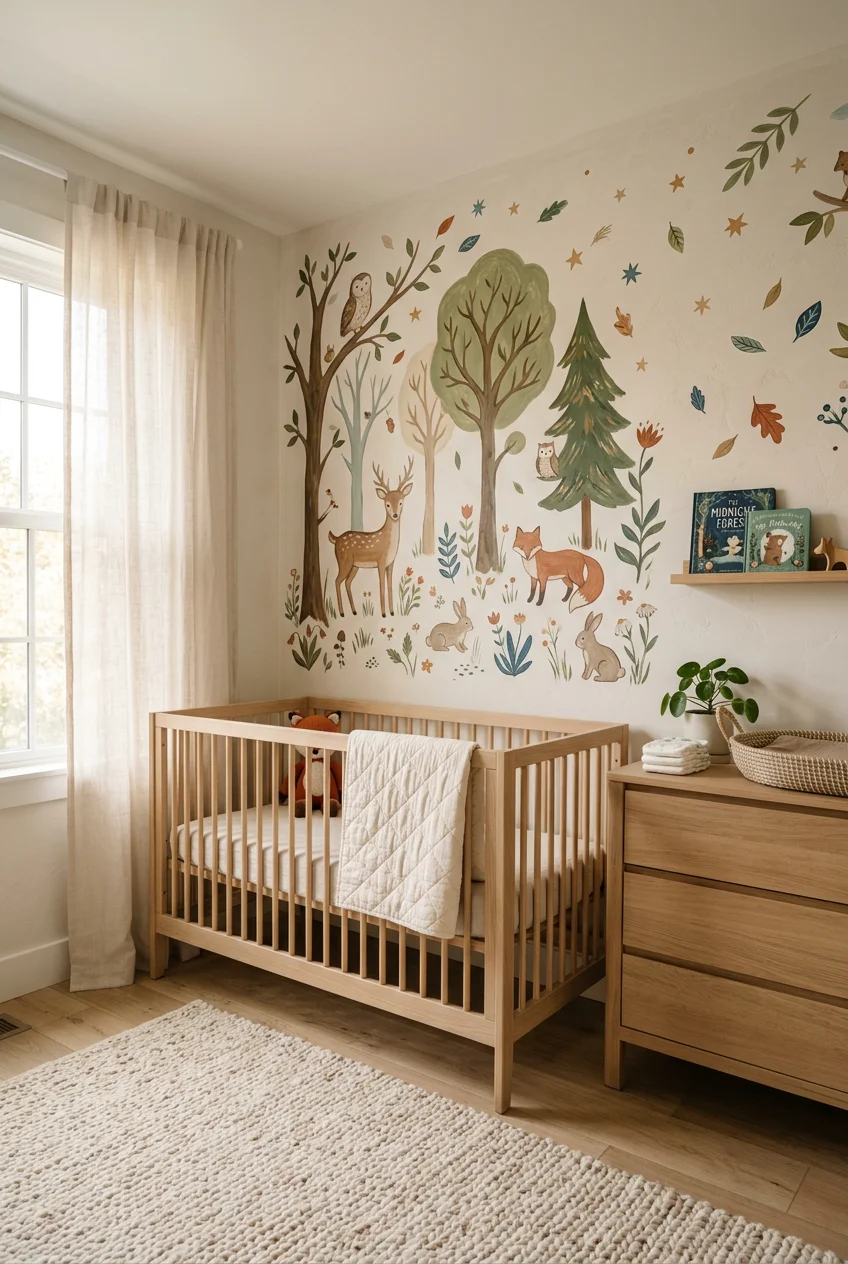
Let’s talk about the biggest 2026 trend. Designers are calling it Moody Woodland Heritage. It’s all about muted nature scenes. I’m obsessed with dusty greens and warm sand tones. Forget bright cartoon trees. You want soft browns and subtle blues that mimic a real forest at dusk. Last Tuesday at Whole Foods, I saw a gorgeous botanical reusable bag for $3.99 that completely inspired my latest client project. I took a photo of it and color-matched it to a $45.98 gallon of Behr Premium Plus paint. It creates this calming backdrop that actually supports a baby’s sensory growth instead of attacking their eyeballs. I painted a soft canopy using a 2-inch Wooster angle brush. The muted colors absorb the morning light beautifully. It feels like you’re standing under real trees. This biophilic approach brings the outdoors inside, providing a grounding atmosphere for late-night feedings.
2. Opt for Geometric Color-Block Mountains


Geometric color-block mountains are everywhere right now. It’s a stylized look with crisp, intentionally imperfect hand-painted edges. I tried this wrong for months before figuring it out. I used cheap dollar-store tape, and the paint bled everywhere. It was a disaster. Now, I only use the 1.88-inch wide 3M ScotchBlue painter’s tape ($8.48 at Walmart). You want a palette of warm terracotta, golden ochre, lilac shadows, and slate blues. It gives a graphic yet organic feel. I usually map out 4 distinct mountain peaks across a standard 10-foot wall. The trick is to peel the tape while the paint is still slightly tacky. It makes a satisfying ripping sound and leaves a perfectly sharp line. Skip the perfectly straight ruler lines. A tiny bit of wobble makes it look hand-crafted and expensive. This is one of my favorite nursery mural ideas because it grows with your child easily. Learned that the hard way.
3. Utilize Projector Tracing for DIY Murals

You don’t need to be Picasso to paint a masterpiece. I’m terrible at freehand drawing. My circles look like squashed potatoes. The secret to those intricate animal scenes you see on Pinterest is projector tracing. I bought a little AuKing Mini Projector for $69.99 on Amazon, hooked it up to my laptop, and beamed a vintage world map directly onto the drywall. You just trace the outlines lightly with a standard number 2 Ticonderoga pencil. It takes maybe 45 minutes to trace a massive 8-foot by 6-foot animal safari scene. I did this last month while snacking on a $4.99 box of organic strawberries from Sprouts. It’s almost mindless work, but the result looks completely professional. Just make sure you tape your projector down to a table. If you bump it, realigning the image is a massive headache you won’t want to deal with.

Delta Children Nursery Storage 48 Piece Set
If you want something that just works, Delta Children Nursery Storage 48 Piece Set – Easy Storage/Organizatio is a safe bet (17 reviews, 4.5 stars).
4. Consider Removable Wallpaper Murals for Flexibility

If you’re renting or just terrified of commitment, peel-and-stick removable wallpaper murals are your best friend. I’ve used standard wallpaper paste before, and it smells like sour glue. It’s awful. Removable options are basically giant stickers. The Glitter Guy offers incredible custom murals for about $3.00 to $4.00 per square foot, printed on massive 50-inch wide panels. Limitless Walls is another fantastic option. Their peel-and-stick fabric starts at $8.06 per square foot for orders over 35 square feet. The fabric texture feels thick and luxurious, hiding tiny wall bumps perfectly. I helped my sister install a floral panel last weekend. We bought a massive $12.99 party-size bag of tortilla chips from Kroger to keep our energy up. You just peel down 6 inches at a time and smooth it out. It’s truly foolproof.
5. Consider the Ceiling as the Fifth Wall

Don’t ignore the ceiling. Interior designers call it the fifth wall for a reason. When your baby is lying flat in their crib, they aren’t looking at the baseboards. They’re staring straight up. Painting a soft blue sky with wispy white clouds is incredibly soothing. I painted a celestial night sky in my daughter’s room using a $14.98 quart of Rust-Oleum metallic gold paint for the stars. I used a tiny 1/4-inch artist brush to dab on little constellations. It took me three hours, and my neck was screaming by the end. Honestly, it was a painful mistake not buying a proper scaffolding step ladder ($45.99 at Target) first. But the visual is stunning. It maximizes the natural light bouncing around the room and gives them something magical to focus on while drifting off. You might also like: 20 Creative Small Spaces Baby Room Organization Ideas You Haven’t Thought Of
6. Embrace Color Drenching for a Modern Vibe

Color drenching is a massive trend right now. It’s when you paint the walls, the baseboards, the window trim, and even the ceiling in one single, saturated, muted shade. It creates a deeply immersive mood. I highly recommend a soft sage or a dusty terracotta. I did this in a tiny 8×10 foot nursery, and it made the room feel like a cozy little jewelry box. I bought 3 gallons of Clare Paint in the shade Current Mood ($64.00 per gallon). The paint has this rich, velvety texture that rolls on like butter. I spent a Saturday blasting music and rolling the walls, fueled entirely by a $5.99 box of macadamia nut cookies from Trader Joe’s. The continuous color erases visual boundaries, making the space feel larger and modern. It’s a bold choice, but it pays off beautifully. You might also like: 20 Stunning Childcare Nursery Room Ideas Worth Trying This Year

Criusia Over the Door Organizer
Honestly, Criusia Over the Door Organizer surprised me — sturdier than it looks in the photos, and over 218 buyers gave it 4.5 stars.
7. Incorporate Textured Walls with Limewash

If you want a textured, artisanal backdrop, you need to look into limewash. Standard flat paint can look a bit dead. Limewash creates a soft, mottled, plaster-inspired finish that looks like an old European villa. Portola Paints makes a stunning zero-VOC limewash ($65.00 per gallon) that actually regulates room moisture and improves air quality. It’s completely breathable. You apply it with a special 5-inch block brush ($24.00) in overlapping X motions. I tried using a regular roller the first time. It looked like a smeared mess. You really have to use the brush technique to get that cloudy, suede-like texture. It dries down to this gorgeous matte finish that feels chalky and cool to the touch. It’s the perfect subtle base for a minimalist nursery design. You might also like: 15 Beautiful Baby Room Organization Ideas You Haven’t Thought Of
8. Design for Sensory Engagement with Subtle Textures

Babies learn through touch. Integrating sensory elements directly into your mural is brilliant. I like adding simple geometric shapes like circles or gentle waves using lightly raised paint or soft fabrics. I bought 12 sheets of soft merino wool felt (9×12 inches, $14.99 at Michaels) and cut them into fluffy cloud shapes. I attached them to the painted sky mural using a $6.48 bottle of Gorilla spray adhesive. The contrast between the smooth painted drywall and the fuzzy felt is perfect for tiny hands to explore once they start standing in the crib. You can also mix a 1/2 cup of standard baking soda into a quart of acrylic paint to create a rough, sandy texture for painted tree trunks. It offers gentle stimulation without being overwhelming visually.
9. Avoid Overly Themed or Bright Saturated Rooms

Here is a hard truth. You need to avoid overly themed or bright, saturated rooms. A common mistake is painting a nursery with loud primary reds, blues, and yellows. I did this for a client years ago. We painted a fire engine red stripe around the room. It looked like a fast-food restaurant. The baby never slept. Experts agree that bright, saturated colors overstimulate infants and ruin their sleep cycles. Skip the neon colors. They give off a frantic energy. Stick to calming, gender-neutral hues. Muted tones are your best friend. You want the room to feel like a deep breath. I recently swapped a client’s neon yellow walls for a soft, creamy buttermilk shade ($55.00 a gallon, Benjamin Moore Eco Spec), and the baby’s sleep improved in three days. Trust me on this.

Beautiful Wooden Baby Closet Dividers Set of 7
If you want something that just works, Beautiful Wooden Baby Closet Dividers Set of 7 – Double-Sided Organize is a safe bet (11 reviews, 4.5 stars).
10. Plan Mural Placement and Size Carefully

If you’re ordering custom wallpaper, you have to plan your placement and size meticulously. You can’t just guess. I once eye-balled a wall, ordered a $300 mural, and it was 4 inches too short. I cried on the floor. Always measure the absolute maximum height and width of your wall. Use a heavy-duty 25-foot Stanley tape measure ($12.97 at Home Depot). When you give the printer your exact dimensions, add a buffer. An expert tip is to leave 2 to 3 inches of extra material at the top and bottom. Houses aren’t perfectly square. Your ceiling line is probably crooked. Having that extra 3 inches of bleed room means you can trim the excess perfectly to the baseboard with a sharp blade. It saves you from having a weird, glaring gap at the ceiling.
11. Use Digital Visualization Tools Before Committing

Don’t buy a single drop of paint until you’ve used a digital visualization tool. You wouldn’t buy a car without test-driving it. I use free platforms like Roomstyler or the Sherwin-Williams ColorSnap Visualizer app on my phone. You just snap a photo of your empty nursery, upload it, and virtually test different mural designs and color palettes. I was convinced I wanted a dark navy woodland scene until I visualized it. It made the room look like a dark cave. I immediately pivoted to a soft sage green. It takes 10 minutes and saves you hundreds of dollars in wasted paint. I usually sit on my couch with a $12.99 massive tub of popcorn from Costco and play around with color combos for hours. It’s addictive and completely eliminates buyer’s remorse.
12. Test Paint Swatches in Various Lighting Conditions

Paint colors are liars. A color that looks like a warm beige in the hardware store will look like muddy pink in your house. You have to test paint swatches in various lighting conditions. Buy 4 or 5 half-pint sample pots ($5.99 each at Lowe’s). Paint large 2-foot by 2-foot squares directly onto the nursery wall. Then, watch them. Look at them in the bright morning sunlight. Look at them at 2 PM. Turn on the artificial lamplight at 8 PM. A soft gray might look beautiful at noon but turn icy and cold under an LED bulb. Last month, I bought a $4.49 iced vanilla latte from a local café and just sat in an empty nursery for an hour, watching how the afternoon shadows changed the tone of a dusty rose swatch. Lighting changes everything.

Criusia Drawer Organizer Clothes
Honestly, Criusia Drawer Organizer Clothes surprised me — sturdier than it looks in the photos, and over 1 buyers gave it 4.5 stars.
13. Invest in Quality Wallpaper Installation Tools

If you’re tackling a peel-and-stick mural, don’t try to smooth it out with your hands or a credit card. You will crease the paper and ruin it. You need to invest in quality wallpaper installation tools. I bought a basic kit for $14.98 on Amazon. It included a hard plastic smoother squeegee and a wooden seam roller. The seam roller is crucial. You press it firmly along the overlapping edges to make the seams literally disappear. You also need fresh razor blades. I buy the 100-pack of heavy-duty utility blades for $9.98 at Costco. You have to snap off or change the blade after every single cut. A dull blade will snag the wet paper and tear a jagged edge along your ceiling line. Crisp edges make it look professionally installed.
14. Prioritize Zero-VOC Paints for Safety

This is non-negotiable. You must prioritize zero-VOC paints for your baby’s room. Regular paint releases toxic chemical fumes into the air for months as it cures. It smells awful and isn’t safe for tiny lungs. I strictly use brands like ECOS Paints. Their Lullaby range is incredible ($75.00 per gallon). It has absolutely no odor. None. I’ve also had great results with Benjamin Moore Eco Spec ($55.00 per gallon) and Clare Paint. AFM Safecoat is another fantastic option for allergy-prone families. I painted my nephew’s room with ECOS paint last year, and we didn’t even have to open a window. It goes on thick, covers beautifully in two coats, and guarantees you aren’t trapping harmful chemicals in the space where your newborn sleeps.
15. Factor in Professional Muralist Costs

Sometimes, the best DIY is admitting you shouldn’t do it yourself. If you want a highly detailed, hand-painted masterpiece and you struggle to draw a straight line, hire a professional muralist. I’ve hired out for intricate floral designs before. You need to factor in the costs accurately. Expect to pay between $20.00 to $26.45 per square foot. This covers their high-end artist materials, design mockups, and the actual on-site labor. Most reputable artists also have a minimum project fee, usually around $300.00, just to show up. It sounds pricey, but watching a real artist work is mesmerizing. They blend colors perfectly and add tiny details you’d never think of. It’s an investment in a custom piece of fine art that your child will grow up staring at every single day.

Vailando 6-Shelf Hanging Closet Organizer with 3 Drawers
Vailando 6-Shelf Hanging Closet Organizer with 3 Drawers punches above its price — 35 buyers rated it 4.5 stars. I would buy it again.
16. Add Personal Keepsake Details

The absolute best part of designing a nursery mural is hiding little personalized easter eggs in the artwork. It makes the space entirely yours. When I painted a forest mural for my daughter, I used a tiny 1/8-inch detail brush ($4.99 at Michaels) to paint her initials carved into one of the birch tree trunks. It’s tiny. You wouldn’t see it unless you knew it was there. I also like incorporating the baby’s birth month flower into the foreground. I painted a cluster of tiny white snowdrops near the baseboards of a client’s room. It took maybe 20 minutes to add, using a 1-ounce tube of titanium white acrylic paint ($3.49). These tiny, thoughtful details turn a standard painted wall into a meaningful family keepsake. It’s the perfect finishing touch. No exaggeration.
I honestly hope these ideas save you from the radioactive dinosaur disaster I went through. Creating a beautiful space for your baby shouldn’t end in tears and four coats of primer. I highly recommend starting with the digital visualizer tool before you buy a single brush. It’s the smartest first step. Pick a muted color palette, grab some zero-VOC paint, and just go for it. Don’t forget to pin this article to your nursery inspiration board so you have all these exact paint brands and measurements handy when you’re standing confused in the hardware store!
Frequently Asked Questions
What is the safest paint to use for a nursery mural?
You should always use zero-VOC paints for a nursery mural. Brands like ECOS Paints, Benjamin Moore Eco Spec, and Clare Paint are excellent choices because they don’t release harmful chemical fumes or odors into your baby’s room.
How much does a professional nursery mural cost?
Hiring a professional muralist typically costs between $20.00 and $26.45 per square foot. Keep in mind that most artists also charge a minimum project fee, which usually starts around $300.00 to cover travel and setup.
Are removable wallpaper murals safe for textured walls?
Removable peel-and-stick wallpaper works best on smooth walls. If you have heavily textured walls, the adhesive won’t stick properly. However, thick fabric-based wallpapers from brands like Limitless Walls can successfully hide very light, subtle wall bumps.
What are the best colors for a calming nursery mural?
Experts recommend avoiding bright, saturated primary colors as they can overstimulate infants. Instead, opt for muted nature tones like dusty greens, warm terracotta, soft browns, and slate blues to create a soothing, sleep-friendly environment.
