What’s Inside
- Embrace the Montessori Floor Bed for Independence
- Prioritize Convertible Cribs for Longevity
- Adopt Muted, Nature-Inspired Color Palettes
- Implement the 80/20 Rule for Future-Proof Design
- Create Accessible, Low-Level Storage
- Anchor All Furniture to the Wall
- Choose Child-Safe and Low-VOC Paints
- Optimize Lighting with Layers and Safety in Mind
- Install Art and Mirrors at Child’s Eye Level
- Prioritize Electrical and Window Safety
- Integrate Play Zones and Passive Learning Elements
- Choose Durable, Easy-to-Clean Flooring and Rugs
- Leverage Vertical Space Smartly
- Avoid Overly Themed Decor
- Conduct a Toddler’s Eye View Safety Sweep
- Layer Sensory Textures for a Cozier Vibe
Last Tuesday at Target, I watched my two-year-old dismantle a perfectly styled display shelf while I was holding a $4.99 iced vanilla latte. The sound of heavy wooden blocks hitting the linoleum was deafening. It hit me then: my house was basically a booby trap. That’s why I’m obsessed with building a functional toddler room. A real toddler space isn’t just about looking cute on Pinterest. It’s about survival. I learned that the hard way when my oldest climbed a wobbly thrift-store dresser. The terrifying thud still haunts me. Designing for a small, chaotic human means balancing safety, sticky fingers, and their need for independence. Let’s fix these rooms. I’ve made every mistake so you don’t have to. Here are sixteen realistic ideas that actually work.
1. Embrace the Montessori Floor Bed for Independence

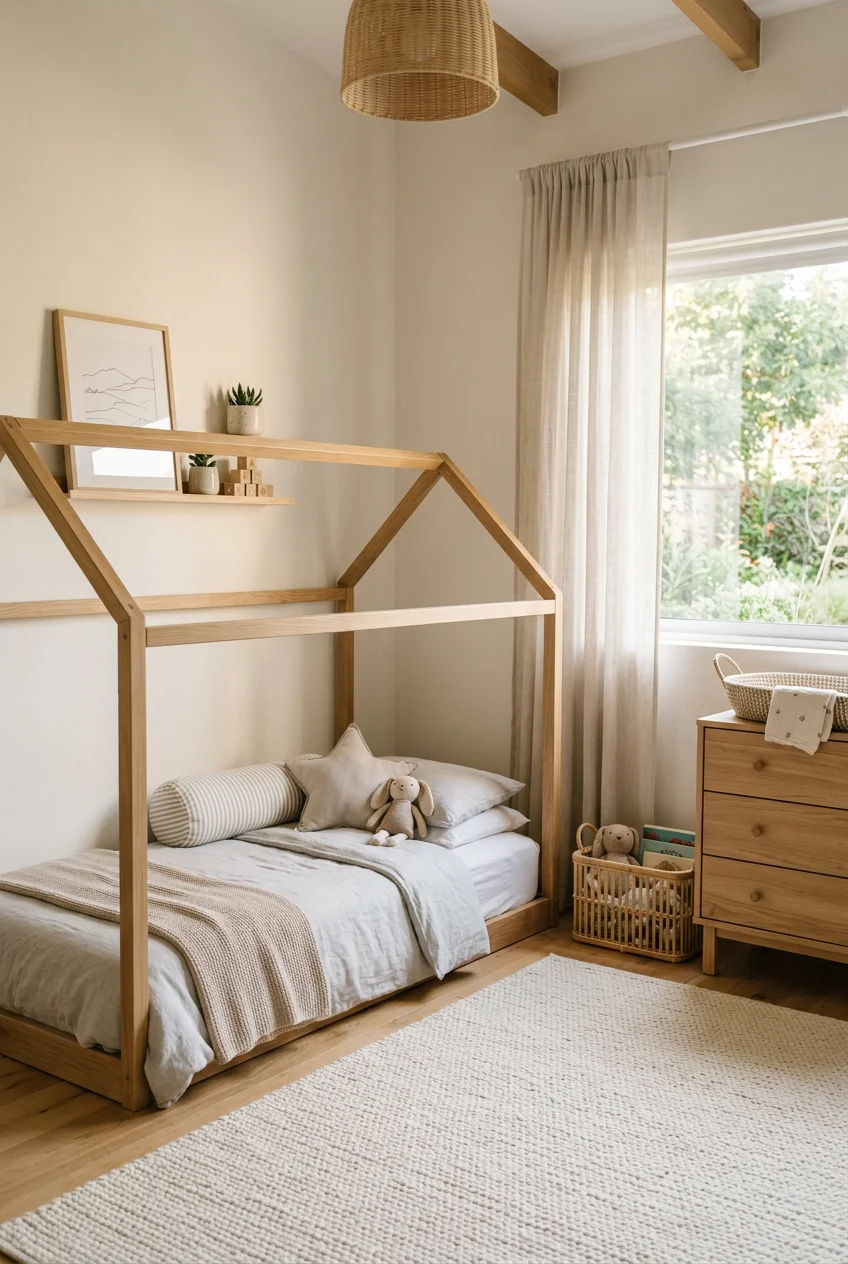
I tried forcing my daughter to stay in her crib for months before giving up. She hated feeling trapped, and the nightly screaming matches were exhausting. Transitioning to a floor bed changed our lives. A Montessori-inspired approach lets toddlers (usually between one and three) get in and out of bed themselves. I’m a huge fan of the Sprout Kids Floor Bed frame. It costs $295.00 for the twin size. It’s smooth, unfinished birch that smells like a lumber yard. Trust me. Just drop a standard 8-inch twin mattress inside. Skip the bulky blankets or heavy stuffed animals to minimize suffocation risks. Keep the sleeping area simple. When we first switched, I found her sleeping on the scratchy wool rug a few times, but she quickly learned her boundaries. It’s amazing to watch them wake up and quietly read a board book instead of screaming for you to lift them over a rail.
2. Prioritize Convertible Cribs for Longevity

If you aren’t ready for a floor bed, get a convertible crib. Don’t buy a standard crib that only lasts eighteen months. I bought a flimsy one for my first baby, and the particle board cracked within a year. It’s a waste of money. Instead, invest in something that grows with your child. The Babyletto Hudson 3-in-1 Convertible Crib is my top pick. It runs about $499.00 and feels sturdy. For a budget option, the DaVinci Kalani 4-in-1 is fantastic at $219.00. I recently helped a client set up the Babyletto Yuzu 8-in-1 ($599.00) in a tiny apartment. It’s brilliant. It shrinks down to a bassinet. Always check for Greenguard Gold certification. You don’t want your baby breathing in chemical emissions from cheap glue. The peace of mind is worth the extra hundred bucks.
3. Adopt Muted, Nature-Inspired Color Palettes

Please step away from the neon yellow paint. I painted my first nursery a blinding shade of sunshine yellow; it felt like staring into a lightbulb. It gave me a headache every time I rocked him to sleep. Trending in 2026 are calming, sophisticated, gender-neutral palettes. Think sage greens, warm terracottas, muted olives, dusty blues, and earthy beiges. These colors create a serene backdrop that grows with your child. Plus, muddy beige hides sour milk splatters way better than crisp white. I’m obsessed with Little Greene’s Intelligent finishes. A 2.5-liter tin costs about $115.00, but it’s certified Child-Safe. It contains zero added VOCs, so it lacks that sharp chemical smell. I painted a client’s room in their Sage Green last month. The matte texture feels like velvet. It’s totally wipeable, which you’ll appreciate when your toddler discovers crayons.

SNSLXH 5 Pack Stackable Closet Storage Basket
Honestly, SNSLXH 5 Pack Stackable Closet Storage Basket surprised me — sturdier than it looks in the photos, and over 4 buyers gave it 4.5 stars.
4. Implement the 80/20 Rule for Future-Proof Design

Designers at HomeLane suggest keeping 80 percent of the room’s core elements in timeless neutrals and natural wood. That means your flooring, large furniture, and wall colors shouldn’t feature cartoon characters. Reserve the remaining 20 percent for high-personality elements. I’m talking about removable decals, bedding, and small rugs. You can swap these out for a few bucks when your child decides they hate dinosaurs and only love dump trucks. Last year, I bought a $400.00 custom space-themed rug. Six months later, my kid was terrified of aliens. It was a costly mistake. Now, I stick to the 80/20 rule. I buy plain wooden dressers and neutral curtains. Then, I’ll grab a $19.99 set of outer space sheets from Target. If they ruin the sheets with a leaky diaper or outgrow the phase, I won’t be weeping over my credit card bill. It’s the smartest way to design without going broke.
5. Create Accessible, Low-Level Storage

Giant toy boxes are a disaster. They’re bottomless pits where toys go to die, and they trap little fingers under heavy lids. You want low shelves that encourage tidiness. The IKEA KALLAX shelf unit is the holy grail. It costs $39.99 for the four-cube version. Turn it on its side. It’s the perfect height for a two-year-old. I use Pehr canvas storage containers ($36.00 each at Whole Foods) because they fit perfectly into 13-inch cube bookcases. The canvas is thick and holds its shape, unlike flimsy bins. Here’s my biggest tip: display only three or four simple toys at a time. Rotate them weekly. I used to cram fifty toys onto a shelf, and my son would just dump them all and walk away overwhelmed. When I reduced the clutter, he actually started playing with his blocks. It’s wild how well this works. You might also like: 15 Inspiring Rustic Nursery Room Ideas to Inspire Your Next Project
6. Anchor All Furniture to the Wall

I can’t stress this enough. Secure all tall furniture to the wall. Dressers, bookcases, and even nightstands need furniture anchors. Toddlers are natural climbers. If they pull out all the drawers to use as a ladder, the whole thing will tip. I once bought a beautiful vintage dresser. I didn’t anchor it right away. My toddler pulled on the bottom drawer, and the heavy oak frame tilted. I caught it just in time, but my heart pounded for an hour. Now, I buy the Hangman Anti-Tip Kit for $12.99 at Walmart. It uses a steel cable that won’t snap. It takes ten minutes and a power drill. Don’t rely on the cheap plastic zip ties that come with furniture. They get brittle and break. Spend the thirteen dollars and anchor every piece. It’s non-negotiable. You might also like: 20 Lovely Space Saving Small Nursery Ideas for Every Budget

Graco Premium Crib & Toddler Mattress
If you want something that just works, Graco Premium Crib & Toddler Mattress – GREENGUARD Gold Certified is a safe bet (515 reviews, 4.5 stars).
7. Choose Child-Safe and Low-VOC Paints

If you’re painting wooden toys or a thrifted rocking chair, you can’t just slap on leftover garage paint. Toddlers chew on everything. I once caught my daughter gnawing on the armrest of a painted wooden chair like it was corn on the cob. You need paints certified as child-safe. Eco-friendly, low-VOC brands like Earthborn, Lullaby Paints, and BioShield are great for walls. For furniture, I swear by RMP Finishes milk paint. It costs $22.00 for a 16-ounce pouch of powder. You mix it with water, and it creates a gorgeous, chalky finish. It’s completely CPSC compliant and VOC-free. The powder smells like powdered milk, and it dries in thirty minutes. I refinished an old wooden toy chest with their Mustard Seed yellow. It took two coats and 4 ounces of paint. It looks stunning, and I don’t panic when I see teeth marks. You might also like: 20 Charming Small Nursery Ideas to Transform Your Space
8. Optimize Lighting with Layers and Safety in Mind

Overhead builder-grade dome lights are the enemy of sleep. They cast harsh shadows and signal to your toddler’s brain that it’s daytime. You need layered lighting: ambient for the whole room, task lighting for reading, and accent lighting for a cozy mood. For ambient light, use soft, diffused bulbs with warm color temperatures (2700K to 3000K). It mimics sunset and promotes relaxation. For task lighting, traditional lamps with hot glass bulbs are a burn hazard. I learned this when my son grabbed a hot bulb and blistered his thumb. Now, I use the BenQ MindDuo 2 Kids Study Lamp. It’s $199.00, but it features concealed cords and cool-touch LED lighting. The LEDs never get hot. Plus, it has an auto-dimming feature. Hide all lamp cords behind furniture or use cord covers. A dangling cord is an invitation for a toddler to yank a heavy lamp onto their head.
9. Install Art and Mirrors at Child’s Eye Level

Most people hang nursery art way too high. You aren’t decorating an art gallery for adults. Following Montessori principles, hang artwork and mirrors at your toddler’s eye level, usually 24 to 36 inches off the floor. This empowers them to interact with their environment. I bought the JONYJ shatterproof acrylic mirror for $18.99 on Amazon. It’s 12 by 16 inches and safe if a rogue wooden block hits it. I screwed it directly into the studs because adhesive strips will eventually peel off. Watching a toddler make faces at themselves in a low mirror is hilarious. It encourages self-awareness. I also frame cheap $5.00 Etsy printable animal prints in lightweight, plastic-front IKEA FISKBO frames ($3.99 each). If they pull a frame off the wall, there’s no shattered glass to clean up.

Letmxiu Premium Crib & Toddler Mattress,100% Knitted Fabric
A dependable everyday pick — Letmxiu Premium Crib & Toddler Mattress pulls in 31 ratings at 4.5 stars. Not flashy, just solid.
10. Prioritize Electrical and Window Safety

You can’t watch a toddler every second, so the room needs to be foolproof. Cover all unused electrical outlets. Don’t use those cheap, clear plastic prongs that toddlers can pry out. I use the Safety 1st Sliding Outlet Plates. They cost $14.99 for a two-pack at Kroger, and they automatically snap shut when you pull a plug out. They’re brilliant. For windows, you must install childproof locks or guards. Ensure windows can’t open more than 4 inches. I once visited a house where a toddler pushed a screen out of a second-story window. It’s my worst nightmare. Also, avoid floor-length curtains. Toddlers will wrap themselves in the fabric and potentially rip the heavy metal rod right out of the drywall. I use cordless blackout cellular shades from SelectBlinds. They cost about $65.00, have zero dangling cords, and block out the sun perfectly.
11. Integrate Play Zones and Passive Learning Elements

You need a dedicated area for play with plenty of open floor space. Don’t cram the room full of bulky armchairs. I love creating a cozy reading nook in one corner. I use a $29.99 large floor cushion from Target and a low wooden bookshelf that displays books face-forward. When kids can see the cover art, they’re ten times more likely to pick up a book. I also love incorporating passive learning elements into the decor. This means subtly integrating education without making the room look like a preschool. I bought a Lorena Canals washable world map rug for $259.00. It’s a soft, muted blue canvas with beige continents. My son traces the shapes with his toy cars. You can also hang simple, beautifully illustrated alphabet wall art. It exposes them to letters and geography naturally while they play, without the pressure of forced flashcard sessions.
12. Choose Durable, Easy-to-Clean Flooring and Rugs

Skip the delicate rugs. If a rug is made from viscose, Tencel, bamboo silk, or faux silk, don’t put it in a toddler room. They are notoriously hard to clean. Water alone will leave a permanent yellow stain on viscose. I learned this after buying a $300.00 faux silk rug that was instantly ruined by half a cup of spilled apple juice. It turned crunchy and brown. Instead, opt for durable, easy-to-clean materials like wool or indoor/outdoor synthetic rugs. Honestly, washable rugs are the way to go. I use Ruggable. A 5×7 size costs around $159.00. When my kid smears blueberries into the fibers, I just peel the top layer off and throw it in my washing machine. Soft area rugs also add a layer of safety. When they trip over their own feet, a thick rug saves them from a bruised forehead.

Rattan Divided Scalloped Basket
If you want something that just works, Rattan Divided Scalloped Basket is a safe bet (15 reviews, 4.5 stars).
13. Leverage Vertical Space Smartly

If you’re working with a tiny 10×10 bedroom, you have to maximize vertical space. Keep the floor clear for play so the room doesn’t feel like a closet. I use wall-mounted cabinets and high-set shelves to store things the toddler doesn’t need daily access to, like out-of-season clothes, extra wipes, or messy art supplies. The IKEA EKET wall cabinets are fantastic. They cost $25.00 for a single 13×13 inch cube. You mount them high up using their suspension rail system. I have three lined up near the ceiling. It keeps dangerous stuff like sharp scissors and markers out of reach while freeing up floor space. Just use heavy-duty drywall anchors. I use the Toggler Snaptoggle anchors ($11.98 for a 10-pack at Home Depot). They hold up to 265 pounds each, so those cabinets aren’t budging.
14. Avoid Overly Themed Decor

Please don’t paint a giant tractor on the wall. While a child’s interests are important, avoid going all out with a theme they’ll outgrow in three months. I once painted a massive, detailed mural of a jungle on my nephew’s wall. It took me four days. A year later, he was terrified of monkeys and refused to sleep in there. It was a disaster. Instead, incorporate themed elements through easily changeable items. Wall decals are your best friend. I love the decalmile Jungle Animals Tree Wall Decals. They cost $16.99 on Amazon and peel off without taking the drywall texture with them. You can stick them up to satisfy their current obsession, and when they move on to ocean creatures, you just peel them off. It allows for easy updates without costing you a weekend of repainting and sanding.
15. Conduct a Toddler’s Eye View Safety Sweep

This is my favorite trick. You have to literally get down on your hands and knees and crawl around the room. Seeing the space from a toddler’s perspective is wildly different than looking down from five feet up. When I did this last month, I found a rogue button battery under the baseboard heater, a loose screw in a door hinge, and a sharp staple in the carpet padding. It’s terrifying what you miss from above. This sweep helps you spot hidden hazards. Use the empty toilet paper roll rule: if an object fits inside, it’s a choking hazard and needs to go. I check under the crib, behind the curtains, and inside the closet tracks. You’ll be shocked at the dust bunnies, loose coins, and small plastic bits that migrate into a room. Do this once a month.

Criusia Drawer Organizer Clothes
Criusia Drawer Organizer Clothes has been one of the most consistently praised picks in this category. 1 reviewers averaged 4.5/5.
16. Layer Sensory Textures for a Cozier Vibe

A room can be safe but still feel sterile and cold. To make it truly dreamy, you need to layer sensory textures. Toddlers are highly tactile. They love running their hands over different fabrics. I skip the scratchy polyester blankets and opt for breathable, organic cotton. I buy the Burt’s Bees Baby organic cotton fitted crib sheets. They’re $24.99, and they feel like a soft, worn-in t-shirt. I also drape a chunky knit cotton throw blanket over the rocking chair. It adds visual warmth and gives them something squishy to grab during storytime. For the windows, I use soft linen-blend curtains (short ones, out of reach!) to soften the hard edges. Even the smell matters. I use a tiny drop of lavender essential oil on a cotton ball hidden high up inside a closet shelf. It gives the room a faint, calming scent that signals it’s time to wind down.
Designing this space doesn’t have to be a nightmare. If you focus on safety first and keep the decor adaptable, you’ll create a room that actually works for both of you. I’ve wasted so much money on things that looked cute but failed in real life. Stick to low storage, anchor that furniture, and embrace the washable rugs. You won’t regret it. If you found these tips helpful, please save this post or pin it to your nursery inspiration board on Pinterest! I’d love to hear what worked best for your own chaotic little climbers.
Frequently Asked Questions
What is the safest bed for a toddler space room?
A Montessori floor bed or a Greenguard Gold certified convertible crib is best. Floor beds allow safe, independent movement, while sturdy convertible cribs adapt as your child grows without the risk of cheap particle board breaking.
How do I organize toys in a toddler room?
Use low-level open shelving like a Kallax unit turned on its side. Display only three to four toys at a time and rotate them weekly. This prevents overwhelm and encourages independent play.
What paint is best for a toddler’s room?
Choose zero-VOC, child-safe paints for the walls. For painting wooden toys or upcycling furniture, use a CPSC-compliant milk paint that won’t harm your toddler if they decide to chew on the edges.
How can I make my toddler’s room safer?
Anchor all heavy furniture to the wall using steel cable anti-tip kits. Cover electrical outlets with sliding plates, use cordless window shades, and crawl on your hands and knees to spot hidden choking hazards.
