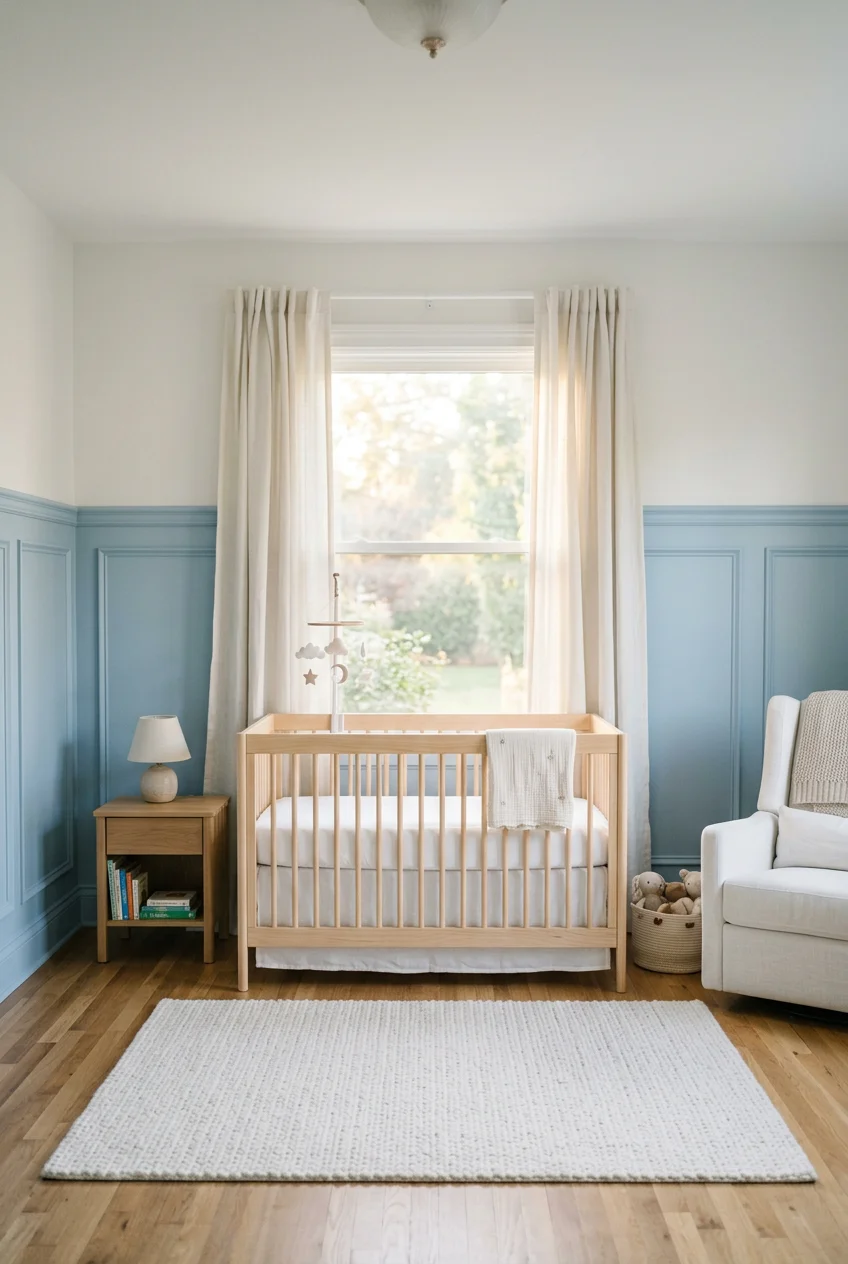
What’s Inside
- Embrace the “New Blues” for a Sophisticated Palette
- Layer Textures and Natural Materials for Coziness
- Balance Dark Blue Walls with Warm Metallic Accents
- Try Wallpaper Drenching for an Immersive Experience
- Invest in GREENGUARD Gold Certified Furniture
- Select an Ergonomic Glider with Lumbar Support
- Decorate the “Fifth Wall” with Subtle Details
- Avoid the Over-Themed Nautical Trap
- Prioritize Layered Lighting with Dimmer Switches
- Incorporate Blackout Curtains with Thermal Linings
- Utilize Acrylic Shelving for Books and Decor
- Ground the Room with a Saturated Area Rug
- Choose Dressers That Double as Changing Stations
- Add Organic Shapes to Soften Rigid Lines
- Keep Wall Art Simple and Intentional
I painted my first son’s room a primary blue back in 2018 and immediately regretted it. It felt like a noisy sensory gym instead of a place to sleep. If you’re hunting for blue nursery ideas, you’re likely after something calming, not a room that screams at you at 3 AM. I spent months repainting and swapping furniture to fix that initial mistake—learned that the hard way, trust me. Now, as a nursery design consultant, I approach blue differently. It’s a neutral, a backdrop, and a mood. Let’s look at 15 specific ways to use blue effectively, without the primary-color headache.
1. Embrace the “New Blues” for a Sophisticated Palette

The days of pastel baby blue are over. For 2026, we’re seeing complex, atmospheric blues that act as sophisticated neutrals. I recommend Behr’s “Hidden Gem” (around $35 a gallon at Home Depot) if you want a serene blue-green that shifts color throughout the day. I used this in a client’s room last Tuesday and the way it catches the afternoon light is remarkable. If you want something moodier, Sherwin-Williams’ “Granite Peak” is a dark, silky blue with soft green undertones. I tried a standard navy first, but it felt too flat. Granite Peak has depth. You can also try Dulux’s “Slow Swing,” which is a highly meditative dark blue. Always buy the $6 sample pots first. Paint a 2-foot by 2-foot square on the wall that gets the least natural light. That’s where the color will look the heaviest. Matte finishes hide drywall imperfections better than eggshell, but they scuff easily when you bump the crib against the wall. I usually compromise with a satin finish for durability.
2. Layer Textures and Natural Materials for Coziness

A room painted entirely blue can feel cold. You fix this with texture. Natural materials are essential for creating warmth and breaking up large blocks of color. I prefer a light beechwood crib over a painted white one. The wood grain adds visual interest. For storage, I use 15-inch diameter woven rattan baskets. I bought a set of three from Target last month for $45. They hold an absurd amount of swaddles and don’t scratch the floor when you drag them across the room. I also layer rugs. A large 8×10 seagrass rug (usually around $150 at Costco) provides a durable base. I layer a smaller, washable 5×7 cotton rug over it near the crib. Seagrass is tough on crawling knees, so the softer top layer is necessary. The contrast between the rough seagrass, the soft cotton, and the smooth beechwood prevents the blue walls from dominating the space. It grounds the room.
3. Balance Dark Blue Walls with Warm Metallic Accents

People are terrified of dark walls in a nursery. Don’t be. Deep blues create a cozy, cave-like environment that actually helps babies sleep. If you use a rich navy like Sherwin-Williams’ “Naval” or Benjamin Moore’s “Newburg Green” (expect to pay about $70 per gallon for their Aura line), you’ll need to balance the darkness with reflective surfaces. I pair dark blue walls with brushed brass or gold accents. A brass curtain rod ($35 at Walmart) or a gold-framed mirror reflects light around the room. I made the mistake of using matte black hardware in a dark blue room once. It completely disappeared into the shadows and made the space feel like a dungeon. You need the contrast. Add luxe textures to soften the heavy paint color. A velvet blackout curtain or a thick wool throw draped over the glider works well. “Smoky Blue” by Sherwin-Williams is another excellent choice for this approach. It has a slightly gray undertone that prevents it from looking like a nautical theme park.

Delta Children Nursery Storage 48 Piece Set
A dependable everyday pick — Delta Children Nursery Storage 48 Piece Set – Easy Storage/Organizatio pulls in 17 ratings at 4.5 stars. Not flashy, just solid.
4. Try Wallpaper Drenching for an Immersive Experience

Accent walls are starting to look dated. The current approach is “wallpaper drenching,” which means wrapping all four walls in the same pattern. It sounds overwhelming, but it actually creates a cohesive, immersive environment. You just have to pick the right scale. I prefer a subtle blue-toned wallpaper, like a watercolor print or a delicate toile. The Pottery Barn Kids Blue Toile Wallpaper is a solid choice. It runs between $50 and $100 per roll, depending on sales. I installed this in a nursery last October. The key is to order 15% more than your square footage calculations suggest. Matching the pattern repeat will eat up a lot of paper, and you don’t want to run out mid-wall. If you drench the room in a busy pattern, keep the furniture completely solid and neutral. A white or natural wood crib and a solid cream glider prevent the room from feeling chaotic. The wallpaper becomes the primary art piece, so you won’t need to clutter the walls with frames and shelves.
5. Invest in GREENGUARD Gold Certified Furniture

When you’re designing a nursery, air quality matters more than aesthetics. Paint and new furniture off-gas volatile organic compounds (VOCs) for months. You need GREENGUARD Gold Certified furniture, which is tested for over 10,000 chemicals. Brands like Dream On Me and Evolur are reliable here. I specifically recommend the Dream On Me Violet 7-in-1 Convertible Crib. It usually retails for around $180 to $200. It’s a smart investment because it transitions from a crib to a toddler bed, a daybed, and eventually a full-size bed. You’re potentially saving hundreds of dollars over 18 years. I bought a cheap, non-certified crib for my first apartment and the chemical smell lingered for three weeks. I ended up leaving the windows open in November just to air it out. Don’t do that. The Dream On Me Violet comes in several finishes, but the natural wood or white options contrast beautifully against a blue wall. It’s sturdy, safe, and doesn’t smell like a factory when you unbox it. You might also like: 15 Inspiring Rustic Nursery Room Ideas to Inspire Your Next Project
6. Select an Ergonomic Glider with Lumbar Support

You’ll spend hundreds of hours in the nursery glider. Don’t buy a chair just because it looks cute. You need serious lumbar support. The Evolur Raleigh Glider and the Dream On Me Chatham Glider are engineered specifically for this. Prices range wildly. You can find basic models for $400, or spend over $2,000 at Pottery Barn Kids for power-reclining versions with USB ports. I tested the Evolur Raleigh last month. The high back actually supports your head when you lean back at 4 AM. I previously owned a vintage wooden rocking chair. It destroyed my lower back within two weeks. I was popping ibuprofen and buying ice packs at Trader Joe’s just to cope. A proper glider is non-negotiable. Look for fabrics that are performance-treated. Babies spit up constantly. A light blue or cream glider looks great against dark walls, but only if it’s stain-resistant. Test the recline mechanism in person if possible. Some require too much leg strength to close, which is annoying when you’re holding a sleeping infant. You might also like: 15 Cozy Baby Nursery Decor Ideas for Any Style

Criusia Over the Door Organizer
Honestly, Criusia Over the Door Organizer surprised me — sturdier than it looks in the photos, and over 218 buyers gave it 4.5 stars.
7. Decorate the “Fifth Wall” with Subtle Details

Most people leave the ceiling flat white. This is a missed opportunity, considering your baby spends the first six months staring straight up. We call the ceiling the “fifth wall” in design. If your walls are white or cream, painting the ceiling a soft, atmospheric blue draws the eye up and makes the room feel taller. If you’re feeling ambitious, try wallpapering it. I recently used a pelican-patterned wallpaper on a ceiling. It took two people and a lot of patience, but the result was striking. For a lower-effort option, use high-quality vinyl decals. A subtle star or moon decal set usually costs around $20 to $50 on Etsy. I bought a $35 set of matte gold stars for my niece’s room. They took about an hour to apply with a plastic smoothing tool. The negative here is that cheap decals will peel if your room gets too humid. Make sure you clean the ceiling with a dry microfiber cloth before applying them, or the adhesive won’t stick properly to the flat ceiling paint. You might also like: 20 Creative Small Spaces Baby Room Organization Ideas You Haven’t Thought Of
8. Avoid the Over-Themed Nautical Trap

A common mistake is treating a nursery like a theme park. If you want a nautical blue nursery, you don’t need anchor-printed curtains, sailboat sheets, and a life preserver wall hanging. It feels dated and childish almost immediately. Instead, focus on subtle nods to the theme. Use soft navy and white stripes on a single wall or in the area rug. Keep the color palette extremely tight. Use just one specific shade of navy blue, crisp white, and natural wood tones. I learned this the hard way. I once decorated a room with so many woodland creature items that it looked like a pet store. It was visually exhausting. Use closed storage to hide the brightly colored plastic toys. A white three-drawer dresser ($250 at IKEA) keeps the visual clutter hidden. The goal is a calm, meditative space. Let the blue paint and the quality of the textiles do the heavy lifting. A single, well-framed vintage print of a sailboat above the dresser is much more effective than plastering anchors on every available surface.
9. Prioritize Layered Lighting with Dimmer Switches

Fussy or overly bright lighting is a massive mistake in nurseries. You need layered lighting, which is a major 2026 design standard. The most critical step is installing a dimmer switch on your main overhead light. A standard Lutron dimmer costs about $25 at Home Depot. I wired one in my own house, and it took 15 minutes after turning off the breaker. You need to control the intensity of the light during late-night feedings. Flipping on a 60-watt bulb at 3 AM will wake your baby up completely. Beyond the overhead light, you need a task light near the glider and a low-wattage ambient light near the changing table. I use a small brass table lamp with a 4-watt amber LED bulb (about $8 for a two-pack). The amber light doesn’t disrupt melatonin production. I used to use a bright white LED nightlight, and my son would stare at it for hours instead of sleeping. Swap out all cool-toned bulbs for warm white (2700K) to keep the blue walls looking cozy rather than clinical.

Beautiful Wooden Baby Closet Dividers Set of 7
Beautiful Wooden Baby Closet Dividers Set of 7 – Double-Sided Organize has been one of the most consistently praised picks in this category. 11 reviewers averaged 4.5/5.
10. Incorporate Blackout Curtains with Thermal Linings

Blue walls absorb a lot of light, which is great for sleep, but you still need proper window treatments. Standard blinds aren’t enough. You need heavy blackout curtains with thermal linings. I use the Eclipse Absolute Zero velvet curtains. They run about $45 per panel on Amazon. The thermal lining does two things. It blocks 100% of the streetlights and it insulates the window. Nurseries are often the smallest rooms in the house and their temperature fluctuates wildly. I noticed a 4-degree difference in my nursery after hanging these. The mistake most people make is hanging the curtain rod right above the window frame. Mount the rod at least six inches above the window and extend it eight inches on either side. This makes the window look larger and prevents light from bleeding out the edges. I chose a deep navy velvet to blend seamlessly with the dark blue walls. If you use a lighter blue paint, a crisp white linen blackout curtain provides a clean, tailored contrast.
11. Utilize Acrylic Shelving for Books and Decor

When you have a strong blue wall color, heavy wooden bookshelves can make the room feel cramped. I use clear acrylic floating shelves instead. You can buy a six-pack of 15-inch acrylic shelves for roughly $35 online. They are virtually invisible, which allows the colorful spines of children’s books to act as the artwork. I installed these in a tight 10×10 nursery last spring. The clear material keeps the sightlines open and prevents the walls from feeling heavy. One negative is that acrylic scratches easily. Don’t use abrasive sponges to clean them. A simple microfiber cloth and glass cleaner work fine. Mount them low enough so your toddler can eventually reach the books, usually starting about 18 inches off the floor. I space them 12 inches apart vertically. This creates a functional, gallery-like display against the blue backdrop. It’s much cheaper than buying a massive bookcase, and it doesn’t eat up any floor space, which is crucial when you’re trying to fit a crib, a glider, and a dresser into a small room.
12. Ground the Room with a Saturated Area Rug

If you choose a subtle, pale blue for the walls, you need to ground the space with something heavier on the floor. A saturated, patterned area rug is the most effective way to do this. I frequently use vintage-inspired washable rugs from Ruggable. The 8×10 Kamran Blue Quartz rug costs around $400. It features deep navy, faded denim, and cream tones. I spilled an entire iced coffee from Whole Foods on one last year, and it washed out completely in a standard front-loading washing machine. The pattern hides lint and small stains effortlessly. A common mistake is buying a rug that is too small. A 5×7 rug in the center of the room looks like a bathmat. The front legs of the crib and the glider should rest on the rug. This anchors the furniture. If you have hardwood floors, you must buy a thick, 1/4-inch felt rug pad ($60). The thin non-slip pads offer zero cushioning, and you’ll spend a lot of time sitting on this floor playing with blocks.

Criusia Drawer Organizer Clothes
Criusia Drawer Organizer Clothes punches above its price — 1 buyers rated it 4.5 stars. I would buy it again.
13. Choose Dressers That Double as Changing Stations

Dedicated changing tables are a waste of money and space. They become obsolete the moment your child is potty trained. Instead, buy a wide, sturdy dresser and attach a removable changing tray to the top. The IKEA Hemnes 8-drawer dresser ($299) is a staple for a reason. It’s exactly the right height (37.7 inches) so you don’t have to hunch over while changing diapers. I bought one in white stain to contrast with a navy blue accent wall. I added a wooden changing tray ($40 at Target) and secured it to the back of the dresser with metal brackets. Do not skip the brackets. Babies roll suddenly, and the tray will slide off the slick dresser top if it isn’t anchored. I also swapped out the standard black IKEA knobs for brushed brass pulls ($3 each from Home Depot) to match the room’s hardware. This small upgrade makes a cheap dresser look like a high-end piece of furniture. When you’re done with diapers, you remove the tray, and it’s just a normal dresser.
14. Add Organic Shapes to Soften Rigid Lines

Cribs are rectangles. Dressers are rectangles. Windows are rectangles. If you aren’t careful, a nursery can feel like a rigid box. You need organic shapes to soften the room, especially if you’re using a cool, icy blue paint which can feel a bit sterile. I always hang a large round mirror above the dresser. A 30-inch brass-rimmed mirror from Target ($70) breaks up the straight lines perfectly. It also gives babies something to look at during diaper changes. I also look for gliders with rounded arms and curved backs rather than square, modern silhouettes. I bought a cheap square ottoman once, and I kept bruising my shins on the corners during middle-of-the-night feedings. I swapped it for a round, knitted pouf ($50 at Sprouts). It’s softer, safer for a crawling baby, and introduces a curved element. Even small details, like a scalloped edge on a lampshade or a round woven laundry hamper, help break up the grid. The contrast makes the blue walls feel welcoming rather than institutional.
15. Keep Wall Art Simple and Intentional

The fastest way to ruin a beautifully painted blue room is to clutter the walls with cheap, mismatched art. I see this constantly. People buy a dozen small, framed prints and scatter them randomly. It looks messy. Keep your wall art simple and intentional. I prefer one large statement piece or a symmetrical grid of four frames. I recently bought four 16×20 inch Ribba frames from IKEA ($15 each) and hung them in a tight square above the crib. I filled them with black and white photos of the parents’ travels. I printed the photos at the Kroger photo kiosk for about $12 total. The black and white photography looks incredibly sharp against a medium blue wall. If you want color, choose art that incorporates the specific blue of your walls along with one complementary color, like a burnt orange or mustard yellow. Use a laser level when hanging frames. I tried to eyeball a gallery wall once, and the slight crookedness drove me insane for six months until I finally took it down and patched the holes.
Designing a nursery shouldn’t feel like a high-stakes exam. Blue is incredibly forgiving if you choose the right shade and balance it with warm textures and proper lighting. I’ve made plenty of expensive mistakes in my own home so you don’t have to—took me years to figure out these tricks, no exaggeration. Pick one or two of these blue nursery ideas to focus on, grab some paint samples, and start testing them on your walls. Save or pin this article so you can reference the specific paint colors and product dimensions when you’re standing in the middle of the hardware store trying to make a decision.
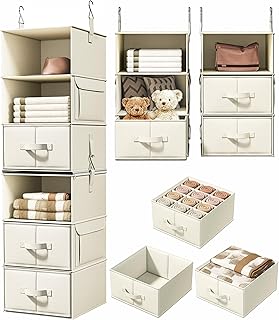
Vailando 6-Shelf Hanging Closet Organizer with 3 Drawers
If you want something that just works, Vailando 6-Shelf Hanging Closet Organizer with 3 Drawers is a safe bet (35 reviews, 4.5 stars).
Frequently Asked Questions
What is the best blue paint color for a nursery?
For 2026, atmospheric blue-greens like Behr’s Hidden Gem or dark, silky blues like Sherwin-Williams’ Granite Peak are highly recommended. They act as sophisticated neutrals that grow with your child, avoiding the harshness of primary baby blues.
How do you warm up a blue nursery?
Balance cool blue walls by layering natural textures. Incorporate a light beechwood crib, woven rattan storage baskets, and a textured seagrass rug. Adding brushed brass or gold hardware also reflects warm light around the room.
Are dark blue walls too stimulating for a baby?
No, dark blues like Sherwin-Williams’ Naval actually create a cozy, cave-like environment that promotes sleep. The key is to balance the dark walls with adequate layered lighting, dimmer switches, and lighter furniture to prevent the room from feeling heavy.
How much wallpaper do I need for a nursery?
If you are wallpaper drenching all four walls, always order 15% more than your square footage calculation. Matching the pattern repeat wastes a significant amount of paper, and running out mid-installation is a frustrating mistake.
