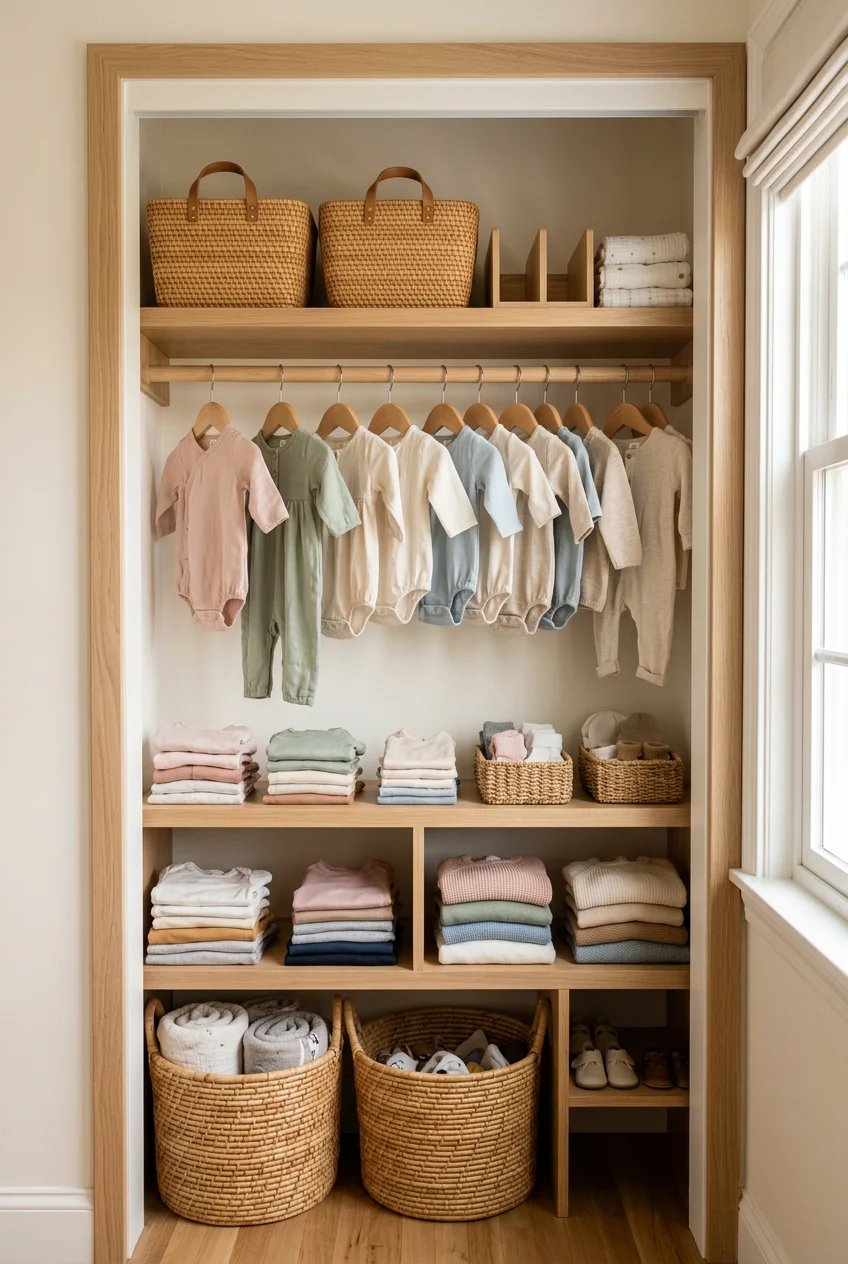
What’s Inside
- Install a Double Hanging Rod System for a Small Nursery Closet
- Utilize Hanging Closet Organizers for Folded Items
- Implement Drawer Dividers for Tiny Apparel
- Employ Over-the-Door Storage for Essentials
- Categorize with Baby Closet Dividers
- Invest in Slim, Uniform Hangers
- Designate a Too Small Bin for Outgrown Clothes
- Integrate a Dresser or Cube Organizer within the Closet
- Utilize Clear Bins with Labels for Visibility
- Embrace IKEA Hacks for Budget-Friendly Customization
- Create a Next Size Up Zone
- Install a Locking Cabinet for Safety in Your Small Nursery Closet
- Consider a Closet-Based Changing Station
- Implement the Rainbow Order Trend for Visual Appeal
- Pre-Plan and Declutter Ruthlessly
- Use Floor Space for Bulky Item Storage
- Add Battery-Operated Lighting to Dark Corners
- Maximize the Top Shelf for Long-Term Storage
I stared at the pile of newborn onesies dumped at my feet. My first attempt at organizing the nursery closet was a disaster—collapsed cardboard, cheap plastic hangers, and pure frustration. A functional closet doesn’t just happen. I learned that the hard way after three months of digging through a cramped, dark space at 3 AM while my daughter screamed. You can’t just toss tiny clothes onto shelves and expect order. The fabrics are slippery, the pieces are microscopic, and the sheer volume is a nightmare. I spent weeks measuring, testing, and returning gear until I found a system that actually works without looking like a warehouse. Let’s walk through the bins, rods, and organizers that saved my sanity. It took me years to figure this out, no exaggeration.
1. Install a Double Hanging Rod System for a Small Nursery Closet

Baby clothes are tiny. If you hang a 0-3 month onesie on a standard rod, you’re left with three feet of wasted air underneath. I dealt with that for a month before I realized how much space I was losing. You need a second adjustable rod to double your capacity. I bought the ClosetMaid ShelfTrack and Brackets system at Home Depot. Each rod was about $15.00. I set the lower one 36 inches off the ground and the upper at 72 inches. This lets me hang current sizes low and stash the next-size-up gear higher. The metal brackets feel solid and won’t bow under winter coats. Skip the cheap plastic tension rods. I tried one from Amazon first; it crashed down in the middle of the night, taking a dozen velvet hangers with it. Drill the holes. Mount the metal hardware. It’s the only way to make a small closet work.
2. Utilize Hanging Closet Organizers for Folded Items

Not everything belongs on a hanger. Sweaters stretch out, and swaddle blankets just slide off onto the floor. For items that don’t hang well, a multi-compartment organizer is the best fix. I grabbed the Brightroom 6 Shelf Hanging Closet Organizer from Target for exactly $9.00. It’s made of a stiff, grey fabric that smells a bit like canvas. I velcroed it right to the top rod. Each cubby is the perfect size for rolled blankets, burp cloths, or small bins. I used to keep thick sweaters stacked on a shelf, but they constantly toppled into a mess. These rigid shelves keep everything contained. Just don’t overload it with bulk wipes. The velcro is strong, but it’ll peel apart if you put ten pounds in the bottom cubby. Keep it light and use it for textiles.
3. Implement Drawer Dividers for Tiny Apparel

Baby socks are a nightmare. They’re the size of cotton balls and vanish if you throw them into a large drawer. You need dividers to stop the jumble. I bought the Brightroom Set of 2 Plastic Drawer Dividers at Target for $15.00. They click into place with a snap and stay put. If you want a more natural look—a big trend for 2026—bamboo dividers run about $25.00 a set. I prefer the plastic ones because they wipe clean when a tube of diaper cream inevitably explodes. I tried cardboard boxes for a while, but they looked terrible and bent out of shape. Rigid dividers let you create custom rows for onesies and pants. It takes extra time to fold, but you won’t be digging frantically for socks anymore.

Criusia Over the Door Organizer
A dependable everyday pick — Criusia Over the Door Organizer pulls in 218 ratings at 4.5 stars. Not flashy, just solid.
4. Employ Over-the-Door Storage for Essentials

The back of the closet door is wasted real estate. An over-the-door organizer with clear pockets solves the problem of where to put those odd-shaped tubes and bottles. I use the Kisportee Over the Door Pocket Organizer. It costs $15.99 at Walmart. It has 24 clear pockets that smell like vinyl when you first open them, so let it air out on the porch. I fill the pockets with diaper rash cream, thermometers, and extra pacifiers. I used to keep these in a basket on the changing table, but my toddler painted the wall with a $14.00 tube of Aquaphor. Moving the mess behind a closed door solved it instantly. Just measure your door width first. If the hooks are too wide, the door won’t latch.
5. Categorize with Baby Closet Dividers

A common mistake is hanging all clothes together regardless of size. You end up squeezing a six-month-old into a newborn sleeper because you can’t tell the difference at a glance. You need durable dividers labeled from Newborn to 2T. I bought The Peanutshell 10-pack for $8.99 at Target. They’re simple plastic rings that slip over the rod. If you want something prettier, wooden dividers from White Loft cost around $25.00 and fit the 2026 natural nursery trend. I prefer the cheap plastic ones because the text is printed in bold, high-contrast black. Wooden ones are often engraved, which is hard to read from three feet away in a dim room. I sort everything by size, taking the guesswork out of dressing a squirming infant when I’m running late.
6. Invest in Slim, Uniform Hangers

Throw away the thick plastic tubular hangers. They take up too much room and baby clothes slide right off the slick plastic. Switch to slim-profile velvet hangers to maximize space. I bought a 50-pack of Casafield 11-inch Velvet Baby Hangers for $23.99 on Amazon. The velvet grips the tiny shoulders of cotton onesies so they don’t end up in a pile. The slim profile means I can fit twice as many garments on the same rod. I tried mixing velvet with the plastic hangers I got for free, but it looked chaotic and they kept tangling. I finally bagged up the plastic ones and dropped them at Goodwill. Uniform hangers make the space look calm. The velvet attracts dust, so I run a sticky lint roller over them now and then. You might also like: 20 Stunning Layout Small Nursery Ideas That Are Totally Worth It

Criusia Drawer Organizer Clothes
Criusia Drawer Organizer Clothes has been one of the most consistently praised picks in this category. 1 reviewers averaged 4.5/5.
7. Designate a Too Small Bin for Outgrown Clothes

Babies grow overnight. You’ll put a sleeper on them on Tuesday, and by Thursday, it won’t zip. If you don’t have a spot for outgrown clothes, they end up mixed back in with clean laundry, and you’ll accidentally try to use them again. I keep a Sorbus Storage Bin with a Metal Frame on the top shelf. It costs $8.99. Every time a piece is too tight, I wash it, fold it, and toss it in that bin. Once full, I label it and stick it in the attic. I used to toss small clothes in a corner. It created a dusty pile I tripped over constantly. Having a rigid, dedicated bin keeps the floor clear and removes the emotional friction of sorting through clothes that don’t fit. You might also like: 15 Inspiring Rustic Nursery Room Ideas to Inspire Your Next Project
8. Integrate a Dresser or Cube Organizer within the Closet

If your nursery is tiny, putting the dresser inside the closet opens up floor space. I bought the Brightroom 4 Cube Organizer for $45.00 at Target and placed it on the floor inside the closet. I added four fabric bins to hold pants, pajamas, and swaddles. This eliminated the need for a bulky dresser in the bedroom. I can now fit a rocking chair in the corner where the dresser used to be. The trick is to measure the interior width, including door frame clearance. I originally bought a six-cube organizer, but I couldn’t angle it past the door hinges. The four-cube version slid in perfectly. I use the flat top to store a wipe warmer and fresh towels. You might also like: 15 Charming Safari Nursery Lighting Ideas for Every Budget
9. Utilize Clear Bins with Labels for Visibility

Opaque bins are where baby items go to die. If you can’t see what’s inside, you won’t use it. For items on upper shelves, clear plastic is mandatory. I use the Sterilite 15 Quart Clear View Storage Latch Boxes. They cost about $8.00 each at Walmart. The plastic lets me see exactly where I stored the extra crib sheets and winter blankets. I used to use woven seagrass baskets for everything. They looked beautiful on Pinterest, but they shed sharp fibers onto the clothes, and I could never remember which basket held the burp cloths. I’d end up pulling everything down to find one item. Switching to clear bins is a huge trend for efficiency, and it actually works. The latches snap shut securely.

Beautiful Wooden Baby Closet Dividers Set of 7
If you want something that just works, Beautiful Wooden Baby Closet Dividers Set of 7 – Double-Sided Organize is a safe bet (11 reviews, 4.5 stars).
10. Embrace IKEA Hacks for Budget-Friendly Customization

Custom closet systems cost thousands. You can get the same functionality by hacking IKEA furniture. I bought the IKEA KALLAX 4-shelf unit for $49.99 and pushed it horizontally into the bottom of the closet. Then, I mounted an IKEA MULIG clothes bar for $6.99 to the wall above it. For less than sixty bucks, I built a custom zone. The KALLAX has a smooth finish that wipes clean. I fill the cubbies with heavy canvas bins to hold toys and extra wipes. I grabbed the KALLAX on a whim while eating lunch at the IKEA cafeteria, and it ended up being my best storage decision. The only downside is the assembly. You have to use wooden dowels, and if you tighten the screws too much, the particle board will crack. Build it slowly.
11. Create a Next Size Up Zone

You’ll constantly receive hand-me-downs in larger sizes. If you don’t have a spot for them, they’ll clutter your main rod. I keep one drawer dedicated to the next size up. I use the Criusia Clothes Drawer Organizers, a 9-pack of foldable bins for $19.99 on Amazon. I place these inside a larger basket on the top shelf. When my baby is wearing 3-6 month clothes, that basket is filled with 6-9 month gear. When a growth spurt hits on a Tuesday morning and nothing fits, I don’t panic. I just pull down the basket and swap. I learned this after spending an hour digging through a trash bag of hand-me-downs in the garage. Having the next size washed and ready saves your sanity.
12. Install a Locking Cabinet for Safety in Your Small Nursery Closet

Most parents store Tylenol and diaper cream in a basket on a shelf. That’s fine for newborns, but the second they walk, that basket is a hazard. You need a locking cabinet for meds. I bought a small steel lockbox with a digital keypad at Lowe’s for $35.00. I bolted it to one of the wooden shelves. The metal is cold and heavy, and the keypad beeps loudly. It holds all the infant Motrin and ointments. I used to keep medicine in the kitchen, but walking downstairs at 2 AM with a feverish baby is miserable. Having a secure, locked box right in the nursery gives me instant access, but my toddler can’t reach anything dangerous.

Delta Children Nursery Storage 48 Piece Set
If you want something that just works, Delta Children Nursery Storage 48 Piece Set – Easy Storage/Organizatio is a safe bet (17 reviews, 4.5 stars).
13. Consider a Closet-Based Changing Station

If your nursery is truly tiny, you might not have room for a crib, chair, and table. The solution is building the station into the closet. I helped a client do this last year. We removed the lower hanging rod and slid a sturdy dresser into the closet space. We put a Delta Children Contoured Changing Pad, which costs $30.00, right on top. We mounted a battery-operated puck light on the wall above it. It creates a cozy nook for diaper changes. The best part is you can shut the closet doors when company comes over, hiding the diaper pail and clutter. The downside is you lose half your hanging space. You have to rely entirely on drawers, which requires ruthless decluttering.
14. Implement the Rainbow Order Trend for Visual Appeal

Organizing by color isn’t just for Pinterest; it makes finding things faster. This is a huge trend for 2026, often called the Home Edit method. Within each size, I arrange the clothes in rainbow order: red, orange, yellow, green, blue, purple, pink, white, grey, black. I buy a lot of the simple Carter’s Sleep ‘n Plays, which cost about $12.00 each, and they come in solid, bright colors. When I open the closet, the gradient is instantly calming. More importantly, it helps me spot gaps in the wardrobe. If I see a sea of grey and blue, I know I don’t need more neutral sweatpants. I tried organizing by clothing type first, but it looked messy because the colors clashed. The rainbow method takes five seconds, but the visual reward is fantastic.
15. Pre-Plan and Declutter Ruthlessly

You can’t organize clutter. Before you buy a single bin, pull everything out and sort it. I usually do this on a Saturday. I dump everything on the nursery rug and touch every single item. If it’s stained or missing a snap, I throw it away. I keep a large Kirkland Signature trash bag handy. I buy them in bulk at Costco for $22.00, and they’re thick enough that they don’t rip when I stuff them full of old diaper boxes. I used to hold onto every piece of clothing just in case, but I realized I was just storing anxiety. If you have four identical grey cardigans, donate three. A small closet only works if you limit what goes inside. Be ruthless. Keep what you actually use.

Vailando 6-Shelf Hanging Closet Organizer with 3 Drawers
Vailando 6-Shelf Hanging Closet Organizer with 3 Drawers has been one of the most consistently praised picks in this category. 35 reviewers averaged 4.5/5.
16. Use Floor Space for Bulky Item Storage

The closet floor is the best place for heavy, awkward items that don’t fit on shelves. I use the floor for unopened diaper boxes and the pail. I use the Ubbi Steel Odor Locking Diaper Pail, which costs $79.99 at Target. It’s made of powder-coated steel, not plastic, so it doesn’t absorb smells over time. I tuck it in the back corner. I also stack the massive boxes of wipes I buy from Sam’s Club right next to it. I made the mistake of storing bulk diapers on the top shelf once. I pulled the box down, and it slipped, hitting me square in the chest. Heavy items belong on the floor. Just leave enough room to actually walk into the space and push items flush against the baseboards.
17. Add Battery-Operated Lighting to Dark Corners

Most small closets don’t have hardwired lighting. Trying to find pajamas in the dark while your baby cries is a miserable experience. I solved this by installing battery-operated LED lights. I bought a 2-pack of GE Wireless LED Puck Lights at Home Depot for $15.00. They run on AA batteries and stick to the wall with heavy-duty adhesive. I stuck one under the top shelf and one near the floor by the diaper pail. You just tap the lens, and they emit a bright, cool white light. I originally tried stringing fairy lights around the door frame, but the wires got tangled in the hangers and the light wasn’t bright enough. The puck lights are a cheap, instant fix. Just remember to buy a large pack of backup batteries.
18. Maximize the Top Shelf for Long-Term Storage

The top shelf is the hardest to reach, making it perfect for long-term storage. I use this space for items I only need once or twice a year. I bought three Sterilite 66 Quart Clear Latching Storage Boxes at Walmart for $12.00 each. I use one for keepsakes, like the hospital blanket and first shoes. I use the second for seasonal gear, like heavy coats. The third holds the breast pump and bottles I’m saving for a future baby. I used to stack loose items on the top shelf, but they’d get covered in a thick layer of dust after a few months. The hard plastic bins protect everything. I grabbed these during a grocery run to Kroger. Label the outward-facing side clearly.
Organizing a tiny space takes patience, but it’s possible. I spent months fighting with my daughter’s closet before I finally implemented these bins, rods, and dividers. You don’t need a walk-in closet to have a beautiful, functional nursery. You just need deliberate zones and the right hardware. I highly recommend starting with the double hanging rod—it’s the single most effective change you can make. Trust me on this. Grab your tape measure, head to the hardware store, and start maximizing that vertical space. If you found this breakdown helpful, save this post to your nursery planning Pinterest board so you can reference the exact product names and dimensions when you’re ready to start building.
Frequently Asked Questions
How can I maximize space in a small nursery closet?
Install a double hanging rod system to utilize vertical space. Baby clothes are short, so adding a second rod instantly doubles your hanging capacity for current and future sizes.
What is the best way to store baby socks and mittens?
Use rigid plastic or bamboo drawer dividers inside your closet dresser or cube organizer. They prevent tiny items from getting lost and allow you to separate them by type.
Should I hang or fold baby clothes?
Hang everyday items like onesies and dresses on slim velvet hangers to save space. Fold textiles like thick knit sweaters, swaddles, and pants, storing them in hanging fabric organizers or bins.
How do I organize clothes my baby hasn’t grown into yet?
Create a dedicated next-size-up zone using fabric bins on a top shelf. When a growth spurt hits, you can easily pull down the bin and swap out the outgrown clothes.
