What’s Inside
- Prioritize Safe Sleep With A Separate Crib
- Opt For A Mini-Crib To Save Floor Space
- Create Distinct Zones With Strategic Dividers
- Invest In True Blackout Window Treatments
- Utilize A White Noise Machine Strategically
- Maximize Vertical Storage With Floating Shelves
- Choose Multi-Functional Furniture For Both Kids
- Involve The Toddler In The Design Process
- Opt For A Compact, Comfortable Glider
- Embrace Japandi Style For A Shared Room With Toddler Parents
- Set Up A Portable Changing Station
- The Common Mistake Of Bed-Sharing
- Use A Fan To Reduce SIDS Risk
- Childproof For Both Ages In A Shared Room With Toddler Parents
- Create A Quiet Time Basket For The Toddler
Setting up a shared room with toddler parents usually starts with a delusion of peaceful, synchronized sleeping. I tried putting my two-year-old and newborn in the same room last November, and it ended with me crying on a pile of clean laundry at 3 AM. The toddler threw a hard plastic fire truck into the bassinet while the baby was sleeping. That was the moment I realized my aesthetic Pinterest board was a hazard zone. I’m Lauren, a nursery design consultant, and I’ve spent the last four years fixing these logistical nightmares for exhausted families. You can’t just hope for the best when combining a feral toddler and a fragile newborn. You need a plan based on safety and spatial awareness. I did this wrong for months before figuring it out. No exaggeration. Here is how I structure these spaces now, focusing on hard boundaries, specific gear, and preventing middle-of-the-night disasters.
1. Prioritize Safe Sleep With A Separate Crib

The American Academy of Pediatrics states infants need to sleep on a separate, firm surface for at least the first six months. I’m strict about this. You can’t put the baby in the toddler’s floor bed, even for a short nap. When I set up my first shared room, I bought a gorgeous, plush bassinet that looked like a cloud. I returned it three days later because the mattress felt like a marshmallow. You need a firm, bare crib. I typically specify the Babyletto Hudson 3-in-1 Convertible Crib. It costs $399 at Pottery Barn Kids. The mattress support is rigid metal, not flimsy particle board. It measures 53.6 inches long, which eats up significant real estate, but the safety tradeoff is non-negotiable. Room-sharing without bed-sharing reduces the risk of SIDS by up to 50 percent. Keep the crib completely bare. No bumpers, no stuffed animals, no muslin blankets. Just a fitted sheet over a firm mattress. I learned this the hard way when my toddler tried to share his heavy winter quilt with the baby through the crib slats. Trust me on this.
2. Opt For A Mini-Crib To Save Floor Space

If a full-size crib takes up too much floor space, a mini-crib is the logical move. I’ve used the Dream On Me Aden 4-in-1 Convertible Mini Baby Crib in at least twelve client homes this year. It retails for $149 on Amazon and measures exactly 39 inches in length. That 14-inch difference means you can actually open the closet door all the way. I placed one in a tiny apartment last Tuesday, and it squeezed perfectly between the radiator and the window frame. Delta Children also makes a Classic Mini Crib for around $139 at Target. Both options convert to twin beds later. The tradeoff is that your baby will outgrow it faster. My son hit the length limit at 14 months, which meant buying another bed sooner than I planned. But if you’re dealing with a 10×12 room, that extra square footage keeps you from tripping over the crib legs during a 2 AM feeding.
3. Create Distinct Zones With Strategic Dividers

You have to visually separate the room so the toddler feels they have their own territory. I tried skipping this step in 2021. My toddler constantly climbed into the baby’s changing area because it all felt like one big playground. Now, I use a tall, anchored bookshelf to cut the room in half. The IKEA Kallax 4×4 shelving unit costs $129.99 and works perfectly as a room divider when secured to the wall studs. I fill the bottom cubbies with heavy wooden toys and the top cubbies with the baby’s swaddles and burp cloths. You can also use a heavy dresser placed perpendicular to the wall. This physical barrier stops the toddler from sprinting directly at the crib. It also breaks up the sightline. If the toddler wakes up at 6 AM, they don’t immediately make eye contact with the baby and start yelling their name. Just make sure whatever you use is heavy and bracketed securely to the wall.

Criusia Over the Door Organizer
If you want something that just works, Criusia Over the Door Organizer is a safe bet (231 reviews, 4.5 stars).
4. Invest In True Blackout Window Treatments

Managing two different sleep schedules in one room is brutal. You need absolute darkness. I bought cheap blackout curtains from Walmart once, and the streetlights bled right through the fabric, keeping my toddler up until 9 PM. Skip the flimsy stuff. I install the IKEA FRIDANS Black-out roller blinds. The 48×76 ¾ inch size costs $27.99. They actually block the light. If you have a larger budget, UBlockout makes custom shades with light-blocking side tracks starting around $150. They guarantee 100 percent light blockage. This matters when your toddler takes one afternoon nap and your baby takes three. The room needs to be pitch black at 2 PM. I usually layer a heavy curtain over the roller blind to muffle street noise. The room gets dark. You’ll need a small amber nightlight near the door so you aren’t stepping on a rogue plastic block.
5. Utilize A White Noise Machine Strategically

White noise acts as your primary defense against a noisy toddler waking a sleeping newborn. But you can’t just blast it. The AAP recommends keeping the machine at least 7 feet away from the baby’s head and under 50 decibels. I used a decibel meter app on my phone to measure the volume in my own nursery because I realized I had it cranked up to 70 decibels—like standing next to a running vacuum. I use the Yogasleep Dohm UNO. It costs $37.99 at Target. It has a real internal fan, so the sound doesn’t loop digitally. Digital looping drives me insane. Place the machine exactly between the two beds. It acts as an acoustic shield. When the toddler drops a hard toy on the hardwood floor, the Dohm absorbs the sharp peak of the sound. It won’t drown out a full toddler tantrum, but it masks the standard rustling perfectly.
6. Maximize Vertical Storage With Floating Shelves

Floor space disappears fast when you have two kids in one room. Look at the walls. I spent six months digging through overflowing plastic bins on the floor before I finally installed vertical shelving. I buy the IKEA Lack floating shelves. They cost $24.99 each and hold up to 11 pounds if you hit a stud. I mount three of them directly above the changing dresser. I keep the heavy diaper creams, the 16-ounce bottle of Aquaphor ($17.49 at Kroger), and the wipes up there. The toddler can’t reach them, which means no more finding diaper cream smeared on the baseboards. I also hang an over-the-door shoe organizer on the closet door. You can get a clear plastic one at Walmart for $14.88. I stuff it with rolled up baby socks, burp cloths, and thermometer covers. It looks a little cluttered, but the function is worth it. You might also like: 20 Stunning Childcare Nursery Room Ideas Worth Trying This Year

Baby Sound Machine, Momcozy White Noise Machine for Baby
If you want something that just works, Baby Sound Machine is a safe bet (71 reviews, 4.5 stars).
7. Choose Multi-Functional Furniture For Both Kids

Don’t buy a standalone changing table. It’s a waste of money and space. I specify a wide, sturdy dresser with a removable changing topper for almost all my clients. The Delta Children 6-Drawer Dresser with Changing Topper runs about $299 on Amazon. You use the top three drawers for the baby’s onesies and diapers, and the bottom three for the toddler’s clothes. Once the baby is potty trained, you unscrew the topper and it’s just a normal piece of furniture. For the toddler’s bed, you need built-in storage. I recently sourced the Ashley Furniture Baystorm Panel Bed for a client. It costs $949.99 and has two massive storage drawers built into the footboard. We shoved all the bulky winter sweaters and extra crib sheets in there. You’re trying to eliminate extra furniture pieces. Every single item in the room needs to pull double duty. You might also like: 17 Nursery Ideas Girl for Every Budget
8. Involve The Toddler In The Design Process

A new baby invading their space acts as a trigger for a toddler. If you just rearrange their room one day while they are at daycare, they will revolt. I did this. I moved my son’s bed to the opposite wall on a Tuesday, and he refused to sleep in it for a week. You have to give them some control over the changes. Take them to Target and let them pick out a new set of sheets. A basic Pillowfort twin sheet set is $19.99. Let them choose between the dinosaurs or the space print. Have them pick out three specific books to put on the shared bookshelf. When we set up the room, I gave my toddler a $5 pack of star stickers from Sprouts and let him put them on the side of his new dresser. It looks terrible, honestly. But he points to them every night and says they belong to him. It gave him ownership of his corner. You might also like: 20 Charming Small Nursery Ideas to Transform Your Space
9. Opt For A Compact, Comfortable Glider

You need a place to sit and feed the baby at 3 AM, but oversized recliners will choke the room. I bought a massive, plush nursing chair for my first baby. It took up a quarter of the room and I stubbed my toe on the metal gliding track daily. For a shared room, you need a slim-profile chair. The Delta Children Blair Slim Nursery Glider Swivel Rocker is exactly what I use now. It costs around $250. It measures 26.5 inches wide. It doesn’t have a built-in footrest, which saves about two feet of floor space. Another good option is the DaVinci Gabby Swivel Glider for $399. These chairs tuck tightly into a corner. The tradeoff is that you can’t recline and sleep in them. But you shouldn’t be sleeping in a glider holding a baby anyway due to the drop risk. The firm, upright back support is better for your posture during a 45-minute feeding session.

JolyWell Night Light for Kids
A dependable everyday pick — JolyWell Night Light for Kids pulls in 51 ratings at 4.5 stars. Not flashy, just solid.
10. Embrace Japandi Style For A Shared Room With Toddler Parents

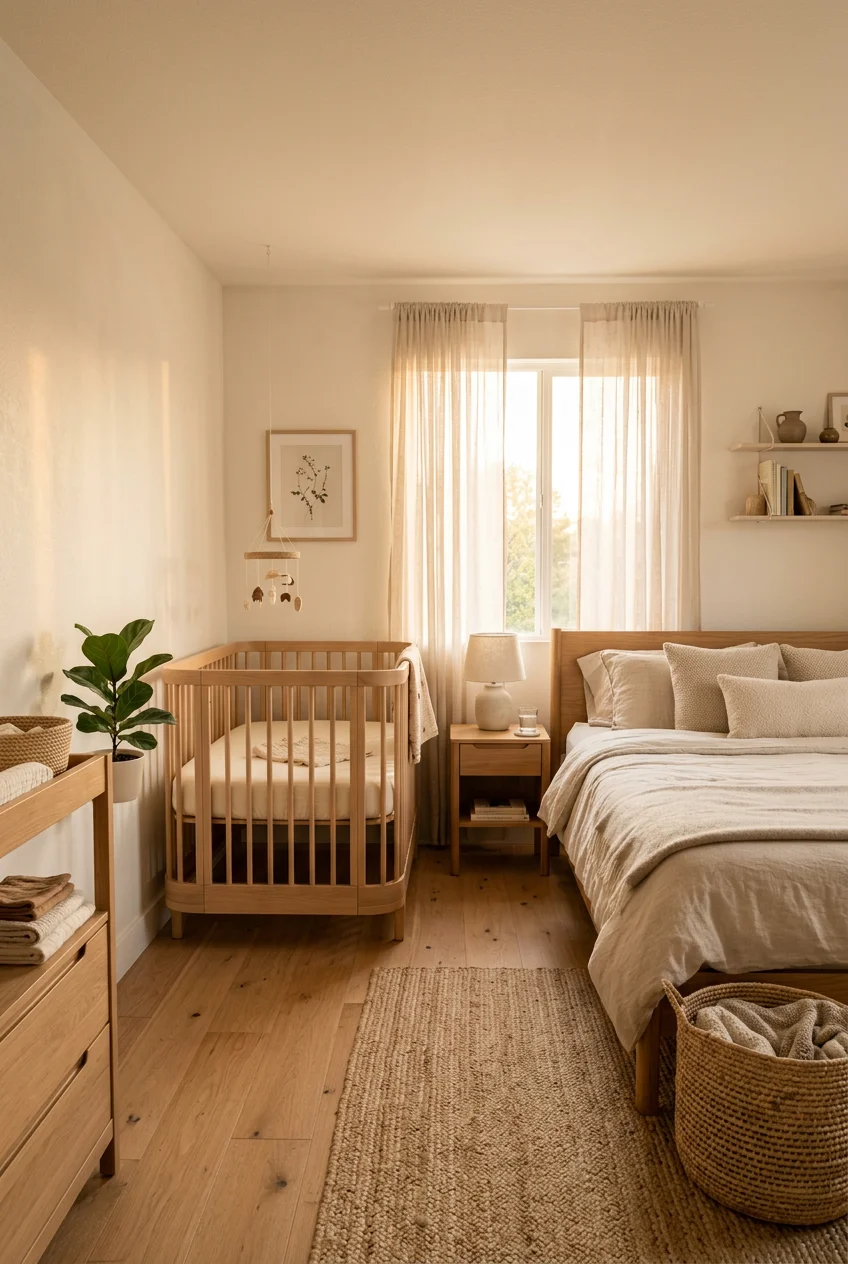
If you try to mix a bright pink princess theme with a woodland creature baby theme, the room will look like a chaotic explosion. You need visual calm. The 2026 design trend I lean on is Japandi style. It blends Japanese minimalism with Scandinavian functionality. Think muted, natural tones. I use a lot of sage green, terracotta, and warm beige. I recently painted a shared room with toddler parents in Sherwin-Williams Evergreen Fog ($75 a gallon). It lowered the visual temperature of the room. I use natural materials like birch wood, rattan baskets from West Elm ($45 each), and washed linen curtains. This neutral palette doesn’t skew too babyish or too mature. It bridges the age gap. When the room is visually quiet, the inevitable clutter of plastic toys and colorful board books doesn’t feel quite as overwhelming.
11. Set Up A Portable Changing Station

Sometimes changing a blowout at 2 AM in the shared room is going to wake the toddler, no matter how quiet you are. The smell alone will do it. I stopped doing middle-of-the-night changes in the nursery. Instead, I use a portable diaper caddy. The Munchkin Portable Diaper Caddy Organizer is $18.99 at Target. I stock it with a 900-count box of Kirkland wipes from Costco ($24.99), two sleeves of diapers, a tube of Boudreaux’s Butt Paste, and a foldable changing mat. When the baby wakes up soaked, I grab the baby and the caddy and walk out to the living room rug. I do the change out there in the dim light, feed the baby, and then quietly return them to the crib. It keeps the shared room as a strict sleep-only zone during the night, which prevents the toddler from waking up and demanding a snack.
12. The Common Mistake Of Bed-Sharing

When you’re exhausted and the baby is crying and you’re terrified they’ll wake the toddler, the temptation to just pull the baby into your bed or the toddler’s bed is overwhelming. Don’t do it. The AAP explicitly advises against bed-sharing with infants. It significantly increases the risk of SIDS and accidental suffocation. I’ve had clients admit they fell asleep nursing the baby in the toddler’s floor bed because they were too tired to stand up. You have to put the baby back in their own separate, firm crib. Every single time. If you feel yourself falling asleep, put the baby down, even if they are crying. A crying baby is a breathing baby. It’s brutal in the moment, but the safety data is clear. Keep the sleep surfaces separate, no matter how tired you are. I took years to figure out that consistency is the only way to survive.

Graco Premium Crib & Toddler Mattress
Honestly, Graco Premium Crib & Toddler Mattress – GREENGUARD Gold Certified surprised me — sturdier than it looks in the photos, and over 515 buyers gave it 4.5 stars.
13. Use A Fan To Reduce SIDS Risk

This is a tip most parents don’t know. Running a simple fan in the room can reduce the risk of SIDS by 72 percent. It prevents the baby from re-breathing exhaled carbon dioxide by keeping the air circulating. I always place a small oscillating fan on top of the dresser, pointing at the ceiling, not directly at the baby. I use the Vornado 460 Small Whole Room Air Circulator. It costs $49.99 at Home Depot. It moves a massive amount of air without creating a harsh draft. The secondary benefit is that the mechanical hum of the fan blades acts as another layer of white noise. I bought one last July during a heatwave, and I noticed both kids slept about forty minutes longer in the morning just because the air in the room felt less stagnant and stuffy.
14. Childproof For Both Ages In A Shared Room With Toddler Parents

You aren’t just baby-proofing against electrical outlets anymore. You have to toddler-proof the baby’s gear. Toddlers are aggressively helpful. My son tried to feed the newborn a solid carrot stick when I turned my back for ten seconds. You have to establish hard physical boundaries in a shared room with toddler parents. Anchor every single piece of furniture to the wall. I buy the Safety 1st Furniture Wall Straps. A two-pack is $12.99 at Lowe’s. Toddlers will try to scale the dresser to reach the baby’s pacifiers. You also have to teach the toddler strict rules: nothing goes in the crib. No blankets, no toys, no snacks. I installed a small latch high up on the closet door so the toddler couldn’t drag out the heavy boxes of baby wipes and drop them in the crib. You have to anticipate the toddler’s curiosity before it becomes a hazard.
15. Create A Quiet Time Basket For The Toddler

You will inevitably have moments where the baby is napping in the room, and the toddler needs to be in there too. You need a distraction that doesn’t involve loud electronic noises. I build a quiet time basket that only comes out during these specific windows. I use a soft rope basket from Target ($16). Inside, I put three Melissa & Doug Water Wow books ($5.99 each), a small tub of Play-Doh, and a few soft fabric blocks. I also throw in a small snack, usually a box of Annie’s Cheddar Bunnies from Whole Foods ($4.49). The rule is simple: you can play with the special basket, but you have to sit on your rug and be silent. It took about two weeks of training, but it works. It gives the toddler something exclusive and positive to focus on while the baby gets their required sleep.
Setting up this room takes precision and a lot of measuring tape. I’ve rearranged these spaces dozens of times, and the most important thing is prioritizing safety over aesthetics. If you’re currently staring at an empty room and feeling overwhelmed, start by measuring for the crib and the room divider. Save this guide for your next Target run, and let’s get that room functioning properly.

Rattan Divided Scalloped Basket
Honestly, Rattan Divided Scalloped Basket surprised me — sturdier than it looks in the photos, and over 15 buyers gave it 4.5 stars.
Frequently Asked Questions
Is it safe for a newborn and a toddler to share a room?
Yes, but you must follow strict safety guidelines. The newborn needs a separate, firm crib free of blankets or toys. You also need to toddler-proof the baby’s gear and anchor all furniture to prevent tip-overs.
How do I fit two beds in a small shared nursery?
Opt for a mini-crib, which is typically 39 inches long and saves significant floor space. Use a tall bookshelf as a room divider, and choose a toddler bed with built-in storage drawers to eliminate the need for extra dressers.
How do I keep my toddler from waking the baby?
Use a white noise machine placed exactly between the two beds to create an acoustic shield. Keep the volume under 50 decibels. Also, install 100 percent blackout shades to help regulate their different sleep schedules.
What should I do for middle-of-the-night diaper changes?
Keep a portable diaper caddy stocked with wipes and a changing mat. Take the baby out of the shared room for nighttime changes to avoid waking the toddler with lights, noises, or smells.
