What’s Inside
- Embrace Earthy, Grounded Color Palettes
- Implement Strategic Color Drenching
- Prioritize Multi-Stage Convertible Furniture
- Opt for GREENGUARD Gold Certified Furniture
- Layer Textures Extensively for Sensory Engagement
- Choose Organic and Neutral Crib Bedding
- Select a Fully Washable Crib Mattress
- Incorporate Biophilic Design with Nature-Inspired Art
- Utilize Smart, Integrated Storage Solutions
- Install True Blackout Curtains for Optimal Sleep
- Avoid Overly Bright or Saturated Hues
- Create a Gallery Wall with Varied Art
- Choose a Soft, Secured Nursery Rug
- Integrate “Grow-With-Me” Decor Elements
- Embrace the “Mood-First” Design Approach
Three years ago, I stood in my spare bedroom holding a dripping paint roller, sobbing because the walls looked like a radioactive lemon. I thought I was nailing my gender-neutral nursery ideas, but I ended up with a room so aggressively bright it gave me a migraine. If you’re hunting for gender-neutral nursery ideas that actually look chic, you need to abandon the old rules. No more primary yellow. No more generic baby animal borders. Designing a space for your baby without leaning into pink or blue isn’t about stripping away personality. It’s about building a calm, grounded room that won’t make you wince at 3 AM. I’ve made every mistake in the book. I bought the cheap rugs that shed like golden retrievers. I bought the stiff curtains that let streetlights shine right into the crib. Learned that the hard way. Now, as a nursery consultant, I’m sharing exactly what works. Let’s build a room you’ll actually want to sit in.
1. Embrace Earthy, Grounded Color Palettes

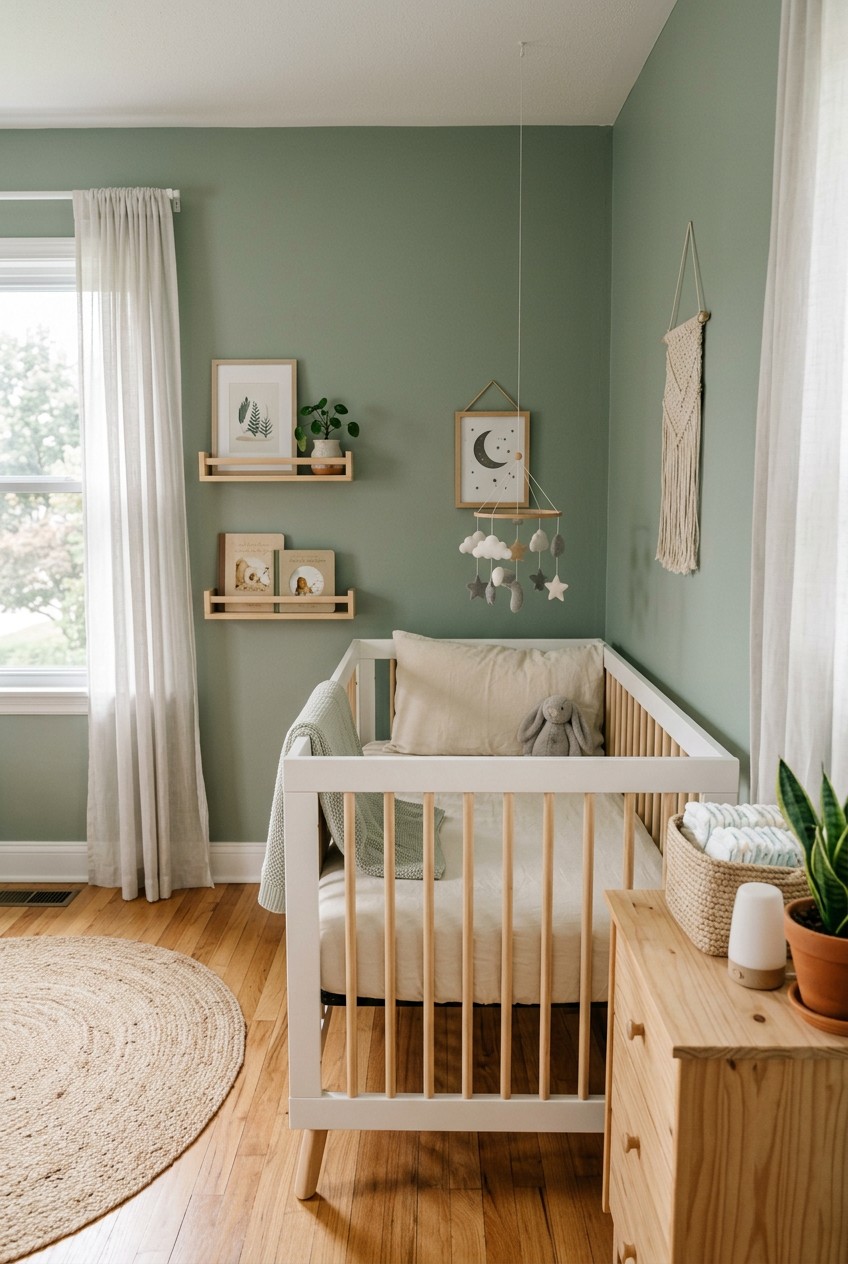
I’m begging you to skip the pastel yellows and mint greens. They feel dated the second they dry on the wall. Instead, the absolute best gender-neutral nursery ideas start with sophisticated, warm neutrals. Think soft sage green, warm stone, mushroom, muted terracotta, and dusty clay. Last Tuesday, I was walking through Lowe’s holding a lukewarm coffee, and I saw the Sherwin-Williams “Universal Khaki” paint display. It’s priced around $54.98 a gallon, and it provides the perfect warm base. Valspar’s “Warm Eucalyptus” is another incredible option for a soothing backdrop. These tones pair effortlessly with natural wood furniture and woven rattan baskets. I tried doing a crisp, cool white in my very first nursery, and it felt exactly like a sterile hospital waiting room. Babies need warmth. A muted clay wall absorbs light beautifully and makes the whole room feel like a cozy hug. It’s also incredibly forgiving if you accidentally smudge diaper cream on the wall. Just wipe it down with a damp cloth. Trust me on this. You’ll want a color that hides a little chaos. You won’t regret going warmer.
2. Implement Strategic Color Drenching

Most people get this completely wrong. They paint one wall a fun accent color and leave the rest bright white. It looks choppy and unfinished. Instead, you need to try strategic color drenching. This means you paint all four walls, the ceiling, the baseboards, and the door frames in a single, calming tone. I did this with a warm dusty rose in a client’s home last month using Behr Dynasty paint from Home Depot, which costs exactly $64.98 a gallon. It creates an immersive, cocooning feel. The room instantly feels sophisticated and intentionally designed. Honestly, this changed how I view small spaces. When the ceiling matches the walls, the sharp corners blur, and the room actually feels significantly larger. I know it sounds terrifying to paint your ceiling sage green. I was sweating through my shirt when I first tried it with a heavy roller. But the payoff is massive. Just make sure you use a flat or matte finish for the walls and ceiling, and a satin finish for the trim so you can easily wipe off sticky fingerprints later.
3. Prioritize Multi-Stage Convertible Furniture
Please don’t buy a standalone bassinet, a separate crib, and then a toddler bed. You’re just throwing money into a fire. You need multi-stage convertible furniture. I personally swear by the Dream On Me Violet 7-in-1 Convertible Crib. I grabbed one at Walmart for $219.99, and it transitions smoothly from a crib to a toddler bed, a daybed, and eventually a full-size bed. If you want something a bit more high-end, the Evolur Aurora 5-in-1 Convertible Crib runs about $599.99. I bought a cheap, non-convertible crib for my oldest child, and we had to drag it to the curb after two years. It felt so incredibly wasteful. A convertible crib anchors the room for a full decade. Plus, the classic wood finishes on these specific models fit perfectly into any neutral design scheme. When you’re buying, make sure to check the exact dimensions. A standard crib is usually 54 inches long and 28 inches wide. I measured wrong once and couldn’t open the closet door. Measure your wall space twice before you hit checkout.

Beautiful Wooden Baby Closet Dividers Set of 7
A dependable everyday pick — Beautiful Wooden Baby Closet Dividers Set of 7 – Double-Sided Organize pulls in 11 ratings at 4.5 stars. Not flashy, just solid.
4. Opt for GREENGUARD Gold Certified Furniture

I’ll never forget the sharp chemical smell of the first cheap dresser I bought online. It off-gassed for three solid weeks, and I wouldn’t even let my golden retriever sleep in that room. You must prioritize indoor air quality. Look for GREENGUARD Gold Certified furniture. This specific certification means the pieces are rigorously tested for low-VOC emissions. The Evolur Aurora crib I mentioned earlier is GREENGUARD Gold Certified, combining kiln-dried hardwood with strict safety standards. Target sells an amazing GREENGUARD certified Delta Children dresser for $249.99. It’s incredibly heavy, sturdy, and has absolutely zero toxic smell straight out of the cardboard box. Babies breathe at a much faster rate than adults, so putting them in a room full of formaldehyde fumes is a massive mistake. Spending an extra fifty bucks for that gold sticker is the cheapest peace of mind you can buy. Plus, the build quality is usually much better. You won’t deal with wobbly legs or cheap plastic drawers that stick when you’re desperately trying to put away onesies with one hand.
5. Layer Textures Extensively for Sensory Engagement

When you’re working with muted colors, a room can quickly look flat and boring. You fix this with heavy texture. Texture is the absolute secret ingredient. You need a boucle nursing chair, a linen canopy over the crib, a chunky knit blanket, and woven rugs. I bought a Project 62 boucle chair from Target for $250, and it adds so much visual interest to an otherwise quiet corner. Linen is my absolute favorite material for nurseries. It’s a durable natural fiber that adds depth without relying on loud, obnoxious patterns. I used to buy cheap, shiny polyester curtains, and they looked terrible under the overhead light. Now, I hang 100% linen panels. You can find beautiful ones at Pottery Barn Kids for about $89.00 a panel. Layering textures gives your baby vital sensory input. They love touching the bumpy boucle, the soft knit blankets, and the smooth wood of their crib. It makes the room feel rich and collected over time, rather than bought from a single catalog page in one exhausting afternoon. You might also like: 20 Stunning Layout Small Nursery Ideas That Are Totally Worth It
6. Choose Organic and Neutral Crib Bedding

Skip the scratchy polyester blend sheets with neon cartoon monkeys on them. You want crib sheets made from 100% Certified Organic breathable cotton in solid neutral tones or very simple prints. Crate & Kids and Lambs & Ivy are my absolute go-to brands for this. A beautiful 4-piece organic crib bedding set from Lambs & Ivy usually costs around $139.00. I once bought a cheap $12 sheet set from a random discount store. After exactly one wash, it felt like rough sandpaper and shrank so much I could barely stretch it over the mattress corners. My fingers were aching. Organic cotton gets softer with every single wash. I prefer a simple oatmeal color or a very subtle gray ticking stripe. It keeps the crib looking clean and inviting. Plus, organic cotton breathes significantly better, which helps regulate your baby’s body temperature while they sleep. You’ll need at least three fitted sheets. One on the bed, one in the washing machine, and one folded in the closet for those inevitable midnight diaper accidents. You might also like: 20 Creative Small Spaces Baby Room Organization Ideas You Haven’t Thought Of

DIMJ Drawer Organizer Clothes, 12 Pack Dresser Organizer
DIMJ Drawer Organizer Clothes has been one of the most consistently praised picks in this category. 13 reviewers averaged 4.5/5.
7. Select a Fully Washable Crib Mattress
This is honestly the most important tip in this entire article. Buy a 100% washable crib mattress. Last Tuesday at 3 AM, my youngest had a diaper blowout that defied the laws of physics. Because I had the Newton Baby Crib Mattress, which costs $299.99, I didn’t panic and cry. You can literally take the soft cover off to throw in the wash, and put the entire core in the shower to rinse it out. It’s entirely breathable and completely washable. Most people buy a standard $50 mattress with a stiff plastic cover. Those plastic covers crinkle loudly every time the baby moves, waking them up instantly. Then you have to buy three different waterproof mattress pads to layer on top. The Newton mattress eliminates all of that nonsense. It’s firm enough for a tiny newborn but comfortable enough for a heavy toddler. Yes, it’s a financial investment upfront. But when you’re standing in the bathroom at dawn washing out a mattress core with your showerhead, you’ll realize it’s worth double the price. You might also like: 15 Charming Safari Nursery Lighting Ideas for Every Budget
8. Incorporate Biophilic Design with Nature-Inspired Art

Biophilic design is just a fancy architectural way of saying you should bring the outdoors inside. It’s incredibly calming for both babies and exhausted adults. You want botanical motifs, forest animal prints, or subtle nature-themed wallpaper. I love sourcing from independent artists online. Pretty in Print Art and My Tommy Prints on Etsy offer stunning, modern options. You can buy a set of 6 printable woodland nursery prints for exactly $17.00. I bought a set last month, printed them on heavy matte paper at my local Walgreens for a few dollars, and hung them directly above a changing table. It instantly grounded the entire room. Nature scenes don’t scream boy or girl at you. They just feel peaceful. A common mistake is buying art that is way too cartoonish. You want illustrations that look like vintage field guides or soft watercolor landscapes. This type of art actually grows with your child. A watercolor pine tree looks just as good in a seven-year-old’s room as it does in a newborn’s nursery.
9. Utilize Smart, Integrated Storage Solutions

Babies come with a terrifying amount of tiny, easily lost stuff. If you don’t have a strict system, your beautiful nursery will look like a disaster zone in three days. You need clever, hidden storage. I rely heavily on woven baskets made from natural rattan or seagrass. They add organic warmth and give you easy access to swaddles or wooden toys. I buy the 3-pack of seagrass baskets at Costco whenever they have them in stock for $24.99. I also insist on buying furniture with built-in storage. A dresser with a removable changing tray is absolutely essential. Don’t buy a standalone changing table. It’s a massive waste of floor space. Buy a wide, sturdy six-drawer dresser instead. I use the top right drawer exclusively for diapers and wipes, the top left for clean onesies, and the bottom drawers for bulky knit blankets. I learned this the hard way after tripping over a pile of loose receiving blankets in the dark and stubbing my toe. Give every single item a designated home.

Criusia Over the Door Organizer
A dependable everyday pick — Criusia Over the Door Organizer pulls in 205 ratings at 4.5 stars. Not flashy, just solid.
10. Install True Blackout Curtains for Optimal Sleep
If you want your baby to sleep past 5 AM, you need blackout curtains. This isn’t optional. Blackout curtains help babies distinguish between day and night, promoting healthy, consistent sleep cycles. I used to think room darkening curtains were good enough. They aren’t. I spent months exhausted before I realized the bright streetlights were shining right onto my baby’s face through the thin fabric. You need true, 100% blackout panels. Target sells the Eclipse brand blackout curtains for $14.99 a panel. They are heavy, thick, and block absolutely everything. If you already have beautiful linen curtains that you love, don’t throw them away. You can buy separate blackout liners and clip them directly to the back of your existing curtains. Make sure you hang the heavy curtain rod high and wide. I mount my metal rods about four inches below the ceiling and extend them six inches past the window frame on each side. This prevents harsh light from bleeding out the edges and makes the window look massive.
11. Avoid Overly Bright or Saturated Hues
I see this specific mistake constantly. Parents think babies need bright primary colors to be stimulated. While high contrast is good for newborns, painting a room fire-engine red or royal blue is a terrible idea. Those highly saturated hues can overstimulate babies and make the room feel chaotic and tiny. Stick to soft, muted tones for your main palette. You can introduce fun pops of color through easily changeable accents like hardcover books, small artwork, or textured throw pillows. I was walking through Whole Foods last week and noticed their floral section. The soft, muted tones of dried eucalyptus and pale peach roses are exactly what a peaceful nursery should look like. Not the bright plastic toy aisle at a big box store. If you want visual contrast, use black and white. A matte black picture frame against a warm stone wall provides excellent visual stimulation for a baby without ruining the peaceful vibe of the room. Keep the big elements quiet, and let the small accessories do the talking.
12. Create a Gallery Wall with Varied Art
Instead of hanging one massive, expensive piece of canvas art, curate a gallery wall. You want different print types, varying sizes, and mixed frame colors. This allows for total personalization and can easily evolve as your child discovers new interests. I buy cheap digital downloads from Mini Learners on Etsy. They cost about $5.50 per PDF file. I then drive over to Michaels and buy a mix of their Belmont frames, which usually run about $9.99 each when they’re on sale. I’ll mix a light oak frame with a matte black one and a shiny brass one. It looks collected and highly intentional. A huge mistake I made early on was hanging frames perfectly straight in a rigid grid pattern. It looked like a sterile corporate office. Now, I lay all the frames out on the floor first. I mix horizontal and vertical orientations. I leave about two inches of breathing space between each frame. It feels organic and relaxed. Plus, if one frame gets bumped, it doesn’t ruin the whole arrangement.

Criusia Drawer Organizer Clothes
Criusia Drawer Organizer Clothes has been one of the most consistently praised picks in this category. 1 reviewers averaged 4.5/5.
13. Choose a Soft, Secured Nursery Rug
A rug is completely non-negotiable. It adds necessary warmth, soft texture, and a safe surface for daily tummy time. But you absolutely have to secure it. I once slipped on an unsecured cotton rug while holding a warm bottle, and it was genuinely terrifying. For a standard crib, which is about four by two feet, a three by five foot rug positioned halfway underneath works okay, but an eight by ten foot rug is much better for full room coverage. I’m completely obsessed with Tumble rugs. They make washable, non-slip rugs that actually look like high-end vintage woven pieces. An eight by ten Tumble rug costs around $379.00. I bought one for my living room, and after I accidentally spilled a dark green smoothie from Sprouts all over it, I threw it straight in the washing machine. It came out looking brand new. You need that exact level of extreme durability in a nursery. Babies spit up. Toddlers grind sticky snacks into the floor. A washable rug will save your sanity.
14. Integrate “Grow-With-Me” Decor Elements
Stop buying expensive decor that explicitly says baby on it. You’ll be throwing it out in three short years. You need to select items that naturally transition beyond the nursery years. Wall decals are my absolute favorite budget-friendly alternative to traditional wallpaper. They offer the flexibility to change themes without scraping sticky glue off the drywall for a week. Urban Walls sells gorgeous, high-quality vinyl decals starting around $45.00. I applied their subtle watercolor dots to a client’s nursery, and it took me exactly forty-five minutes. When the kid turns five and wants a dinosaur room, you just peel them right off. Zero damage. I also love using real, functional items as decor. A beautiful wooden rocking horse, a vintage-style globe, or a minimalist quote print are completely timeless. Don’t buy the cheap plastic diaper caddies. Buy a beautiful leather or heavy canvas tote from a local craft market. It holds diapers right now, and it can hold art supplies later. Buy quality things once, and use them forever.
15. Embrace the “Mood-First” Design Approach

This is the biggest design trend for 2026, and I’m fully on board. Rather than picking a rigid theme like safari or outer space, you need to focus on a specific mood. Do you want the room to feel calm, warm, nostalgic, or highly energetic? I decided I wanted my second nursery to feel like a quiet Sunday morning. I went to Trader Joe’s, bought a $3.99 bunch of fresh eucalyptus, and put it in a simple glass vase on the wooden dresser. I added a soft linen lamp and a plush wool rug. There was no specific theme, but the room felt incredibly cohesive and deeply personal. When you lock yourself into a strict theme, you end up buying cheap matching sets that look incredibly tacky. A mood-first approach gives you the ultimate freedom to buy a beautiful piece of art just because you like it, not because it has a cartoon giraffe on it. It ensures the nursery feels like a natural extension of your home’s overall aesthetic.
Designing a nursery shouldn’t feel like a stressful test you’re failing. I’ve spent years figuring out what actually works so you don’t have to. If you stick to warm neutrals, invest in a washable mattress, and prioritize clever storage, you’ll create a space that feels like a sanctuary. I honestly wish I’d known all of this before I painted that first room neon yellow. Save these tips, pin your favorite ideas, and start building a room you’ll love rocking your baby to sleep in. You’ve got this.

Delta Children Nursery Storage 48 Piece Set
Delta Children Nursery Storage 48 Piece Set – Easy Storage/Organizatio punches above its price — 17 buyers rated it 4.5 stars. I would buy it again.
Frequently Asked Questions
What are the best colors for a gender neutral nursery?
The best colors are warm, earthy neutrals. Soft sage green, warm stone, mushroom, muted terracotta, and dusty clay create a calming environment that won’t overstimulate your baby. These shades pair beautifully with natural wood and woven textures.
How do I make a neutral nursery feel cozy?
You need to layer heavy textures. Incorporate a boucle nursing chair, heavy linen curtains, chunky knit blankets, and a soft washable rug. Texture prevents muted colors from looking flat and gives your baby healthy sensory engagement.
Are convertible cribs worth the money?
Absolutely. A 7-in-1 or 5-in-1 convertible crib saves you from buying a bassinet, a toddler bed, and a full-size bed later. It’s a smart, long-term investment that anchors the room’s design for a decade.
How can I add art without using a specific theme?
Use a mood-first approach and create a gallery wall. Frame nature-inspired prints, subtle watercolor landscapes, or botanical motifs in mixed frames. This biophilic design feels peaceful and easily grows with your child as their interests change.