What’s Inside
- 1. Ditch the Over-the-Top Themes for Warm Neutrals
- 2. Invest in a Heavy-Duty Air Purifier
- 3. Buy a Dresser That Doubles as a Changing Station
- 4. Spend the Money on a Power Glider
- 5. Layer Your Lighting for 3 AM Feedings
- 6. Pick a Non-Toxic, Low-Pile Rug
- 7. Keep the Crib Away From the Window
- 8. Anchor Every Single Piece of Furniture
- 9. Add Chunky Sensory Textures
- 10. Get a Smart Sound Machine
- 11. Start With High-Contrast Visuals for Newborns
- 12. Modern Woodland Baby Boy Nursery Room Ideas
- 13. Hang Your Wall Art at Adult Eye Level
- 14. Install Adaptable Built-In Closet Storage
- 15. Blackout Curtains Are Non-Negotiable
- 16. Swap the Standard Closet Doors for Curtains
- 17. Use Open Shelving for Daily Essentials
- 18. Keep a Dedicated Laundry and Trash Zone
- 19. Coastal Blues Baby Boy Nursery Room Ideas
I stood in my son’s room at 2 AM last Tuesday, holding a dripping paintbrush. I’d meant to paint the walls a soft navy; instead, I was staring at a blinding neon blue. The fumes gave me a nasty headache, and I’d splattered paint all over my favorite $45 gray leggings. Designing a nursery shouldn’t end in tears and ruined clothes. I’ve spent six years as a consultant fixing these exact disasters. Most people mess up by rushing to buy matching furniture sets that look dated within months. Let’s skip the stress. I’m sharing the strategies I use with my clients to build spaces that actually work. Grab a coffee. We’ve got a lot to cover.
1. Ditch the Over-the-Top Themes for Warm Neutrals
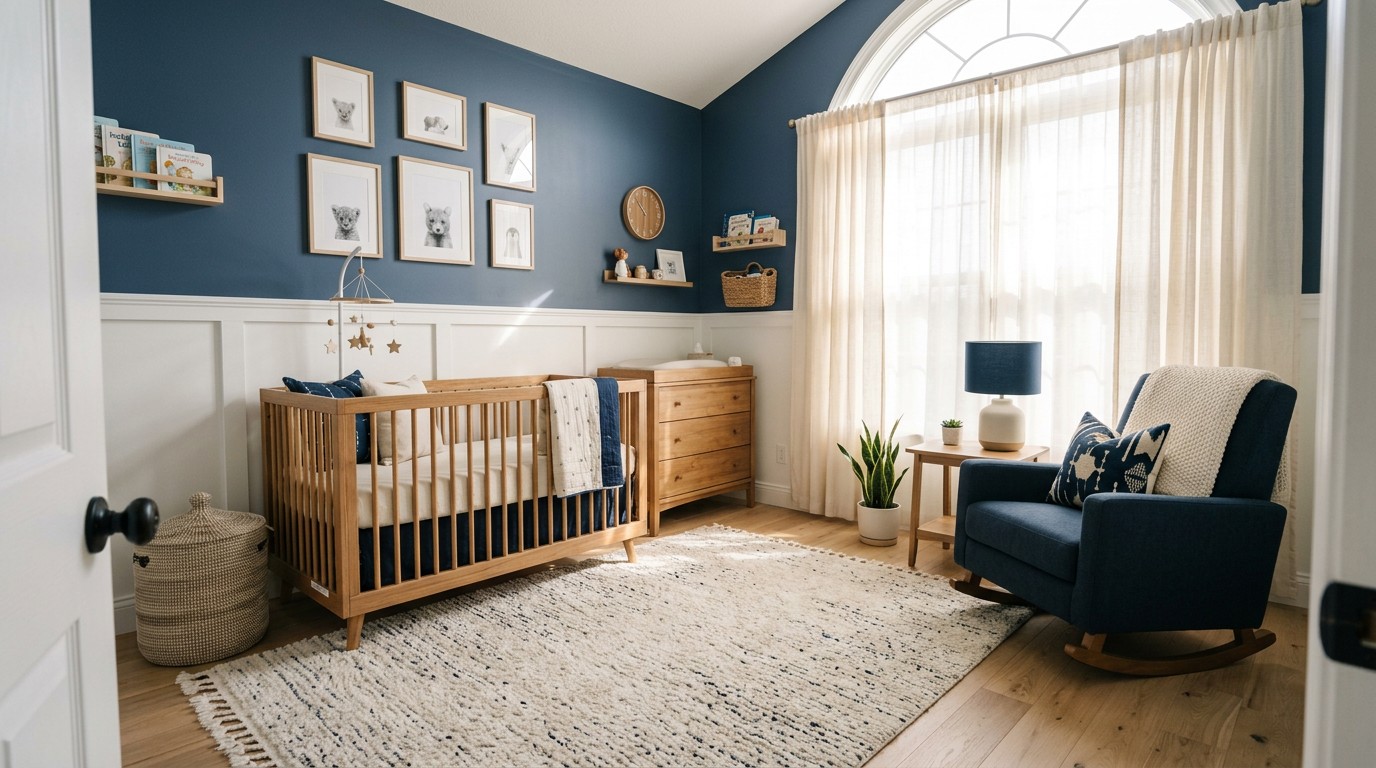
Instead of plastering cartoon characters everywhere, go for warm neutrals like taupe, creamy white, and muted green. These earthy tones are huge for 2026 because they create a calm space that grows with your child. I see parents choose loud colors that feel dated quickly. A client recently showed me a bright red fire truck room she spent $800 on; her toddler hated it. I always start with a base like Sherwin Williams Alabaster ($72 per gallon). It’s a creamy white that feels warm, not clinical. You can pick up a 2-inch angled Purdy brush for $14.99 at Walmart to cut in the edges. This neutral backdrop means you won’t have to repaint when your kid decides he prefers dinosaurs. Took me years to learn that.

2. Invest in a Heavy-Duty Air Purifier
Four in 10 people live in areas with poor air quality, so an air purifier is a must. You don’t want your newborn breathing in dust or paint fumes. I swear by the Coway Airmega 160, which costs exactly $149.99. It cleans the air 4.8 times an hour in a 214-square-foot room. If you want a smart version, the LEVOIT Core 300S is also $149.99. I bought a cheap $30 purifier for my firstborn, and it sounded like a rattling lawnmower. Total mistake. The Coway is whisper-quiet. I grabbed mine at Costco during a sale. Filter replacements are about $45, but it’s worth it to keep the nursery air crisp.

3. Buy a Dresser That Doubles as a Changing Station
I’d never recommend a flimsy, standalone changing table. They’re a waste of money and become useless once your kid is potty trained. Choose a piece that transitions into a regular dresser. The Pottery Barn Kids Kendall 7-Drawer Dresser And Topper Set is a top pick for $899. It offers solid wood construction that won’t wobble when your baby wiggles. Alternatively, the Babyletto Hudson 3-Drawer Changer Dresser runs about $399 and works beautifully. I bought a cheap particle board table for $80 at Target years ago, and the bottom drawer fell out on my foot. Buy something heavy. You’ll need those deep drawers for the endless 4 oz tubes of diaper cream and stacks of onesies.

JolyWell Night Light for Kids
JolyWell Night Light for Kids punches above its price — 63 buyers rated it 4.5 stars. I would buy it again.

4. Spend the Money on a Power Glider
A glider will be the most used piece of furniture in the room; prioritize comfort. I spent three months rocking my son in a stiff vintage chair, and my lower back screamed every morning. Learn from me. The Babyletto Kiwi Electronic Power Recliner ranges from $719 to $899 and is worth every penny. It has a nearly flat recline, a smooth swivel, and built-in USB ports. For smaller spaces, the DaVinci Gabby is under $400 and offers a great high back. The plush boucle fabric feels soft against your skin, unlike the scratchy linen I tried first. Spot-clean spit-up with a damp cloth and 1 teaspoon of Dawn dish soap.

5. Layer Your Lighting for 3 AM Feedings
Avoid harsh overhead lighting. It stresses infants out and ruins their sleep. Interior expert Rachel Zepernick recommends dimmers to ease light on gradually. I bought a Lutron LED dimmer switch for $24.97 at Home Depot and wired it myself. For nighttime checks, use red or amber lights around 2800K to 3000K. These warm tones don’t wreck melatonin production. I keep a small VAVA nightlight ($23.99) on the changing table. It emits a soft glow that doesn’t blind me at 3 AM. Honestly, this changed my life. I used to flip on the bright ceiling fan light, and my baby would instantly start screaming. Layered lighting keeps the room feeling sleepy.

6. Pick a Non-Toxic, Low-Pile Rug
Babies spend hours rolling on the floor, so a safe rug is essential. Look for natural fibers like cotton or wool, free of chemical treatments and synthetic dyes. I bought a cheap synthetic rug once; the off-gassing smell gave me a headache for a week. I had to throw it in the garage. I recommend a large 8×10 wool rug that fits under the crib. It provides cushioning and acts as a barrier against toxins in older carpets. You can find organic cotton rugs at Sprouts for around $200. Ensure it has a non-slip backing, or buy a Mohawk non-slip pad for $35 so you don’t go sliding across the room holding a baby. You might also like: 15 Lovely Nursery Lighting Ideas to Transform Your Space

Modanais Baby Diaper Caddy Organizer Cart
Modanais Baby Diaper Caddy Organizer Cart – 3 Tier Rolling Cart with D punches above its price — 613 buyers rated it 4.5 stars. I would buy it again.

7. Keep the Crib Away From the Window
Don’t place the crib near windows, heaters, or blind cords. These are safety risks and can disturb sleep. As stylist Kim Doren advises, give the crib some breathing room. Drafty windows make babies freeze in the winter. I initially put my son’s Ikea Sniglar crib ($119) under a large double-hung window. The streetlights glared in his eyes, and the chill seeped through the glass. I had to rearrange the room at midnight just to get him to sleep. Center the crib on a solid interior wall. It looks better, and you won’t panic about blind cords. You might also like: 15 Clever Neutral Small Nursery Ideas for Every Budget

8. Anchor Every Single Piece of Furniture
This is a safety measure most parents ignore until it’s too late. Dressers and bookshelves must be anchored to the wall to prevent tipping. I was at a friend’s house when her toddler tried to climb a lightweight bookshelf. It tipped, and we barely caught it. My heart stopped. You can buy a pack of heavy-duty metal anti-tip straps for $14.99 at Walmart. It takes ten minutes and a basic drill to hit the studs. Don’t rely on drywall anchors for heavy furniture. Find the stud. Even if your dresser feels heavy, a 25-pound toddler opening all the top drawers shifts the center of gravity instantly. Anchor everything before the baby arrives. You might also like: 15 Cozy Baby Nursery Decor Ideas for Any Style

9. Add Chunky Sensory Textures
Dr. Karen Aronian emphasizes exposing infants to different textures to aid sensory development. A nursery shouldn’t just look good; it needs to feel interesting. Integrate soft textiles like organic cotton blankets or a plush wool rug. I picked up a chunky knit organic cotton throw at Whole Foods last Tuesday for $39.99. The knobby texture is perfect for tummy time. Babies love running their fingers over different fabrics. Skip the scratchy polyester sheets. I buy Burt’s Bees Baby fitted crib sheets ($19.99). They’re 100% organic cotton and feel incredibly soft. Mixing textures like smooth wood and chunky knits creates a rich tactile experience.

Modanais Baby Diaper Caddy Organizer Cart
If you want something that just works, Modanais Baby Diaper Caddy Organizer Cart – 3 Tier Rolling Storage Car is a safe bet (303 reviews, 4.5 stars).

10. Get a Smart Sound Machine
A sound machine helps babies stay asleep by drowning out the dog barking or the delivery guy. The Hatch Rest+ 2nd Gen is my pick at $89.99. It offers multiple sounds, a customizable light, app control, and an audio monitor. I keep mine set to the TV static sound. Place the machine at least 7 feet away from the crib and keep the volume at or below 50 decibels. This is recommended by the American Academy of Pediatrics to protect developing ears. I used to blast a cheap $15 machine right next to my son’s head, thinking louder was better. My pediatrician quickly corrected me.
11. Start With High-Contrast Visuals for Newborns
Newborn vision is blurry. Incorporate high-contrast black and white elements. Dr. Aronian suggests starting with stark contrast and moving to primary colors later. Soft pastels aren’t going to stimulate a two-week-old; they just look like a gray blur. I bought a set of high-contrast geometric prints for $15 at Target and framed them above the changing table. It gave my son something distinct to stare at, which stopped him from crying instantly. You don’t have to paint the walls black. Use small accessories. A black and white striped crib skirt or a geometric mobile works perfectly.
12. Modern Woodland Baby Boy Nursery Room Ideas
Finding the right theme means picking something that isn’t suffocating. A common mistake is filling the room with too much stuff, making it feel chaotic. Avoid themes your child will outgrow in a year. Instead, opt for flexible concepts like a Modern Woodland theme. Use specific touches rather than a giant forest mural. I love using Crate & Kids woodland animal fitted sheets ($24) paired with natural oak furniture. Bring in a faux olive tree from Kroger ($45) for greenery. Keep the walls a warm taupe and let the accessories do the talking. If he hates animals at age three, you just change the sheets.

Beautiful Wooden Baby Closet Dividers Set of 7
Beautiful Wooden Baby Closet Dividers Set of 7 – Double-Sided Organize punches above its price — 11 buyers rated it 4.5 stars. I would buy it again.
13. Hang Your Wall Art at Adult Eye Level
Don’t hang art near the ceiling. Position it at adult eye level, exactly 57 to 60 inches from the floor to the center of the piece. This grounds the room and connects the art to the furniture below. I used to hang pictures way too high, making the walls look awkward. Ensure all decor is securely fastened. Never hang heavy frames above the crib or changing table. I use heavy-duty Command Strips ($5.99 at Walmart) for lightweight canvas, but I use drywall anchors for wooden frames. Keep the heavy stuff away from where the baby sleeps.
14. Install Adaptable Built-In Closet Storage
To combat the clutter of tiny socks and blankets, you need serious organization. Rachel Blindauer recommends systems that grow with your child. The Elfa Custom Closet System from The Container Store (starting around $500) is versatile. You can move the shelves as clothes get bigger. I tried using a cheap plastic drawer tower from Target. The drawers jammed, and the plastic cracked within three months. It was a frustrating waste of $40. A proper closet system lets you add wire baskets for burp cloths. If you’re on a budget, the Ikea Boaxel system is a great alternative for about $120. Just measure your closet width exactly.
15. Blackout Curtains Are Non-Negotiable
Install cordless blinds or thick curtains to control light for naps. This is crucial for a good sleep environment. I bought Eclipse Absolute Zero blackout curtains for $24.99 a panel at Target. They block 100% of the sunlight. More importantly, they eliminate the strangulation hazards that come with old-school blind cords. I once stayed at an Airbnb with cheap paper blinds, and the morning sun woke my baby at 4:30 AM three days in a row. I was miserable. Buy the good curtains. Hang the rod high and wide, about 4 inches above the frame, to make the room look taller.

Criusia Over the Door Organizer
If you want something that just works, Criusia Over the Door Organizer is a safe bet (205 reviews, 4.5 stars).
16. Swap the Standard Closet Doors for Curtains
If you have a small nursery, standard bi-fold closet doors take up too much floor space. I took the doors off the hinges in my son’s room and stored them. I installed a heavy-duty tension rod ($12.99 at Walmart) and hung a linen curtain across the opening. It softens the room and gives you an extra 3 feet of space for a glider or hamper. Plus, you won’t pinch your fingers in those annoying metal tracks. Make sure the curtain is hemmed 1 inch above the floor. If it drags, it’ll collect dust instantly. Learned that the hard way.
17. Use Open Shelving for Daily Essentials
You need one hand on your baby during a diaper change, so you can’t be digging through deep drawers for wipes. Install a simple floating shelf right above the changing station, high enough so the baby can’t reach. I use the Ikea Lack floating shelf ($29.99). It’s sleek and holds exactly what I need. I keep a 4 oz tube of Desitin ($6.49 at Walgreens), a stack of water wipes, and unscented baby lotion on top. Everything is within reach. I used to keep this in a zippered caddy; fumbling with the zipper while holding a screaming baby was a nightmare. Open shelving keeps essentials visible.
18. Keep a Dedicated Laundry and Trash Zone
Babies generate an alarming amount of laundry and trash. You need a smell-proof zone. I recommend the Ubbi Steel Odor Locking Diaper Pail ($79.99). Because it’s steel, it doesn’t absorb smells like cheap plastic pails. I bought a plastic one first, and after a month, the room smelled like dirty diapers even when empty. The Ubbi uses regular kitchen trash bags, saving you money. Place a structured laundry hamper right next to it. I found a woven cotton rope hamper at Trader Joe’s for $19.99. Having the trash and laundry next to the changing table means you can toss dirty clothes instantly.

19. Coastal Blues Baby Boy Nursery Room Ideas
If you want another flexible theme, Coastal Blues are a fantastic direction. This trend is huge for 2026. Instead of anchors everywhere, focus on the colors and textures of the coast. Paint the walls a soft, muted blue like Sherwin Williams Sea Salt ($70 per gallon). Bring in natural rattan baskets ($25 at Target) and light washed oak furniture. I recently designed a coastal room, and we used a jute rug and vintage prints of ocean waves. It felt serene. The mistake parents make is buying literal beach decor. Skip the wooden signs that say “Ahoy.” Stick to the palette and natural textures. It creates a relaxing environment.
Designing a nursery doesn’t mean maxing out your credit cards on matching furniture sets. You just need a solid plan. I’ve seen firsthand how prioritizing safety, investing in a good glider, and keeping the colors warm changes the feel of the room. Don’t stress if it isn’t perfect on day one. You’ll move things around once you find your rhythm. I’m telling you, skip the cheap changing tables and get the blackout curtains. If you found these tips helpful, save this post or pin it to your inspiration board so you can reference the paint colors and prices when you’re ready to shop. You’ve got this!

Frequently Asked Questions
What are the best colors for a baby boy nursery?
Warm neutrals, soft blues, and muted greens are trending. Sherwin Williams Alabaster or Sea Salt are excellent choices that grow with your child.
How can I make my baby boy’s nursery safer?
Always anchor heavy furniture like dressers to the wall studs. Keep the crib away from windows, heaters, and blind cords to prevent accidents.
What furniture is essential for a baby boy nursery room?
You absolutely need a convertible crib, a solid dresser that doubles as a changing table, and a comfortable power glider for late-night feedings.
How do I organize a small baby boy nursery?
Maximize vertical space with built-in closet systems like Elfa. Swap traditional closet doors for curtains to save floor space, and use open floating shelves for daily essentials.
3 thoughts on “19 Baby Boy Nursery Room Ideas Worth Trying”