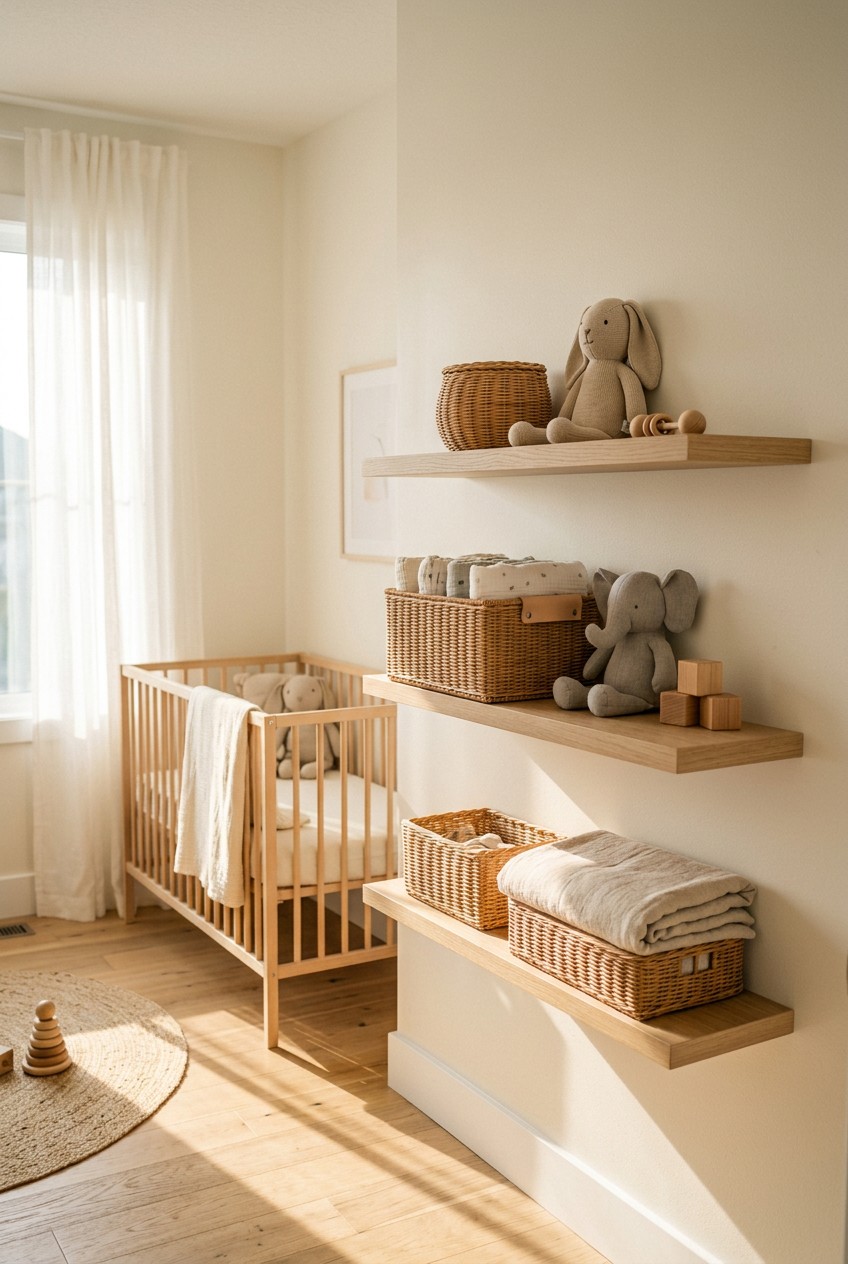
What’s Inside
- Prioritize Closed Storage to Combat Clutter
- Embrace Modular Cube Organizers for Versatility
- Install Floating Shelves for Display, Not Heavy Storage
- Adhere to Safe Shelf Heights
- Maintain Optimal Shelf Spacing
- Utilize Over-the-Door Organizers for Hidden Gems
- Invest in Quality Storage Bins and Baskets
- Incorporate a Rolling Utility Cart for Diapering Essentials
- Create a Montessori-Inspired Book Nook
- Don’t Underestimate the Power of Pegboards
- Avoid the Mistake of Unanchored Furniture
- Utilize Closet Space with Internal Shelving
- Choose Adjustable Shelving for Long-Term Use
- Visualize Shelf Placement with Painter’s Tape
- Consider Unfinished Wood Floating Shelves for Customization
- Install Clear Acrylic Ledges for a Modern Look
- Maximize Dead Corners with Corner Shelving Units
- Use Soft Woven Baskets on Top of Wardrobes
- Repurpose Picture Ledges for Tiny Items
- Invest in Modular Wall Systems for Large Walls
My first attempt at nursery shelving ended with a 16-ounce bottle of baby lotion exploding across my freshly painted baseboards. I thought floating glass shelves would look chic and airy. Instead, I created a precarious tower of heavy bottles and stacked wipes that tumbled down the second I bumped it in the dark. The sharp snap of the plastic pump breaking still haunts me. The smell of lavender lotion soaked into the carpet for weeks. I learned that the hard way. Last Tuesday at Trader Joe’s, I saw a pregnant woman buying three massive, flimsy wire baskets for her nursery, and I wanted to warn her. Open storage is a trap. You’re tired, you’re nesting, and you want everything to look like a magazine spread. But practicality has to win. If your setup requires perfect folding to look decent, it won’t last a week. Let’s talk about real, functional storage that actually works for sleep-deprived parents. I’ve spent years designing these spaces. I’ve learned exactly what fails. I tried this wrong for months before figuring it out. Here are twenty specific ways to organize your baby’s room without losing your mind.
1. Prioritize Closed Storage to Combat Clutter

I can’t stress this enough. Open shelves look beautiful in photos, but they’re dust magnets in a real house. I had stacked newborn clothes and tiny soft toys on open ledges; within two weeks, they were coated in a fine layer of gray dust. It’s gross. You need closed storage. I highly recommend the IKEA KALLAX shelf unit. The 4-cube organizer costs exactly $79.99, and it’s a lifesaver. You pair it with their DRÖNA fabric boxes ($5.99 each) to hide the chaos. When I come home from a massive Costco run with a 192-count box of Huggies, I don’t want to look at that giant cardboard box. I want to shove those diapers into a fabric bin where I can’t see them. The rough texture of the canvas bins sliding into the smooth laminate cubes is satisfying. It keeps the room visually calm. Skip the complicated custom cabinets and just use cube storage with bins. It’s practical, cheap, and hides the ugly plastic packaging of baby gear.
2. Embrace Modular Cube Organizers for Versatility

If you don’t live near an IKEA, the Target Brightroom 6-Cube Organizer ($65) is your best friend. Modular cube organizers are versatile and grow with your child. You can place them standing up vertically for a narrow wall, or lay them on their side to create a low console. Last month, I did a frantic Sprouts run for organic toddler snacks because my client’s nursery was a disaster zone and we needed a break. When we got back, we flipped her 6-cube organizer on its side. Suddenly, her crawling baby could reach the bottom three bins for toys, while we kept the top three bins for 4 oz tubes of diaper cream and wipes. It fixed the flow of the room. Don’t buy baby-specific furniture that only serves one purpose. A modular cube shelf holds 10-inch fabric bins perfectly and transitions from a diaper station to a bookshelf when they hit preschool.
3. Install Floating Shelves for Display, Not Heavy Storage

Floating shelves are excellent for displaying lightweight decor, small 6-inch square board books, or framed photos. They aren’t meant for heavy storage. I made the mistake of loading up a cheap floating shelf with a heavy ceramic piggy bank and ten hardcover books. The drywall anchors failed, and the sound of drywall crumbling at 2 AM is terrifying. You must install these into wall studs. I personally swear by the Pafoli 16.5-inch floating nursery book shelves. They come in a 3-pack for $24.99 and feature rounded edges, which is crucial for safety once your kid starts walking and bumping into things. The natural pine wood smells amazing out of the box. Use a magnetic stud finder, mark your spots, and only put lightweight, decorative items on these. Keep the heavy lifting for your floor-anchored bookcases.

Delta Children Nursery Storage 48 Piece Set
Delta Children Nursery Storage 48 Piece Set – Easy Storage/Organizatio has been one of the most consistently praised picks in this category. 17 reviewers averaged 4.5/5.
4. Adhere to Safe Shelf Heights

Most people get this wrong. They hang shelves based on where it looks cute on the wall, ignoring functionality. For items you need to access quickly while holding a squirming baby, shelves should be hung at eye-level, approximately 4 to 5 feet (120-150 cm) from the ground. I once hung a shelf at 6 feet high because it centered nicely over a window. I ended up needing a step stool just to grab a 2 oz bottle of saline drops. It was infuriating. Conversely, for items intended for children to reach independently, the top shelf should be between 24 to 36 inches (60-90 cm) from the floor. This Montessori-inspired height lets toddlers grab their own toys without climbing. Measure twice, think about your own height, and hang things where your arms naturally reach.
5. Maintain Optimal Shelf Spacing

Spacing matters just as much as height. When you’re stacking multiple shelves on a wall, you need to allow 10 to 12 inches (25-30 cm) between them for standard picture books and small decor items. If you space them too closely, you can’t slide books in and out easily, and you’ll end up scraping your knuckles on the wood above. For larger oversized books, framed art, or 12-inch plush toys, increase that spacing to 14 to 16 inches (35-40 cm). I learned this the hard way when I bought a gorgeous 14-inch tall stuffed giraffe and tried to jam it onto a shelf with only 10 inches of clearance. It looked ridiculous, squished up against the bottom of the next shelf. Use a tape measure and a stack of your actual baby books to test the clearance before you drill a single hole.
6. Utilize Over-the-Door Organizers for Hidden Gems

Honestly, this changed how I organize tiny nurseries. You don’t always need more wall shelves. You just need to use the back of the closet door. I bought a SimpleHouseware Over-The-Door Organizer with 24 clear pockets for $14.99. It’s a massive space saver. I use it for all the tiny, annoying items that clutter up drawers: tiny baby socks, rolled-up bibs, 4 oz bottles of lotion, and pacifiers. Last week, during a frantic Kroger run for emergency wipes, I realized I had zero space left on the changing table. I came home, hung this organizer over the door, and dumped all the small tubes and bottles into the clear pockets. The thick plastic pockets keep everything visible but completely out of the way. It’s cheap, requires zero tools, and holds an incredible amount of stuff. You might also like: 20 Charming Small Nursery Ideas to Transform Your Space

Beautiful Wooden Baby Closet Dividers Set of 7
Honestly, Beautiful Wooden Baby Closet Dividers Set of 7 – Double-Sided Organize surprised me — sturdier than it looks in the photos, and over 11 buyers gave it 4.5 stars.
7. Invest in Quality Storage Bins and Baskets

Skip the brittle dollar-store plastic bins. They crack if you look at them wrong and feel like cheap takeout containers. You want thick, durable fabric that holds its shape. Pehr Canvas Storage Containers cost $48 each, which sounds steep, but they’re worth every penny. They measure 13 by 13 inches and fit perfectly into standard cube bookcases. The heavy cotton canvas feels incredibly sturdy, and the hand-stitched pom-poms add great texture to the room. I’ve dragged these bins across hardwood floors, stuffed them full of heavy wooden blocks, and washed them in the sink with 1/2 cup of mild detergent. They don’t sag or lose their shape. A good bin hides the visual noise of brightly colored plastic toys and makes a cheap bookshelf look expensive. You might also like: 15 Charming Safari Nursery Lighting Ideas for Every Budget
8. Incorporate a Rolling Utility Cart for Diapering Essentials

You don’t always need fixed wall shelves for diapering. A rolling cart is infinitely better. I recommend the IKEA RÅSKOG utility cart ($39.99). It’s made of powder-coated steel, and the metal wheels clank satisfyingly as you roll it across the floor. I use the top tier for a stack of diapers and a tub of wipes, the middle tier for 4 oz tubes of Aquaphor and burp cloths, and the bottom tier for extra swaddles. When the baby is sick and you’re changing diapers on the living room floor, you just roll the entire cart out there. No running back and forth to the nursery. It’s a mobile shelving unit that adapts to wherever you are in the house. Plus, when you’re done with diapers, it becomes a great art supply cart. You might also like: 20 Cozy Gender Neutral Baby Nursery Decor Ideas for Any Style
9. Create a Montessori-Inspired Book Nook

Traditional deep bookshelves are terrible for toddlers. They pull one book out, and the rest collapse like dominoes. Instead, install low, front-facing book ledges. This allows children to see the book covers, making it easier for them to choose their own stories. The Babyletto Spruce Tree Bookcase ($249) is a fantastic floor option, but you can also mount shallow 4-inch deep ledges directly to the wall. Keep them at a child’s height, roughly 24 to 36 inches off the floor. I love the visual of brightly colored book covers acting as art in the room. It encourages independent reading. Just make sure the ledge has a front lip so the books don’t slide off onto your kid’s toes.

Criusia Drawer Organizer Clothes
Criusia Drawer Organizer Clothes punches above its price — 1 buyers rated it 4.5 stars. I would buy it again.
10. Don’t Underestimate the Power of Pegboards

Pegboards aren’t just for garages anymore. They’re a customizable storage solution for nurseries. I use the Wall Control Metal Pegboard panels ($44.99 for two 16×32 inch panels). Unlike cheap fiberboard that warps and chips, the metal feels cold, heavy, and industrial-chic. You mount it right next to the changing table. You can buy little metal hooks and baskets that snap into place with a satisfying click. I hang tiny wire baskets filled with 2 oz pacifier clips, nail clippers, and thermometer covers. As your baby grows, you just rearrange the hooks. It takes up zero floor space and keeps dangerous items high up and away from grabbing hands. It’s the most adaptable shelving you’ll ever install.
11. Avoid the Mistake of Unanchored Furniture

This isn’t just a tip; it’s a mandatory rule. Always anchor freestanding shelving units, dressers, and bookcases to the wall. I had a terrifying moment years ago when a toddler tried to climb the front of a lightweight bookshelf. It tipped forward, and I barely caught it in time. My heart pounded for an hour. Don’t trust the weight of the furniture to keep it stable. Buy a 10-pack of Ougourim Furniture Anchors for $12.99. They use heavy-duty steel cables that won’t snap. You drill one bracket into the furniture and one into a wall stud, then connect them with the steel wire. It takes ten minutes and costs next to nothing. Never skip this step, no matter how short or heavy you think the shelf is.
12. Utilize Closet Space with Internal Shelving

Nursery closets usually come with one high wire shelf and a hanging rod. Babies wear tiny clothes. You don’t need 4 feet of vertical hanging space. Maximize that wasted space by adding extra shelving units inside the closet. I like to take a 2×4 IKEA KALLAX unit ($89.99) and lay it sideways directly on the closet floor. It instantly gives you eight cubbies for folded pants, shoes, and bins of outgrown clothes. It smells like fresh pine and completely organizes the black hole at the bottom of the closet. You can still hang clothes above it, but now you have a functional mini-wardrobe setup underneath. It’s a quick fix that doubles your storage without renovating the closet.

Criusia Over the Door Organizer
Honestly, Criusia Over the Door Organizer surprised me — sturdier than it looks in the photos, and over 208 buyers gave it 4.5 stars.
13. Choose Adjustable Shelving for Long-Term Use

Fixed shelves are frustrating because baby gear changes size constantly. First you’re storing 4 oz baby bottles, then giant plastic toy trucks. Look for shelving systems with adjustable tracks. The IKEA TROFAST storage combination ($94.99) is brilliant for this. The wooden frame has plastic rails on the inside, allowing you to slide plastic bins in and out like drawers. You can swap out shallow 4-inch bins for deep 9-inch bins as their toys get bigger. The plastic bins slide with a slightly noisy plastic-on-plastic scrape, but they are indestructible. This future-proofing prevents the common mistake of buying cute, tiny shelves that become completely useless by the time your kid turns three.
14. Visualize Shelf Placement with Painter’s Tape

Before you touch a drill, you need to visualize the layout. I once eyeballed a set of three shelves, drilled six holes, and realized they were completely crooked and too close to the door frame. I had to patch the drywall and start over. Now, I use Scotch Blue Painter’s Tape (1.41-inch width, $4.50). I tear off strips the exact length of the shelves and stick them to the wall. You can step back, see how it looks from the doorway, and adjust the spacing without ruining your paint. The sticky residue of cheap tape can peel your fresh nursery paint, so spend the extra two dollars on the name-brand blue stuff. Leave the tape up for a day and see how the placement feels before committing.
15. Consider Unfinished Wood Floating Shelves for Customization

If you want a custom look without the custom price tag, buy unfinished wood shelves. Pafoli sells unfinished 16.5-inch pine shelves for around $22.99. You can paint or stain them to perfectly match your crib or dresser. I did a project last month where I bought a half-pint of Minwax stain at Walmart for $6. I used about 1/2 cup of stain on a rag, rubbed it into the raw wood, and let it dry. The fumes were strong, so do this outside. The result was a gorgeous, rich walnut color that matched a vintage rocking chair perfectly. It’s a little extra work, but the raw wood absorbs the stain beautifully and gives you total control over the nursery’s color palette.

Vailando 6-Shelf Hanging Closet Organizer with 3 Drawers
A dependable everyday pick — Vailando 6-Shelf Hanging Closet Organizer with 3 Drawers pulls in 34 ratings at 4.5 stars. Not flashy, just solid.
16. Install Clear Acrylic Ledges for a Modern Look

If you have bold wallpaper and don’t want heavy wooden shelves blocking the pattern, use clear acrylic ledges. The NIUBEE 15-inch clear acrylic shelves come in a 4-pack for $23.99. They are completely transparent, so the books and toys look like they’re floating on the wall. The smooth, hard plastic is easy to wipe down with a damp cloth. I love these for tight corners or small rooms because they don’t add visual bulk. Just be careful during installation. If you overtighten the screws, the brittle acrylic will crack with a loud snap. Use a manual screwdriver, not a power drill, to secure them gently against the drywall.
17. Maximize Dead Corners with Corner Shelving Units

Every nursery has that one awkward corner behind the door or next to the glider that feels useless. Don’t leave it empty. A corner shelving unit is perfect for this. The VASAGLE 5-Tier Corner Shelf ($35.99) has a 7.9-inch radius that tucks perfectly into tight spaces. I use these specifically for things I want out of reach but visible, like a baby monitor camera, a small sound machine, or a delicate 5×7 framed ultrasound photo. The dark faux-wood finish looks surprisingly good for the price. It turns a dark, dusty corner into vertical storage without eating up any precious floor space in a small room.
18. Use Soft Woven Baskets on Top of Wardrobes

Don’t forget the space on top of your furniture. If you have a tall dresser or wardrobe, that flat surface is prime real estate for lightweight, bulky items. I buy the Target Pillowfort Coiled Rope Baskets ($12 each). The soft, thick cotton rope feels amazing, and they won’t scratch the top of your furniture. I use these to store extra packs of wipes, out-of-season clothes, or surplus crib sheets. Because they’re up high, you don’t want anything heavy in them. If a basket full of soft blankets falls on your head while you’re reaching for it, you’ll be fine. No exaggeration. It keeps the bulky backup supplies out of your daily way.
19. Repurpose Picture Ledges for Tiny Items

Standard shelves are often too deep for tiny nursery items, which just get pushed to the back and lost. Picture ledges are the perfect solution. The IKEA MOSSLANDA picture ledge is 21.75 inches long and costs $14.99. It has a tiny groove meant for picture frames, but it’s brilliant for holding 1 oz bottles of essential oils, tiny wooden teething rings, or small pacifiers. The front lip keeps everything from rolling off. I mount one of these directly above the changing pad. It keeps the tiniest, most annoying items organized in a single row where I can see and grab them instantly with one hand.
20. Invest in Modular Wall Systems for Large Walls

If you have a large, blank wall and the budget for it, a full modular wall system is incredible. The Pottery Barn Kids Cameron Modular Wall Storage System starts around $161 for base units. It’s an investment, but it looks built-in without the contractor fees. I assembled one of these for a client, fueled entirely by a massive iced coffee from Whole Foods. The painted wood is heavy, smooth, and flawlessly finished. You can mix and match open cubbies, closed cabinets, and drawer bases. It anchors securely to the wall and provides enough storage to last from infancy through high school. If you plan to stay in your house for a long time, skip the cheap temporary fixes and build a proper wall system.
I hope these nursery shelving ideas save you from the mistakes I’ve made. Don’t let the pressure of a perfect aesthetic ruin the functionality of your baby’s room. Stick to closed storage for the messy stuff, anchor everything to the wall, and keep your daily essentials within arm’s reach. You’ll thank yourself during those 3 AM diaper changes. If you found this helpful, pin this article to your nursery planning board so you can reference these measurements and brands when you’re ready to start drilling.
Frequently Asked Questions
What is the safest height for nursery shelving?
For adults, hang shelves at eye level, about 4 to 5 feet from the floor. For toddlers to reach toys independently, mount shelves 24 to 36 inches off the ground. Always ensure heavy items are kept low.
How much space should be between nursery shelves?
Allow 10 to 12 inches of vertical clearance between shelves for standard books and small decor. For taller items, framed art, or oversized books, increase the spacing to 14 to 16 inches.
Are open shelves a good idea in a nursery?
Open shelves are great for displaying lightweight decor and books, but they collect dust quickly. For daily essentials and baby gear, closed storage like cube organizers with fabric bins is much more practical.
Do I need to anchor nursery shelves to the wall?
Yes, absolutely. All freestanding shelving units, dressers, and bookcases must be anchored to wall studs using anti-tip furniture straps or steel cables to prevent dangerous tip-overs when toddlers start climbing.
