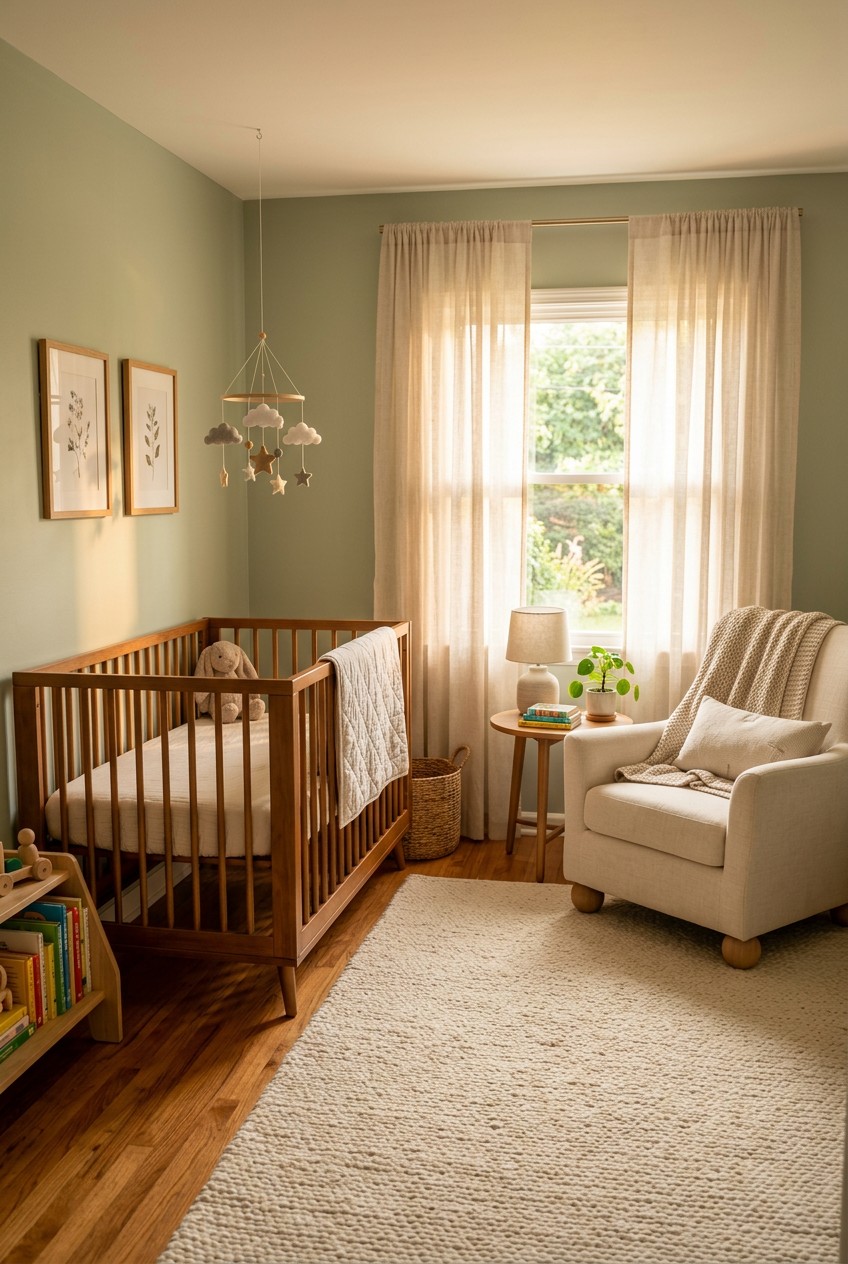
What’s Inside
- Prioritize a Certified Safe Crib Mattress for Optimal Sleep
- Choose Zero-VOC Paint for a Healthier Environment
- Design an Ergonomic and Safe Changing Station
- Implement Layered and Dimmable Lighting
- Maximize Storage with Multi-Functional Furniture and Vertical Solutions
- Choose the Right-Sized Rug for Comfort and Safety
- Baby Boy Nursery Room Design Needs Blackout Curtains
- Create a Sensory-Rich Reading Nook
- Install a Ceiling Fan for Airflow Safety
- Pick a Glider That Actually Supports Your Neck
- Essential Baby Boy Nursery Room Design Wall Anchors
- Skip the Changing Table and Use a Real Dresser
- Use Floating Shelves for Decor Out of Reach
- Bring in Low-Maintenance Real Plants
- Set Up a Sneaky Laundry System
Last Tuesday at Whole Foods, a pregnant mom in the produce aisle asked how I survived setting up my first son’s room. I laughed right next to the organic apples. My first attempt at a nursery ended with me sobbing on a cheap, scratchy rug at 2 AM, surrounded by unassembled particle board that smelled like a chemical factory. I’m Lauren. I’ve made every rookie mistake possible so you don’t have to. Trust me.
Creating a space for your baby isn’t just about picking cute animal prints. It’s about surviving 3 AM feedings without stubbing your toe and keeping the air clean so your little one sleeps. Skip the trendy, overpriced catalogs. They look pretty but function like a broken umbrella. Let’s get into the messy, realistic details of putting together a room that works.
1. Prioritize a Certified Safe Crib Mattress for Optimal Sleep

Most parents spend weeks picking a crib and ignore the mattress. I got this wrong for months. Back in 2018, I bought a squishy, cheap mattress from a discount store. It smelled like a hot tire shop; my son woke up sweating every two hours. You need a dual-sided, firm crib mattress that’s GREENGUARD Gold certified. The American Academy of Pediatrics says a firm surface is non-negotiable.
I swear by the Newton Waterproof Crib Mattress. It costs $299, but it’s washable. If you want organic materials, the Naturepedic Organic Breathable Ultra Innerspring Crib Mattress runs $299 and is fantastic. For a luxury hybrid, the Saatva Crib Mattress is $345. A standard crib mattress measures exactly 28 by 52 inches. Make sure it fits tightly. If you can’t fit more than two fingers between the mattress and the frame, you’re good. When my son leaked through his diaper, I’d take off the Newton cover and wash it with 1/2 cup of unscented detergent and 4 oz of white vinegar. It works every time.
2. Choose Zero-VOC Paint for a Healthier Environment

Don’t just grab whatever blue paint is on sale. I made this mistake in my oldest son’s room. I bought a generic brand, and the chemical smell gave me a headache that throbbed for three days. You’re exposing your baby’s lungs to harmful off-gassing if you skip zero-VOC paint. VOC stands for Volatile Organic Compounds. You don’t want them near a crib.
My favorite budget option is Behr Pro i300 from Home Depot. It costs $25.98 per gallon, offers great coverage, and has zero VOCs. If you want designer colors, Clare Paint is $69 per gallon and delivers to your door. ECOS Paints and Benjamin Moore Eco Spec are also incredible. Before painting, clean the walls. I mix 2 tablespoons of mild dish soap into 1 gallon of warm water and scrub the drywall with a rough sponge. It removes dust so the paint sticks. A 100 square foot nursery usually requires 2 gallons for two coats. Don’t skip the second coat. It looks streaky and terrible if you do.
3. Design an Ergonomic and Safe Changing Station

You’ll change roughly 2,500 diapers in the first year. If your changing table is the wrong height, your lower back will feel like it’s on fire. I learned that the hard way. I spent six months hunched over a 32-inch high table in a cramped apartment. I had to visit a chiropractor twice a week. The ideal changing table height ranges from 36 to 43 inches.
If you’re under 5 feet 4 inches, aim for 36 to 38 inches. If you’re taller, push for 40 to 43 inches. I recommend buying a sturdy dresser instead of a dedicated table. You need a dresser with a depth of at least 20 inches to fit a standard changing pad, which is typically 32 inches long by 16 inches wide. I bought a solid wood dresser from Costco for $399; it fits perfectly. To clean the pad after a blowout, I use a spray bottle with 1 cup of water and 1/4 cup of rubbing alcohol. It sanitizes instantly.

JolyWell Night Light for Kids
If you want something that just works, JolyWell Night Light for Kids is a safe bet (51 reviews, 4.5 stars).
4. Implement Layered and Dimmable Lighting

Overhead lighting is the enemy of a sleepy baby. Most people rely on the standard ceiling light. I used to flip on the main switch at 3 AM, and the blinding light would wake my baby for two hours. You need layered lighting. Install a dimmer switch for the main light. You can buy a basic Lutron dimmer at Lowe’s for $19.98. It takes ten minutes to install if you turn off the breaker first.
Next, use task lighting. I bought a heavy ceramic table lamp from Target for $25. I placed it on the dresser, out of reach. Use a warm, 40-watt equivalent LED bulb. Expert advice suggests diffused lighting. Spotlights directed downwards disturb a baby’s vision. I keep a tiny nightlight near the floorboards. I wipe the lamp base weekly with a cloth dampened with 2 oz of water and 1 teaspoon of lemon juice to cut through the nursery dust. You might also like: 20 Stunning Layout Small Nursery Ideas That Are Totally Worth It
5. Maximize Storage with Multi-Functional Furniture and Vertical Solutions

Babies are tiny, but they require a massive amount of stuff. Overcrowding the nursery is a common mistake. I used to trip over a giant stuffed elephant every night because I didn’t use vertical space. Combat clutter by choosing furniture that serves dual purposes, like a crib with drawers underneath. You might also like: 15 Beautiful Baby Room Organization Ideas You Haven’t Thought Of
I love the floating shelves from Pottery Barn Kids. They cost $49 each, but the brackets are hidden and they hold up to 20 pounds of books. I also use small fabric baskets from Sprouts Farmers Market. They cost $9.99 each and are perfect for tiny socks and burp cloths. I hang these on hooks near the door. To keep the baskets smelling fresh, I mix 1/2 cup of baking soda with 5 drops of lavender oil, sprinkle it inside, let it sit for an hour, and vacuum it out. It neutralizes that stale milk smell. You might also like: 15 Clever Neutral Small Nursery Ideas for Every Budget
6. Choose the Right-Sized Rug for Comfort and Safety

A bare wooden floor is loud, cold, and terrible for crawling. But buying the wrong rug is just as bad. I bought a fluffy white shag rug from Walmart for my first nursery. It was a disaster. Within a week, it was covered in spit-up, and the long fibers trapped every piece of dirt. For a standard 100 to 120 square foot nursery, a 4 by 6 feet rug is usually ideal. It provides coverage under the crib and chair without overwhelming the room.
If you have a larger room, an 8 by 10 feet rug is better. I recommend a washable rug. Ruggable makes options starting at $159 for a 5 by 7 feet size. They’re thin, but you can buy a cushioned pad. When my kid drops a bottle, I don’t panic. I mix 1/4 cup of warm water with 1 tablespoon of white vinegar, blot the stain, and throw the cover into the washing machine. It comes out looking brand new.

Beautiful Wooden Baby Closet Dividers Set of 7
If you want something that just works, Beautiful Wooden Baby Closet Dividers Set of 7 – Double-Sided Organize is a safe bet (11 reviews, 4.5 stars).
7. Baby Boy Nursery Room Design Needs Blackout Curtains

If you want your baby to sleep past 5 AM, you need darkness. Summer nights with the sun up until 9 PM will ruin your child’s schedule if you have sheer blinds. A proper nursery design must include heavy-duty blackout curtains. I once tried taping garbage bags to the windows. It looked terrible and barely worked.
You don’t have to spend a fortune. The Eclipse brand blackout curtains at Walmart cost $14.96 per panel. They’re thick and block 99 percent of light. Hang the rod at least 4 inches above the window frame and let the panels extend 2 inches past the sides to prevent light leaks. To get wrinkles out of polyester panels, I mix 1 cup of water with 1 teaspoon of fabric softener. I mist the curtains and let them hang dry. The wrinkles fall right out, and it smells amazing.
8. Create a Sensory-Rich Reading Nook

Reading is crucial, but sitting on a hard floor is miserable. I spent months reading Goodnight Moon while sitting cross-legged on hardwood; my knees ached every time. You need a dedicated reading nook. It doesn’t take much space, but it changes the feel of the room.
I use two wooden crates from Sprouts Farmers Market, which cost $12.99 each. I sanded them and stacked them on their sides to hold books. Next to the crates, I put a thick floor cushion. I bought a set of three 12 by 12 inch velvet pillows from Target for $20. The textures are great for sensory development. The velvet feels soft, while the rough wood provides a contrast. To keep the crates looking nice, I rub them down once a month with 2 tablespoons of mineral oil on a microfiber cloth. It brings out the grain and keeps the surface smooth.
9. Install a Ceiling Fan for Airflow Safety

Stagnant air in a nursery is a problem. Before I installed a fan, the room smelled like dirty diapers by morning. More importantly, the American Academy of Pediatrics notes that a fan can reduce the risk of SIDS by circulating air. You need moving air.
I bought a low-profile Hunter 44-inch ceiling fan from Home Depot for $119. It’s silent on the lowest setting, providing a breeze without making the baby cold. Set the fan to rotate counter-clockwise in the summer and clockwise in the winter. Fans get dusty, and you don’t want that raining down into the crib. Every two weeks, I use a pillowcase sprayed with 2 oz of water and 1 tablespoon of all-purpose cleaner. I slide the pillowcase over the blade and wipe it off. The dust stays trapped inside the fabric.

Hotmoon Sound Machine Baby Night Light
If you want something that just works, Hotmoon Sound Machine Baby Night Light is a safe bet (194 reviews, 4.5 stars).
10. Pick a Glider That Actually Supports Your Neck

You’ll spend hundreds of hours in the nursery chair. Don’t buy a stiff, wooden rocker because it looks cute on Pinterest. I did this. I bought a vintage rocker, and after three nights of nursing, I had neck cramps and a bruised tailbone. You need a plush glider with a high back that supports your head when you fall asleep sitting up.
I recommend the Delta Children glider from Costco. It costs $299 and features a 38-inch back height, which is tall enough to rest your head. The armrests are padded, which is essential for supporting your arms while holding a baby. The fabric is a soft microfiber that feels like a worn-in t-shirt. Babies spit up constantly, so the chair will get dirty. I clean mine by mixing 1/2 cup of warm water with 1 tablespoon of Dawn dish soap. I whip it into a foam, apply just the foam to the stain, and wipe it away with a dry towel. It dries in ten minutes.
11. Essential Baby Boy Nursery Room Design Wall Anchors

This is the most critical step parents skip because they’re tired. A beautiful nursery design means nothing if the furniture isn’t safe. Last year, I watched my toddler try to climb his dresser by pulling out the drawers. My heart stopped. If I hadn’t anchored that dresser, it would have crushed him.
You must anchor every piece of furniture taller than 30 inches. I use Safety 1st furniture wall straps. A pack of two costs $5.49 at Target. They’re made of heavy-duty nylon and screw into the wall studs. Don’t use drywall anchors for heavy dressers; they won’t hold. You need a stud finder and a drill. To patch the holes later, I mix 1 tablespoon of spackle with 1/4 teaspoon of water, press it into the hole, and sand it flat. It’s extra work that guarantees your child’s safety.
12. Skip the Changing Table and Use a Real Dresser

Dedicated changing tables are a waste of money. They have open shelves that look messy, and once your kid is potty trained, the table is useless. I had a traditional table for my first baby; it quickly became a laundry dump. Instead, buy a wide dresser.
The IKEA Hemnes 8-drawer dresser is the holy grail. It costs $299, is made of solid pine, and is 63 inches wide. This gives you room for a changing pad, plus space for a wipe warmer and a lamp. The closed drawers hide the mess. To keep drawers organized, I use small plastic storage bins from Kroger that cost $3.99 each. I sort onesies by size and roll them. To keep the dresser top from getting scratched, I cut a piece of non-slip rug pad 30 inches by 14 inches and place it underneath. It stops the pad from sliding and protects the finish.

Criusia Over the Door Organizer
Criusia Over the Door Organizer has been one of the most consistently praised picks in this category. 208 reviewers averaged 4.5/5.
13. Use Floating Shelves for Decor Out of Reach

When your baby starts standing, anything within arm’s reach gets pulled down and chewed on. I learned this when my son grabbed a heavy wooden frame and nearly smashed it on his head. Keep all framed art and heavy toys high up on the walls.
I buy Threshold floating shelves from Target. They cost $15 each and are 16 inches long. I mount them at least 60 inches off the floor. This is where I put the fragile piggy bank and the monitor camera. Make sure the shelves are level. To dust these high shelves without a mess, I mix 1 cup of water, 1/4 cup of vinegar, and 1 tablespoon of olive oil in a spray bottle. I mist a microfiber cloth and wipe the wood. The oil conditions the shelf, and the vinegar cuts the dust, leaving a streak-free surface.
14. Bring in Low-Maintenance Real Plants

Fake plastic plants collect dust and look tacky. Real plants improve air quality and add a pop of green. However, you don’t want a high-maintenance plant. I killed an expensive fiddle leaf fig tree because I was too sleep-deprived to water it. Its dry, brown leaves crunched all over the floor. No exaggeration.
Instead, buy a snake plant. I bought a healthy one in a 6-inch pot from Whole Foods for $14.99. Snake plants are indestructible and thrive in low light. They also release oxygen at night, which is perfect for a sleeping environment. Place the plant on a high shelf so the baby can’t dig in the dirt. To keep it healthy, I water it with 4 oz of tap water every three weeks. I also wipe the leaves once a month with a damp cloth soaked in 2 tablespoons of water and 1 drop of dish soap to remove dust.
15. Set Up a Sneaky Laundry System

Babies generate an ungodly amount of laundry. If you have one open basket, the room will smell like sour milk and poop. I used to stare at mountains of onesies covered in blowout stains and feel overwhelmed. You need a closed, two-hamper system in the closet.
I bought a tall, woven hamper with a lid from Target for $45. Inside, I use two large, reusable canvas bags from Trader Joe’s that cost $0.99 each. I use one bag for regular clothes and the second for soiled items. This saves me from digging through the hamper later. When it’s time to wash, I grab the handles and carry them to the laundry room. For the soiled bag, I soak the clothes in a bucket with 1 gallon of hot water and 1/2 cup of oxygen bleach for four hours before washing. It strips out the stains and the smell. Skip the cheap plastic hampers. They smell like wet cardboard after a week.
Designing a nursery doesn’t have to be a stressful, tear-filled process. By focusing on safe materials, ergonomic furniture, and practical storage, you’re building a room that supports your daily life as a parent. I’ve learned the prettiest room in the world is useless if you can’t find a clean onesie at 4 AM. Take these measurements, grab the products I mentioned, and build a space that works for you. If you found these tips helpful, please save and pin this article so you can reference the measurements when you’re standing in the store!

Criusia Drawer Organizer Clothes
If you want something that just works, Criusia Drawer Organizer Clothes is a safe bet (1 reviews, 4.5 stars).
Frequently Asked Questions
What is the best height for a changing table in a baby boy nursery room design?
The ideal changing table height ranges from 36 to 43 inches. If you’re under 5’4″, aim for 36-38 inches. Taller parents should look for 40-43 inches to prevent severe back strain during frequent diaper changes.
What type of paint should I use for a baby boy nursery room design?
Always use zero-VOC paint to prevent harmful chemical off-gassing. Brands like Behr Pro i300, Clare Paint, and ECOS Paints offer excellent coverage without exposing your baby’s developing lungs to dangerous toxins.
How big should the rug be in a standard nursery?
For a standard 100 to 120 square foot nursery, a 4×6 foot rug is perfect. It provides enough soft coverage under the crib and glider without completely overwhelming the small space. Washable rugs are highly recommended.
Are blackout curtains necessary for a baby boy nursery room design?
Yes, heavy-duty blackout curtains are essential for maintaining your baby’s sleep schedule, especially during summer months. Hang the curtain rod 4 inches above the window frame to block out 99 percent of the light.
