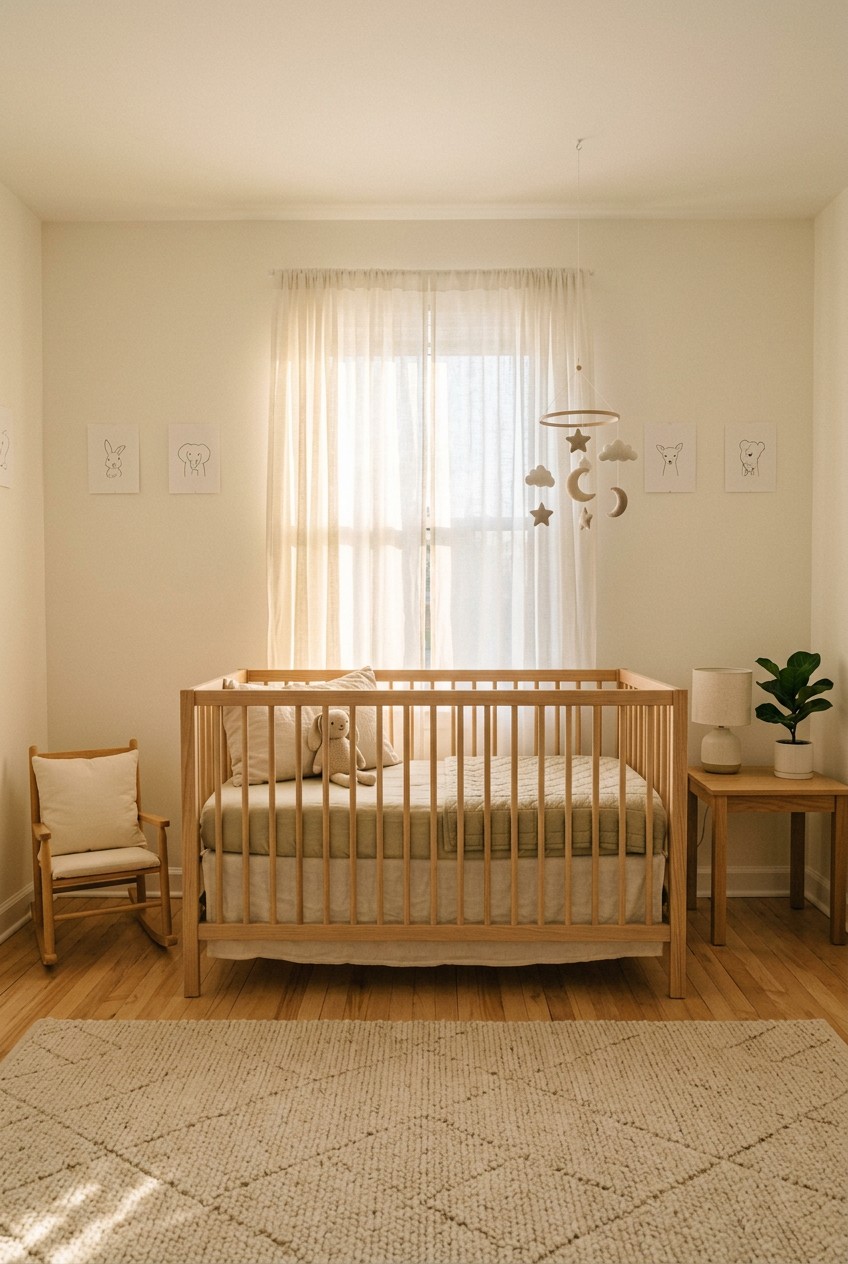
What’s Inside
- Embrace Earthbound Neutrals for a Calming Foundation
- Prioritize Biophilic Design with Natural Materials
- Invest in Multifunctional, Convertible Furniture
- Layer Lighting with Dimmers for Optimal Ambiance
- Select the Right Rug Size for Comfort
- Anchor All Furniture to the Wall Immediately
- Choose a High-Quality, Ergonomic Glider
- Opt for Cordless Window Treatments
- Incorporate a Curated Vintage Touch
- Embrace Color as the Primary Theme
- Avoid Over-Theming and Overstimulation
- Focus on Sensory Textures Instead of Clutter
- Build Highly Functional, Accessible Storage
- Use High-Quality Wall Decals Over Wallpaper
- Install Serious Blackout Solutions
- Improve Air Quality with Safe Plant Life
I spent three months staring at a terrifyingly bright lime-green wall in my first apartment back in 2018, convinced I was creating the ultimate jungle oasis. It turns out, when you’re exploring baby nursery themes, painting an entire room the color of a radioactive glow stick is a massive mistake. The glare gave me a headache every time I walked in, and my newborn daughter screamed whenever the afternoon sun hit that toxic green paint. I ended up crying on the floor with a half-eaten 5 oz bag of Trader Joe’s white cheddar popcorn, desperately taping up black trash bags to block the light. Don’t do that. Learned that the hard way. I’ve learned a lot since then. As a nursery design consultant, I’ve seen exactly what works and what fails miserably. Let’s walk through 16 charming baby nursery themes and design strategies that actually make sense for real life.
1. Embrace Earthbound Neutrals for a Calming Foundation

I’m officially begging you to step away from the neon paint swatches. When you’re researching the best baby nursery themes, you’ve got to prioritize warm, grounded palettes. I tried the stark white minimalist thing once in my own home. It felt exactly like a sterile hospital room, and every single speck of dust showed up like a beacon under the sunlight. You want a color that hides minor scuffs and feels like a warm hug when you walk in. I highly recommend Sherwin-Williams’ 2026 Color of the Year, “Universal Khaki.” It’s a gorgeous warm beige with a subtle green undertone. A gallon of their Emerald interior acrylic latex paint costs about $85.99. You’ll usually need two gallons for a standard 10×12 room. I always buy the eggshell finish because flat paint is impossible to scrub when sticky fingers touch it. If you prefer green, Valspar’s “Warm Eucalyptus” is a soft, muted shade that instantly lowers my blood pressure. These earthy colors promote real relaxation and better sleep for both you and your baby. Skip the harsh primary colors completely. They’re visually exhausting when you’re functioning on two hours of sleep and trying to locate a dropped pacifier at 3 AM.
2. Prioritize Biophilic Design with Natural Materials

Bringing the outdoors inside isn’t just a crunchy mom trend. It’s called biophilic design, and it actually works to soothe a fussy baby. I used to buy cheap plastic organizers from Walmart because they were $4.99, but they cracked within weeks and smelled vaguely of industrial chemicals. Now, I’m obsessed with natural textures like wood, rattan, bamboo, and jute. They add incredible warmth and give your baby safe, interesting surfaces to touch as they grow. For the main piece, I love the Petite Amelie “Branch 4-in-1 Convertible Crib in Acacia with Snow.” It runs exactly $399.00 and features this beautiful light wood that doesn’t look heavy or outdated. Pair that crib with a 5×7 foot woven jute rug. The scratchy, organic texture feels amazing under bare feet during late-night pacing sessions. I usually grab a 3-pack of natural water hyacinth storage baskets from Target for $35.00 to hold swaddles and burp cloths. The natural, earthy smell of the woven fibers is so much better than plastic off-gassing in a small room. Trust me on this.
3. Invest in Multifunctional, Convertible Furniture

Most people get this wrong. They buy a tiny, adorable bassinet for $200 that the baby outgrows in exactly eight weeks. I’ve made this exact mistake. I bought a gorgeous, flimsy wicker bassinet that my son instantly hated. He kept hitting his hands on the narrow sides and waking himself up. You’re much better off spending your budget on pieces that grow with your child. Look at the Cameo Oval 4-in-1 Convertible Crib in Steam. It costs $549.00, but it transitions from a crib to a toddler bed, and eventually to a daybed. That’s years of use instead of months. The same rule applies to your changing table. Don’t buy a standalone changing table with open shelves. It just becomes a dusty dumping ground for half-empty 4 oz tubes of diaper cream. Get a solid dresser with deep drawers instead. I use the IKEA Hemnes 8-drawer dresser ($299.00) and secure a $30.00 Munchkin contoured changing pad to the top. When your kid is potty trained, you just remove the pad, and you’ve got a normal, functional dresser.

Modanais Baby Diaper Caddy Organizer Cart
If you want something that just works, Modanais Baby Diaper Caddy Organizer Cart – 3 Tier Rolling Cart with D is a safe bet (613 reviews, 4.5 stars).
4. Layer Lighting with Dimmers for Optimal Ambiance

I’m still traumatized by the blinding overhead light in my sister’s nursery. Flipping that switch at 2 AM was like staring directly into the sun. Layered lighting is essential for modern baby nursery themes. You need options. Start with a soft ceiling pendant that has a frosted glass diffuser, so the raw bulb isn’t exposed. Then, add a task lamp near your nursing chair. I use a simple brass floor lamp from Target ($45.00) with a 40-watt warm white bulb. But the absolute holy grail is a dimmable LED night light. I personally swear by the VAVA baby night light. It’s exactly $24.99 on Amazon. It emits a warm, soft glow that doesn’t mess with melatonin production the way harsh blue light does. You just tap the smooth plastic top to turn it on, which is a lifesaver when you’re holding a sleeping baby in one arm and a 4 oz bottle of formula in the other. If you don’t install a dimmer switch for your main overhead light, you’re doing it wrong.
5. Select the Right Rug Size for Comfort

A tiny 3×5 rug floating in the middle of a room looks ridiculous. I did this in my first house, and I kept tripping over the curled edges while carrying heavy baskets of laundry. A rug is a crucial soft surface for your baby’s motor development, like tummy time and crawling. For a medium nursery (around 100 square feet), you need at least a 5×7 foot rug (160×230 cm). It needs to sit securely under the front legs of the crib and the glider to anchor the space. If you have a larger room, size up to an 8×10 foot rug so your baby has a massive, padded play area. I always recommend Ruggable’s Kamran Hazel Rug. The 5×7 size is $169.00. It’s machine washable, which is non-negotiable because babies spit up constantly. Just last week, I spilled an entire 12 oz cup of iced coffee from Whole Foods all over my client’s nursery rug. We just peeled off the top layer and threw it in the wash. Always add a 0.25-inch felt non-slip rug pad ($45.00) underneath so you won’t slide around on hardwood floors. You might also like: 20 Brilliant Baby Nursery Themes Ideas You Can Try Today
6. Anchor All Furniture to the Wall Immediately

I can’t stress this enough. Safety isn’t just a suggestion. Pediatrician Dr. Deena Blanchard constantly warns parents about furniture tip-overs. I once watched my toddler try to scale a lightweight bookshelf like a ladder, and my heart completely stopped. The whole thing wobbled violently. Thankfully, I had secured it the weekend before. You must anchor every single dresser, bookshelf, and heavy item to the wall studs. The Juvenile Products Manufacturers Association strongly recommends this. You can buy a 6-pack of Safety 1st Furniture Wall Straps for $9.99 at any hardware store. They are heavy-duty nylon straps that take maybe ten minutes to install with a standard drill and a 1/8 inch drill bit. Do not rely on cheap drywall anchors for heavy wooden dressers; you need to hit the wooden stud. I’ve seen parents skip this step because they don’t want to put holes in their expensive paint job. Trust me, a tiny screw hole is nothing compared to a collapsed dresser. Secure everything before your baby even learns to roll over. You might also like: 20 Cozy Gender Neutral Baby Nursery Decor Ideas for Any Style

DIMJ Drawer Organizer Clothes, 12 Pack Dresser Organizer
If you want something that just works, DIMJ Drawer Organizer Clothes is a safe bet (13 reviews, 4.5 stars).
7. Choose a High-Quality, Ergonomic Glider

You’re going to spend hundreds of hours in this chair. I bought a cheap, rigid wooden rocking chair for my first baby because it looked cute on Pinterest. My back was destroyed within a week. The wood creaked loudly every time I moved, and I ended up crying in the middle of the night, stuffing flat pillows behind my lumbar spine just to survive a feeding. You need a comfortable, ergonomic glider. If you have the budget, the Nurture& The Glider Plus is incredible. It’s $1,299.00, but it features a smooth power recline, adjustable head support, and a built-in USB charger. If you’re watching your budget, the DaVinci Gabby Pillowback Swivel Glider is a fantastic alternative for $349.00. It has a high back so you can actually rest your head, and it swivels silently. Another great option is the Monte Grano Glider Recliner. They offer performance fabrics that repel liquids. When you inevitably drop a 2-ounce bottle of sticky liquid vitamin D on the armrest, you’ll be so glad you chose a stain-resistant fabric instead of standard cotton. You might also like: 15 Cozy Baby Nursery Decor Ideas for Any Style
8. Opt for Cordless Window Treatments

Window cords are a massive strangulation hazard. I refuse to design a nursery that uses traditional corded blinds. When I was consulting for a family last year, I noticed their cat getting tangled in the old plastic blind cords, which immediately made me picture a toddler doing the exact same thing. Rip them out. Go to Home Depot and buy their Home Decorators Collection Cordless Cellular Shades. They cost about $45.98 for a standard 35×64 inch window. You just push the bottom rail up or pull it down with one hand. They slide smoothly and silently. Also, you must position the crib far away from the windows. Drafts can make your baby freeze, and you don’t want them reaching out and grabbing the window sill once they can stand. Keep the crib away from baseboard heaters and don’t hang heavy framed art directly over where the baby sleeps. I use lightweight canvas prints instead, just in case of an earthquake or a poorly placed nail coming loose.
9. Incorporate a Curated Vintage Touch

Buying an entire matching furniture set out of a catalog looks incredibly boring. I call it the showroom trap. Your nursery should have some actual soul. The best rooms feature a curated vintage aesthetic. You don’t need a house full of delicate antiques. Just add one or two intentional vintage pieces. I found a gorgeous, solid oak toy chest at a flea market for $65.00. I sanded it down, rubbed in 2 tablespoons of natural beeswax wood polish, and the rich smell of the wax completely warmed up the room. You could also look for a vintage brass table lamp or a unique handcrafted mirror. I usually stop by local thrift stores after my weekly grocery run at Kroger. You’d be amazed at the heavy, quality wood pieces you can find for under $50. No exaggeration. Mixing old and new gives the space a lived-in, collected feel that you simply can’t buy in a single click online. It makes the room feel like a real part of your home instead of a staged set.

JolyWell Night Light for Kids
A dependable everyday pick — JolyWell Night Light for Kids pulls in 63 ratings at 4.5 stars. Not flashy, just solid.
10. Embrace Color as the Primary Theme

Forget the standard elephant or nautical motifs. A huge trend right now is using color itself as the entire theme. It’s called color drenching. You paint the walls, the baseboards, the trim, and sometimes even the ceiling in one single, saturated shade. I was terrified to try this at first. I thought painting the ceiling would make the room feel like a tiny cave. But I tried it with a soft buttercup yellow in a client’s north-facing nursery, and it created instant cheerfulness. The room literally glowed. If you want a moody, luxurious vibe, try a deep forest green. Benjamin Moore’s “Hunter Green” is stunning. A gallon of their Aura interior paint is $98.99. When you drench the room in a rich color, you don’t need a million tiny pieces of wall decor. The bold color does all the heavy lifting visually. Just balance it with light wood furniture and a simple neutral rug so it doesn’t feel oppressive or heavy. It’s a bold choice that pays off massively.
11. Avoid Over-Theming and Overstimulation

Please don’t turn your nursery into a tacky theme park. I’ve seen rooms where every single surface has a cartoon monkey printed on it: the sheets, the curtains, the rug, the lamp shade. It’s visually exhausting and highly overstimulating for a baby trying to wind down for a nap. If you love a forest theme, focus on subtle integration. I love the Roxy Marj Woodland quilt from Crate & Kids ($89.00). It has a beautiful, artistic animal print. Put that over the side of the glider, and then keep the rest of the room calm. Use a solid sage green sheet and a simple wooden mobile. You don’t need a giant plastic tree bolted to the wall. I once bought a wildly loud, brightly colored geometric rug for my son’s room, and I swear it made him hyperactive before bed. I swapped it for a solid cream rug, and the whole energy of the room shifted immediately. Keep the patterns restrained and intentional.
12. Focus on Sensory Textures Instead of Clutter

Instead of buying twenty cheap plastic knick-knacks to fill up empty shelf space, focus on high-quality sensory textures. Babies learn by touching everything. I like to layer different fabrics that feel interesting. Toss a chunky knit boucle pillow ($35.00 from Target) on the glider. Use 100% organic cotton muslin crib sheets. I love the ones from Mushie; they’re $32.99 and get softer every time you wash them. Hang a thick, woven macrame wall hanging instead of a flat paper poster. I snagged a beautiful handmade cotton macrame piece from a local artisan market for $55.00. Even the curtains can add texture. Heavy velvet blackout curtains feel incredibly luxurious and absorb sound, which helps keep the room quiet when the dog starts barking at the mailman. When I was pregnant, I’d walk through the aisles at Sprouts just feeling the woven produce baskets, realizing how much nicer natural textures feel compared to slick plastic. Bring those rich tactile elements into the nursery for a better vibe. Took me years to figure out.

Parker Baby Diaper Caddy
Parker Baby Diaper Caddy – Nursery Storage Bin and Car Organizer for D punches above its price — 17 buyers rated it 4.5 stars. I would buy it again.
13. Build Highly Functional, Accessible Storage

You’re going to accumulate a shocking amount of stuff. Tiny socks, burp cloths, swaddles, pacifiers, breast pump parts. If you don’t have a rigid system, your nursery will look like a disaster zone in 48 hours. I tried using cute little canvas bins on open shelves, but they just flopped over and looked messy. You need rigid, accessible storage. The IKEA Trofast system is legendary for a reason. You can get a solid pine frame with six sliding plastic bins for $89.99. The bins slide out with a satisfying click, making it perfect for sorting toys, extra wipes, and random baby gear. For the closet, I highly recommend buying a pack of velvet baby hangers. A 50-pack from Amazon is $19.99. The velvet texture stops those tiny, slippery onesies from falling onto the floor. I also use clear acrylic drawer dividers ($15.99 for a set of 4) inside the dresser to separate the 0-3 month clothes from the 3-6 month clothes. Don’t mix the sizes. You’ll end up crying while trying to jam a newborn leg into a preemie sleeper at midnight.
14. Use High-Quality Wall Decals Over Wallpaper

I love the look of expensive wallpaper, but I absolutely hate installing it. I spent six hours trying to line up a floral wallpaper pattern in my guest room, ended up with massive sticky air bubbles, and had a total meltdown. Plus, traditional wallpaper is a nightmare to remove when your kid decides they hate dinosaurs three years from now. Stick to high-quality, peel-and-stick wall decals. Project Nursery sells gorgeous, oversized watercolor floral decals for $45.00 a pack. You just peel them off the backing and smooth them onto the wall. If you mess up the placement, you can literally peel it off and try again. It takes twenty minutes. I once decorated a massive 12-foot wall using just three packs of birch tree decals ($135.00 total). It looked custom-painted, and when the family moved two years later, they peeled them right off without losing their security deposit. It’s the smartest design hack I know for getting a custom look without the tears.
15. Install Serious Blackout Solutions

If your nursery isn’t pitch black during the day, your baby won’t take long naps. I learned this the hard way. I bought these flimsy, sheer linen curtains because they looked light and airy in the store window. My baby woke up at 5:15 AM every single morning when the sun rose. I was a walking zombie. You need absolute darkness. I recommend the Sleepout Portable Blackout Curtain. It’s $109.00 and uses industrial suction cups to stick directly to the window glass, blocking 100% of the light. There are no gaps around the edges. If you prefer traditional curtains, buy actual heavy-duty blackout panels and install the curtain rod at least 6 inches above the window frame, extending 8 inches past the sides. This minimizes the light bleed on the edges. I grabbed a pair of Eclipse absolute zero blackout curtains from Walmart for $34.98, and they work brilliantly. Don’t compromise on this. Sleep is your most valuable resource, and daylight is the enemy of a sleeping newborn.

Blissful Diary Floral Diaper Caddy Organizer
Blissful Diary Floral Diaper Caddy Organizer has been one of the most consistently praised picks in this category. 319 reviewers averaged 4.5/5.
16. Improve Air Quality with Safe Plant Life

Nurseries can get stuffy quickly. Between the diaper pail and the piles of laundry, the air gets stale fast. I strongly advocate for adding a high-quality air purifier and some safe, real plants. I use the Levoit Core 300 True HEPA Air Purifier. It costs $99.99 and is incredibly quiet on the sleep setting. It just hums softly while filtering out dust, pollen, and weird odors. I also love adding a real Snake Plant (Sansevieria) to a high shelf where the baby can’t reach it. A medium-sized one from Costco is usually around $24.99. Snake plants are amazing because they release oxygen at night, improving the air quality while your baby sleeps. Just make sure you check the ASPCA toxic plant list if you have pets. I once bought a beautiful Monstera plant, only to realize it was highly toxic to cats. I had to give it to my neighbor the next day. Stick to safe options like spider plants or Boston ferns, and keep the air circulating constantly.
Designing a nursery shouldn’t make you want to pull your hair out. I’ve made all the expensive, exhausting mistakes so you don’t have to. Whether you’re painting the walls a moody green or just upgrading to a decent glider, focus on what makes the room calm and functional for you. If you’re comfortable, your baby will be comfortable. Save this list, pin your favorite ideas, and tackle one project at a time. You’ve got this.
Frequently Asked Questions
What are the most popular colors for nurseries right now?
Earthy neutrals and muted greens are incredibly popular. Colors like warm khaki, soft sage, and cocoa brown create a calming environment that won’t overstimulate your baby before sleep.
How big should a nursery rug be?
For a standard room, you need at least a 5×7 foot rug. It should anchor the front legs of the crib and your glider. A tiny rug just floats in the room and becomes a tripping hazard.
Are convertible cribs worth the money?
Yes, they absolutely are. A convertible crib transitions into a toddler bed and eventually a daybed. You’re getting years of use out of one piece of furniture instead of replacing a bassinet after two months.
How can I make the nursery safer?
You must anchor all heavy dressers and bookshelves to the wall studs using anti-tip nylon straps. Also, always use cordless window blinds to eliminate strangulation hazards near the crib.
4 thoughts on “16 Baby Nursery Themes That Actually Work”