What’s Inside
- Prioritize GREENGUARD Gold Certified Baby Boy Nursery Wallpaper
- Muted Tones Over Primary Colors
- Peel-and-Stick Is Your Best Friend
- High-Contrast Geometrics for Newborn Eyes
- Botanical Prints That Grow With Them
- The 15 Percent Extra Rule
- Prepping the Wall Perfectly
- The Single Accent Wall Strategy
- Educational World Maps
- Wallpapering the Ceiling
- The 8-Week Off-Gassing Window
- Scrubbable Vinyl for the Win
- Repurposing Leftover Scraps
- The Plumb Line Secret for Straight Seams
- Custom-Sized Murals
- Subtle Houndstooth for a Heritage Look
- Warm Neutrals Are the New Blue
- Avoiding Flat Paint Disasters
- Framing Samples as Art
- Earthy Textures for Baby Boy Nursery Wallpaper
I sat on the floor of my son’s half-finished room last Tuesday, peeling sticky blue paper out of my hair. Finding the perfect baby boy nursery wallpaper is supposed to be fun and magical. Instead, I was crying over a ruined roll of $45.99 NuWallpaper while stress-eating a bag of crushed pretzels I bought at Target. It’s a mess. I tried to hang it by myself without a level. Huge mistake. The paper kept folding in on itself, and the adhesive smelled like chemical glue. After three hours of wrestling, I ripped the whole thing down. I’ve spent years as a nursery design consultant, and I still mess up. I’m here to save you from my meltdowns. Let’s talk about what actually works.
1. Prioritize GREENGUARD Gold Certified Baby Boy Nursery Wallpaper

When I started designing nurseries, I bought the cheapest rolls I could find online. Huge mistake. The chemical smell gave me a massive migraine for three days. You need GREENGUARD Gold Certified inks. It’s non-negotiable for indoor air quality. Brands like Spoonflower and Nestig use FSC-certified paper and breathable non-woven fibers. This means zero exposure to nasty VOCs and phthalates. Spoonflower charges exactly $109.00 for a 24-foot roll of their pre-pasted smooth paper. It’s worth every penny. I’ve ripped down so many cheap, toxic papers for clients. Skip the bargain bin stuff. It tastes like wet cardboard and smells like burnt plastic. If you’re putting a crib near a wall, that wall needs to be safe to breathe. I learned that the hard way after a panic attack over off-gassing in my own home. Trust me. Order the safe stuff.
2. Muted Tones Over Primary Colors

I’m seeing a shift away from bright fire-engine reds and aggressive royal blues. For 2026, we’re doing muted tones. Think warm neutrals, earthy textures, soft blues, and dusty sage greens. I recently designed a space using a subtle houndstooth pattern from Chasing Paper. It cost $45.00 per 2×4 foot panel. The room felt tailored and calm. Bright primary colors actually overstimulate babies. I tried a bright yellow accent wall once, and my client’s baby wouldn’t sleep for weeks. It’s exhausting. Designers like Maggie Richmond agree that illustrative styles feel more timeless. You don’t want a room tied to a cartoon character your kid will hate in two years. Go for soft, heritage patterns. I usually grab a $3.99 iced coffee from Whole Foods and spend hours scrolling through these muted swatch books. It’s my favorite part of the job.
3. Peel-and-Stick Is Your Best Friend

Let’s talk about the magic of peel-and-stick. If you’re renting, or you just have commitment issues like I do, removable paper is the way to go. You won’t damage the drywall when it’s time for a big kid room. Brands like NuWallpaper by WallPops and Wall Blush have incredible selections. A standard roll of Wall Blush goes for $69.00. I remember trying to install traditional paste wallpaper in my apartment back in 2018. I got thick, sticky glue in my eyebrows and ruined the carpet. Never again. Peel-and-stick is basically a giant sticker. You peel down 6 inches of the backing, stick it to the top of the wall, and smooth it down. It’s forgiving. If you mess up, you just pull it off and reposition it. I’ve done this dozens of times while snacking on a $4.49 bag of organic popcorn from Sprouts.

Beautiful Wooden Baby Closet Dividers Set of 7
Beautiful Wooden Baby Closet Dividers Set of 7 – Double-Sided Organize has been one of the most consistently praised picks in this category. 11 reviewers averaged 4.5/5.
4. High-Contrast Geometrics for Newborn Eyes

Babies aged 0 to 6 months have terrible vision. They see blurry blobs. If you want to stimulate their visual development, you need high-contrast patterns. Black and white geometrics are perfect. I put a bold, black-and-white triangle pattern from Spoonflower behind my nephew’s crib. The 24-inch by 9-foot roll cost $90.00. He would stare at it for twenty minutes straight. It’s fascinating to watch their eyes try to focus. I’ve seen parents use soft pastels for newborns, but the babies just ignore the walls. Don’t be afraid of bold shapes. Thick black stripes or large white stars on a dark background work wonders. I actually sketched out a geometric design on a $1.99 notepad from Walmart before ordering. It helps to visualize the scale. You want the shapes to be at least 4 inches wide.
5. Botanical Prints That Grow With Them

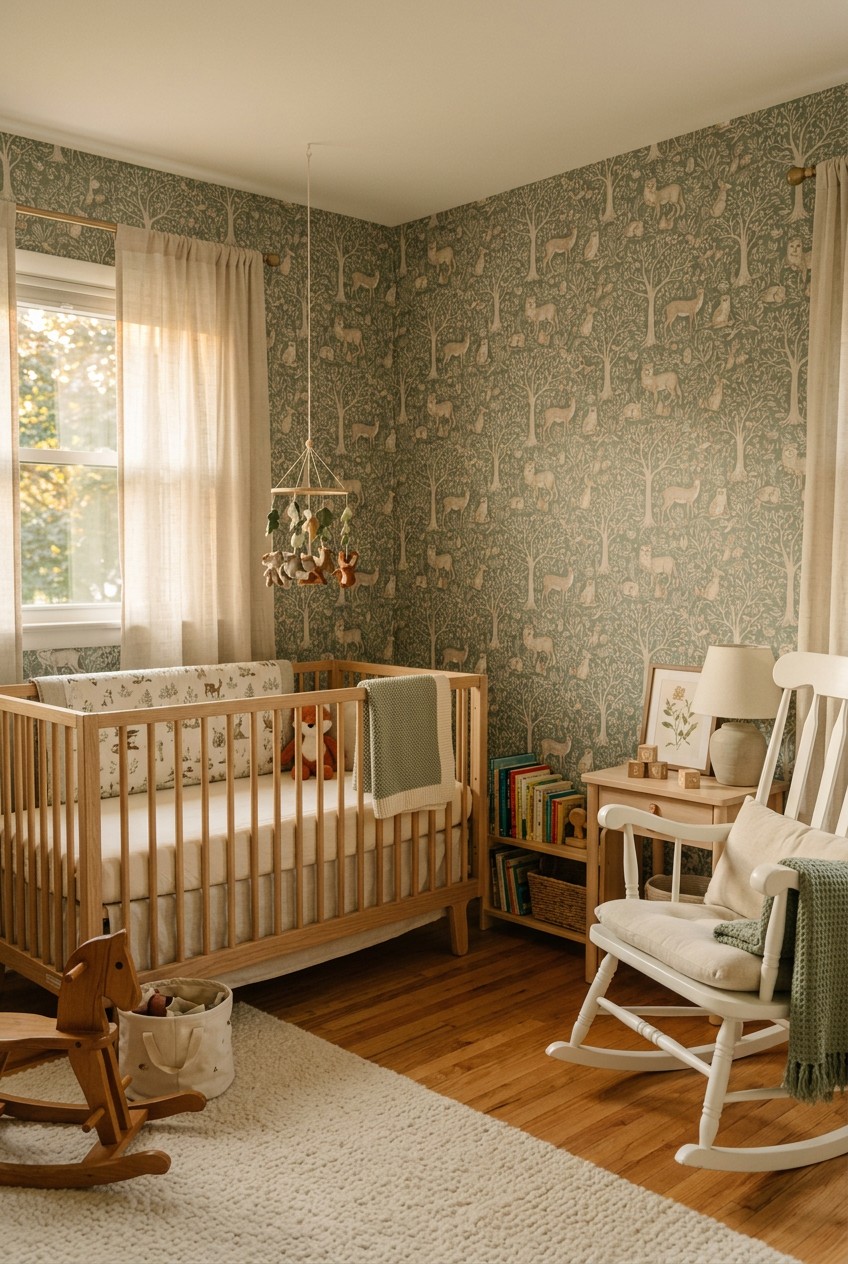
You don’t want to redo the walls every three years. It’s expensive and exhausting. That’s why I push for versatile designs that age well. Botanical prints, subtle woodland themes, and watercolor washes are fantastic. CostaCover makes a minimalist forest animal print I’m obsessed with. It costs $38.50 for a standard panel. The design features soft green ferns and tiny brown bears. It works for a newborn, but it won’t feel babyish when he’s six. I made the mistake of using a giant cartoon dinosaur mural for a client once. Three years later, the kid was terrified of dinosaurs, and we had to rip the whole thing down. Stick to nature themes. They have a grounding effect. I love pairing botanical walls with natural wood cribs. I picked up a $12.99 potted fern from Kroger last week just to match a client’s new leaf-patterned wall.
6. The 15 Percent Extra Rule

Here’s a pro tip that most people get wrong. You must order extra material. Calculate your total wall width, then add 15 percent. If you’re doing a mural, Photowall recommends adding 2 to 4 inches on both height and width. A custom Photowall mural usually runs about $4.30 per square foot. I can’t tell you how many times I’ve been stranded with a 5-inch gap at the edge of a room because I tried to save money. It’s a nightmare. Dye lots change. If you order a second batch a month later, the colors won’t match perfectly. One roll will look greener than the other. I once cried in the parking lot of Costco while eating a $1.50 hot dog because I realized I was one panel short for a major project. Always order an extra roll. You might also like: 15 Inspiring Rustic Nursery Room Ideas to Inspire Your Next Project

Modanais Baby Diaper Caddy Organizer Cart
Honestly, Modanais Baby Diaper Caddy Organizer Cart – 3 Tier Rolling Storage Car surprised me — sturdier than it looks in the photos, and over 308 buyers gave it 4.5 stars.
7. Prepping the Wall Perfectly

You can’t just slap paper onto a dirty wall. Proper prep is crucial for adhesion. The wall needs to be clean, dry, and smooth. I use a damp microfiber cloth and 2 tablespoons of mild dish soap in a bucket of warm water to scrub the walls down. You have to remove all dust and residue. If you’re using peel-and-stick, the paint matters. It won’t stick to matte or flat paint. It just falls off after three days. You need an eggshell, satin, or semi-gloss finish. I learned that the hard way when an entire $200.00 installation peeled off and landed on a client’s floor overnight. I had to pay to fix it. Take the time to fill any tiny nail holes with a $6.48 tube of spackle from the hardware store. Sand it down until it’s flush. You might also like: 20 Charming Gender Neutral Crib Bedding Ideas for Every Budget
8. The Single Accent Wall Strategy

Wallpapering an entire room is expensive. Honestly, it’s usually too overwhelming anyway. I recommend the single accent wall strategy. It’s budget-friendly and makes an impact. Choose the wall behind the crib or the changing table. It anchors the room. I recently did an accent wall using a navy blue linen-textured paper from Olive et Oriel. It cost $59.00 per roll, and we only needed three. The rest of the room was painted crisp white. It looked high-end. When you cover all four walls in a busy pattern, the room feels like a tiny, claustrophobic box. Plus, doing just one wall means you’re only spending a few hours on a ladder. I usually bribe my husband with a $9.99 six-pack of craft beer from Trader Joe’s to help me hang the high pieces. You might also like: 20 Lovely Space Saving Small Nursery Ideas for Every Budget
9. Educational World Maps

I’m a fan of incorporating educational themes right onto the walls. Illustrated world maps or detailed nature scenes spark early curiosity. Wallmur makes an incredible vintage-style world map mural that costs around $35.00 per square meter. It features little illustrations of native animals on each continent. It’s brilliant for cognitive development. Instead of staring at blank paint, your toddler can point out elephants in Africa or penguins in Antarctica. I put a map mural up in a client’s home last year. The mom told me her three-year-old now knows exactly where Australia is. It’s a fun, passive way to learn. Just make sure the colors aren’t too garish. Stick to sepia tones or muted blues. I once bought a cheap, neon-colored map poster, and it looked terrible. A high-quality mural feels like art.

Hotmoon Sound Machine Baby Night Light
Honestly, Hotmoon Sound Machine Baby Night Light surprised me — sturdier than it looks in the photos, and over 194 buyers gave it 4.5 stars.
10. Wallpapering the Ceiling

Don’t forget the fifth wall. Wallpapering the ceiling is a secret for visual impact. Babies spend most of their time lying on their backs anyway. Why not give them something beautiful to look at? I love using dreamy cloud prints or subtle, neutral stars. Chasing Paper has a faint star pattern that costs $45.00 per panel. It looks incredible on a ceiling. You have to keep the pattern subtle, though. If you put a heavy, dark geometric print on the ceiling, the room will feel like a cave. I tried a dark blue floral ceiling once, and it made the 8-foot ceilings feel like they were crushing us. It was a disaster. Applying paper to the ceiling is a two-person job. Your arms will ache. I usually need a giant $5.99 iced latte from Target just to get through it.
11. The 8-Week Off-Gassing Window

If you’re using traditional paste wallpaper or fresh paint, finish the project at least 8 weeks before your due date. This is a strict rule. Traditional pastes and certain inks need time to off-gas. You want all those fumes to dissipate before a newborn sleeps in that room. I remember walking into a nursery that had been papered the day before the baby came home. The chemical smell was so thick I could taste it. I made them move the crib into the master bedroom for a month. It’s not worth the risk. Even with GREENGUARD Gold certified products, I recommend a buffer period. Open the windows, turn on a fan, and let the room breathe. I usually grab a $4.99 bundle of fresh eucalyptus from Trader Joe’s to hang nearby.
12. Scrubbable Vinyl for the Win

Nurseries are messy. There will be spit-up, diaper blowouts, and sticky toddler fingers. You need washable, durable wallpaper. Look for scrubbable or vinyl-based options. These can be wiped clean with a damp microfiber cloth and a drop of mild dish soap without ruining the print. NuWallpaper makes fantastic vinyl-coated peel-and-stick options that run about $49.99 a roll. I once used a beautiful, expensive, uncoated paper in a nursery. Six months later, the baby threw a bottle of formula at the wall. The grease stain never came out. We had to replace a huge section. Vinyl is practically indestructible. I tested a sample once by smearing a spoonful of $3.49 organic blackberry jam from Whole Foods on it and leaving it for an hour. It wiped off clean. Seriously, get the scrubbable stuff.

Modanais Baby Diaper Caddy Organizer Cart
Modanais Baby Diaper Caddy Organizer Cart – 3 Tier Rolling Cart with D has been one of the most consistently praised picks in this category. 617 reviewers averaged 4.5/5.
13. Repurposing Leftover Scraps

Never throw away your leftover wallpaper scraps. It’s throwing money in the trash. I use remnants to line the inside of dresser drawers or the back of bookshelves. It adds an unexpected pop of pattern when you open a drawer. I used leftover scraps from a $109.00 Spoonflower roll to line a boring white IKEA closet. It changed the whole piece. You can also frame large sample swatches as artwork. I bought three cheap $9.99 wooden frames from Target and framed three different botanical wallpaper samples for a gallery wall. It looked chic and cost almost nothing. I used to toss the extra pieces until I realized how much I was wasting. Now, I keep a dedicated bin in my garage for scraps. I even wrapped a baby shower gift in a leftover piece of houndstooth wallpaper last month.
14. The Plumb Line Secret for Straight Seams

The most common installation mistake is misaligned patterns. If your first piece is crooked, every piece after it will be a disaster. Houses aren’t perfectly square. You can’t just line it up with the doorframe and hope for the best. You need a plumb line or a laser level. I use a $14.98 laser level from the hardware store. It projects a straight vertical red line down the wall. You align the edge of your first panel exactly to that line. Take your time to match the patterns at the seams. I once rushed an installation because I was starving and just wanted to eat a $8.99 rotisserie chicken from Costco. I misaligned a subtle stripe pattern by a quarter of an inch. It drove me insane. Step back frequently. Look at the wall from 10 feet away.
15. Custom-Sized Murals

Standard rolls are great, but custom-sized murals are perfection. Brands like Olive et Oriel and Wallmur offer murals printed exactly to your wall’s dimensions. You just type your width and height into their website. An Olive et Oriel custom mural usually costs around $6.00 per square foot. This eliminates waste. You don’t have to worry about awkward partial pattern repeats or seams falling in the middle of a focal point. I ordered a standard forest mural once. Because the wall was slightly wider than average, the main tree trunk got cut in half at the seam. It looked ridiculous. Custom sizing fixes all of that. They send you numbered panels that fit together flawlessly. I unroll them on the floor first to double-check the image. I usually sit on the floor drinking a $2.50 sparkling water from Kroger while I map out the panels.

PeraBella Diaper Caddy Organizer for Changing Table
PeraBella Diaper Caddy Organizer for Changing Table has been one of the most consistently praised picks in this category. 19 reviewers averaged 4.5/5.
16. Subtle Houndstooth for a Heritage Look

If you want a room that feels sophisticated and classic, you can’t go wrong with a subtle houndstooth. It gives off a tailored, English heritage vibe. It’s a huge trend for 2026. I used a pale grey houndstooth paper from Chasing Paper that cost $45.00 a panel. It paired beautifully with dark walnut furniture and brass accents. It doesn’t scream baby room. That’s why I love it. I’m tired of seeing the same cartoon elephants everywhere. Houndstooth adds texture to the walls without being dizzying. I did make a mistake once by choosing a houndstooth pattern that was too small and high-contrast. It created a weird optical illusion that made me dizzy. Stick to larger, muted prints. I found a vintage brass lamp at a thrift store that perfectly matched the heritage feel of the room.
17. Warm Neutrals Are the New Blue

We need to move past the idea that a boy’s room has to be covered in baby blue. Warm neutrals are taking over. I’m talking about rich oatmeals, soft taupes, and warm terracottas. These colors make the room feel cozy and inviting. I recently installed a textured oatmeal grasscloth-look paper from York Wallcoverings. A double roll runs about $85.00. It warmed up the cold, north-facing room. Blue can feel chilly, especially in rooms that don’t get much natural light. I tried a pale blue room for my own son years ago, and it felt like an icebox. Warm neutrals act as a blank canvas. You can bring in color through rugs, curtains, and art. I bought a $24.99 rust-colored throw blanket from Target to drape over the rocking chair, and it popped against the neutral walls.
18. Avoiding Flat Paint Disasters

I mentioned this, but it deserves a warning. Do not put peel-and-stick paper over flat or matte paint. Don’t do it. The adhesive needs a slightly glossy surface to grip. Flat paint is porous and chalky. The paper will peel itself off the wall within a week. I had a client who insisted on putting a $150.00 Wall Blush floral print over brand new matte paint. I warned her. Three days later, I got a frantic text with a picture of the paper crumpled on the floor. It’s a horrible feeling. If your walls have flat paint, prime them or repaint with a coat of eggshell or satin finish first. A gallon of basic eggshell paint costs about $35.00 at the hardware store. I usually grab a $4.99 sandwich from Sprouts and power through the painting process.
19. Framing Samples as Art

If you can’t afford to wallpaper a whole wall, I have a budget hack. Buy the $5.00 samples and frame them as art. Most major brands like Spoonflower and Chasing Paper sell large 8×10 or 2×2 foot samples for a few dollars. I bought six different vintage airplane sketches on Spoonflower for $3.00 each. I popped them into $12.00 black frames from Walmart and created a gallery wall above the changing table. It cost under $100.00 total. It gives you that high-end designer look without the commitment. I tried to hand-paint a mural once to save money. It took 40 hours, my back was screaming, and it looked like a toddler did it. Framing samples is smarter. If you get tired of the pattern, you just swap the paper out.
20. Earthy Textures for Baby Boy Nursery Wallpaper

Finding the perfect baby boy nursery wallpaper comes down to creating a grounded, calm space. I’m drawn to earthy textures right now. Faux linen, subtle grasscloth, and woven patterns add depth to a room without needing loud colors. A textured paper absorbs light, making the room feel softer. I used a faux-linen peel-and-stick from NuWallpaper recently that cost $45.99 a roll. It changed the acoustics, dampening that harsh echo you get in empty spaces. I’m obsessed with how it turned out. I celebrated finishing that room by eating an entire $6.99 pint of chocolate ice cream from Whole Foods in my car. Designing a nursery is a labor of love. You’re creating the backdrop for your baby’s first memories. Take your time, order the 4 oz sample swatches, and don’t be afraid to ask for help. Pin these ideas for later!
Frequently Asked Questions
Is peel-and-stick baby boy nursery wallpaper safe for textured walls?
It’s generally a bad idea. Peel-and-stick adhesive needs a completely smooth surface to grip properly. If you apply it over heavy texture, it won’t adhere and will peel off within days. You’re better off skimming the wall smooth first.
How much should I spend on nursery wallpaper?
You don’t need to spend a fortune, but quality matters. Expect to pay between $45.00 to $110.00 per roll for safe, GREENGUARD Gold certified options. Cheap paper often contains harmful VOCs and smells like burnt plastic.
Can I install nursery wallpaper by myself?
You can, but I highly recommend having a second person. Handling a 9-foot sticky panel while standing on a ladder is incredibly frustrating alone. I’ve ruined expensive rolls trying to do it solo. Grab a friend to help.
How long does wallpaper need to off-gas before the baby arrives?
If you’re using traditional paste or freshly printed paper, you need to let the room air out for at least 8 weeks. Even non-toxic inks need time to cure so your baby isn’t breathing in any lingering odors.
