What’s Inside
- Choose Your Textiles Before Finalizing Paint Colors
- Embrace Earthy Tones for a Calm Vibe
- Use Zero-VOC Paint for Baby’s Lungs
- Color Drench the Room for Cohesiveness
- Space Your Gallery Wall Perfectly
- Stick to Shatter-Resistant Frames
- Scale Art to Your Furniture
- Map It Out With Paper Cut-Outs
- Try Peel-and-Stick Wallpaper
- Wallpaper the Ceiling Instead
- Add Texture With Wood Millwork
- Keep Above-Crib Decor Totally Flat
- Stick on Non-Toxic Wall Decals
- Dampen Sound With Acoustic Panels
- Limit Your Color Palette to Avoid Overstimulation
- Add Botanical Prints for a Nature Connection
- Layer in Lightweight Fabric Banners
- Try a Painted Arch Accent Wall
- Install Picture Ledges for Books
- Add Dimmer Switches and Wall Sconces
Last Tuesday at Whole Foods, I was staring blankly at a display of $2.99 organic honeycrisp apples when I remembered my biggest design failure. I’d painted my very first client’s nursery a blinding shade of lemon yellow. The room smelled like a chemical plant for weeks. The poor baby wouldn’t sleep, and the parents were exhausted. I had to pay out of pocket to fix it. That expensive mistake forced me to rethink my approach to nursery wall ideas entirely. I’m Lauren, and I’ve spent years figuring out exactly what works and what doesn’t for baby rooms. Most people get this wrong. They rush to buy cute art before measuring, or they hang heavy glass frames right over the crib. It’s a recipe for disaster. Let’s fix that. Here are my favorite nursery wall ideas to help you build a safe, gorgeous room.
1. Choose Your Textiles Before Finalizing Paint Colors

Most people get this backward. They paint the room first and then spend six months hunting for curtains that match. I tried this wrong for months before figuring it out. Last year, I spent three hours crying on the floor of a Target because I couldn’t find a $24.99 crib skirt to match a weird peach wall. Pick your fabrics first. Fabric choices are way more limited than paint colors. Grab your 84-inch blackout curtains, your 5×8 area rug, and your crib sheets. Once you’ve got those in hand, take them to the hardware store. It’s much easier to match a paint color to your chosen fabrics than the other way around. I personally swear by taking a physical fabric swatch and holding it against the paint chips under natural light. You won’t regret this order of operations. Trust me.
2. Embrace Earthy Tones for a Calm Vibe

Biophilic design is huge right now. That just means connecting the room to nature. You want colors that mimic the outdoors. I’m obsessed with Benjamin Moore’s Saybrook Sage HC-114. It’s a soft sage green that costs about $64.99 a gallon. It looks incredible in both north and south-facing rooms. If you prefer a warmer neutral, Sherwin-Williams’ Universal Khaki is gorgeous. It has these subtle green undertones that feel really grounding. Skip the bright primary colors. They look like a loud fast-food restaurant. I once painted a room cherry red, and the baby was literally bouncing off the walls. Stick to earthy tones. Grab a $5.99 sample pint and paint a 2-foot by 2-foot square on your wall. Watch how the light hits it at 8 AM versus 8 PM. It changes completely.
3. Use Zero-VOC Paint for Baby’s Lungs

This is a non-negotiable for me. Conventional paint smells terrible and releases toxic chemicals into the air for months. Always choose paints certified GREENGUARD Gold. This ensures minimal volatile organic compounds. Brands like ECOS Paints have a Lullaby line specifically formulated for nurseries. It costs around $75.95 per gallon, but you get exceptional coverage of up to 560 square feet per gallon. It’s thick like pudding and covers beautifully. Even with GREENGUARD Gold certified paints, you must allow at least 24 to 48 hours for off-gassing with the windows wide open. If you use conventional low-VOC paints, you’re looking at 3 to 4 weeks of airing out the room. I learned this the hard way when a cheap paint gave me a massive headache while I was eating a $4.99 rotisserie chicken from Costco in the hallway.

Delta Children Nursery Storage 48 Piece Set
Honestly, Delta Children Nursery Storage 48 Piece Set – Easy Storage/Organizatio surprised me — sturdier than it looks in the photos, and over 17 buyers gave it 4.5 stars.
4. Color Drench the Room for Cohesiveness

Color drenching is when you paint the walls, the baseboards, the window trim, and sometimes even the ceiling all the exact same color. It sounds intense, but it actually creates a super calming, enveloping environment. It stops your eye from jumping around the room. I tried this in a tiny 10×10 nursery last month. We used a flat finish on the walls and a satin finish on the trim, both in the exact same smoky blue. It made the room feel twice as big. You won’t believe how sophisticated it looks. Just be sure to buy enough paint. A standard 12×12 room will need about 2 gallons for the walls and another quart for the trim. I usually grab a $12.98 Purdy 2.5-inch angled brush from Walmart to get those trim lines perfectly smooth.
5. Space Your Gallery Wall Perfectly

A messy gallery wall drives me crazy. When hanging multiple pieces of art, you’ve got to maintain consistent spacing. Aim for exactly 2 to 3 inches (or 5 to 7 centimeters) between every single frame. This ensures they read as one cohesive group instead of random clutter. I use a cheap $1.99 wooden ruler to check the gaps while I’m hammering. For art placed above a dresser or crib, ensure the grouping fills 60 to 75 percent of the furniture’s width. For example, if you’ve got a standard 54-inch wide crib, your artwork grouping should be 36 to 40 inches wide in total. I once hung a tiny 8×10 frame over a massive six-drawer dresser. It looked like a tiny postage stamp floating in space. Scale and spacing aren’t just suggestions. They’re absolute rules.
6. Stick to Shatter-Resistant Frames

Never hang traditional glass frames above a crib or a changing table. I can’t stress this enough. If there’s an earthquake or a door slams too hard, that glass can fall and shatter in the crib. It’s a massive safety risk. Instead, choose prints with acrylic covers, plexiglass, or simple canvas prints. Brands like Prints4Sure offer amazing canvas options starting around $35.99 for an 11×14 size. They’re super lightweight and completely shatterproof. I also make sure all wall decor is securely fastened. I use 50-pound drywall anchors that cost $6.98 for a pack of 20. Ideally, drill straight into the wooden studs. I’ve seen cheap adhesive hooks fail in the middle of the night. The crash sounds like a bomb going off. Don’t risk it. You might also like: 20 Charming Small Nursery Ideas to Transform Your Space

Criusia Drawer Organizer Clothes
Criusia Drawer Organizer Clothes punches above its price — 1 buyers rated it 4.5 stars. I would buy it again.
7. Scale Art to Your Furniture

When hanging art above a dresser or changing table, height matters just as much as width. The bottom edge of the frame should sit exactly 6 to 10 inches above the top of the furniture. If you hang it too high, the art looks disconnected from the dresser. If you hang it too low, it gets blocked by baby lotion bottles and wipe warmers. I usually measure 8 inches up from the dresser, make a tiny pencil mark, and use that as my baseline. The artwork should also span two-thirds to three-quarters of the furniture’s width. I recently bought a gorgeous $45.00 oversized rainbow print. It was 40 inches wide, which perfectly balanced out a 60-inch wide changing table. It anchors the whole room beautifully. You might also like: 15 Inspiring Rustic Nursery Room Ideas to Inspire Your Next Project
8. Map It Out With Paper Cut-Outs

A common mistake is buying a bunch of art, grabbing a hammer, and just winging it. You’ll end up with walls full of useless holes. Instead, measure your available wall space. Account for the furniture, the light switches, and the window frames. Then, trace your frames onto cheap newspaper or $3.99 kraft paper. Cut them out and tape them to the wall using blue painter’s tape. This lets you experiment with the arrangement directly on the wall before making any permanent decisions. I spent an hour doing this while snacking on a $3.49 bag of plantain chips from Trader Joe’s. I ended up completely changing my layout because the original plan looked way too heavy on the left side. Paper templates save your sanity and your drywall. You might also like: 20 Creative Crib Bedding Ideas to Transform Your Space
9. Try Peel-and-Stick Wallpaper

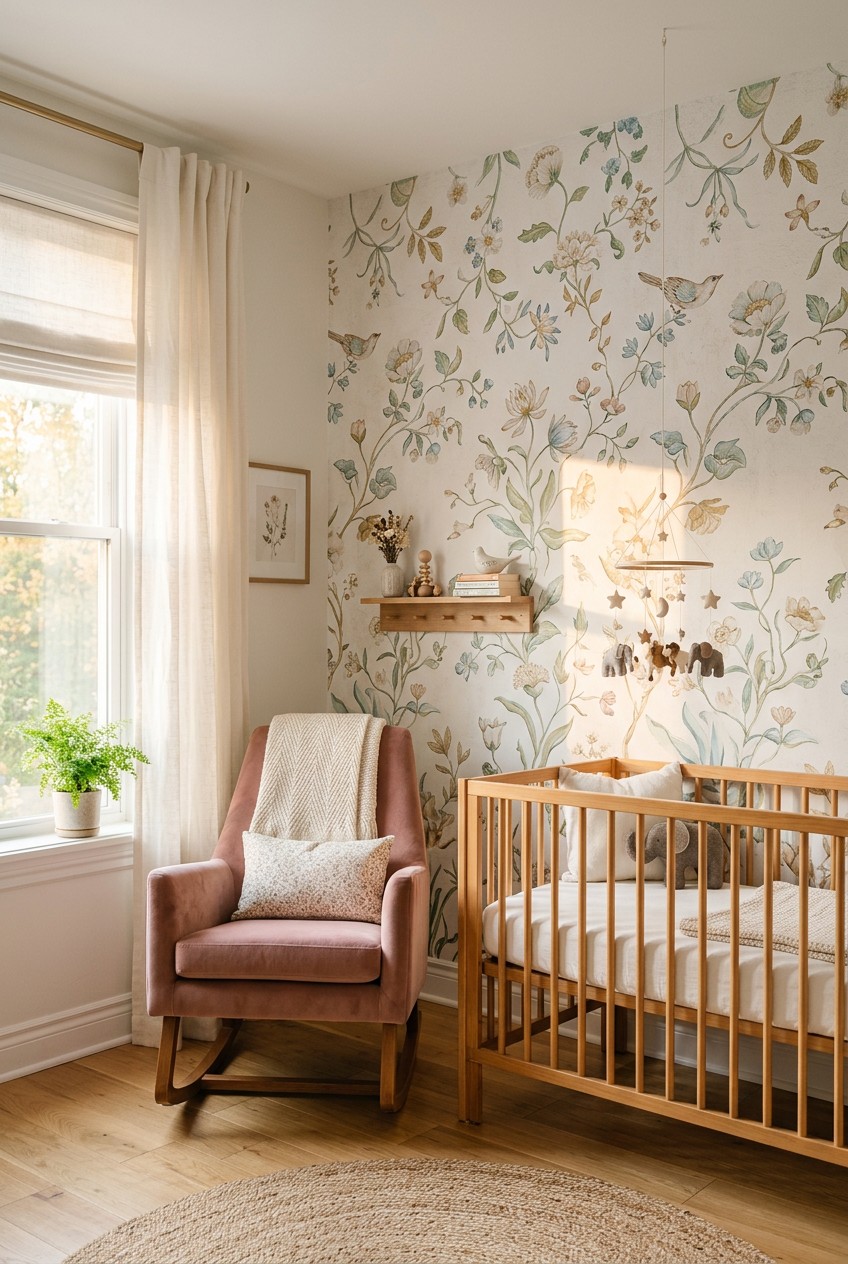
Peel-and-stick wallpaper is my favorite cheat code. It allows for easy updates as your child grows without destroying the drywall. You want to look for PVC-free, VOC-free options printed with water-based inks. Brands like Love vs. Design or Wall Blush are fantastic. They offer customizable colors and designs starting around $2.85 per square foot. I recently installed their Painted Vine pattern in a client’s home. We chose the Matcha colorway, and it completely warmed up the room. Be warned. Installing it yourself is a sweaty, frustrating workout. If you’ve got the budget, professional installation for a full nursery ranges from $600 to $1200 for labor, or about $2 to $7 per square foot. It’s worth every penny to avoid the bubbles and crooked seams.

Criusia Over the Door Organizer
Criusia Over the Door Organizer has been one of the most consistently praised picks in this category. 208 reviewers averaged 4.5/5.
10. Wallpaper the Ceiling Instead

Here’s a surprising tip. Wallpaper the ceiling instead of the walls. It’s often overlooked, but the ceiling is the primary visual for a baby lying flat on their back in the crib. A bold ceiling makes a massive statement. Plus, it can actually be a more budget-friendly option than wallpapering an entire 12×12 room. You only need about 2 or 3 rolls. I did this in my niece’s room using a $110.00 roll of starry night wallpaper. We painted the walls a soft cream and let the ceiling do all the talking. Just make sure your ceiling is totally smooth. If you’ve got popcorn ceilings, the wallpaper won’t stick. I spent three days scraping popcorn texture off a ceiling once. My arms felt like wet noodles.
11. Add Texture With Wood Millwork

If you want a permanent, luxurious feel, add architectural details like wainscoting or picture frame molding. It makes a basic drywall box look like a custom-built home. I love installing simple board and batten. You can buy 1×3 MDF pine boards for about $4.58 each at the hardware store. Nail them to the wall in a grid pattern, caulk the seams, and paint them. If you paint these wood elements in the exact same color as the wall, it adds gorgeous texture without overwhelming the space. I did this last spring. I was completely covered in white caulk and eating a $5.99 sub sandwich from Kroger on the floor, but the end result was stunning. It gives the room an expensive, tailored look for under $150.
12. Keep Above-Crib Decor Totally Flat

I see this mistake on Pinterest all the time. People hang heavy floating shelves right over the crib and fill them with wooden toys and heavy ceramic pots. Never place shelves, heavy frames, or loose decorative items directly above the baby’s bed. Babies learn to stand and grab things much faster than you expect. If they pull a shelf down, it’s a disaster. Instead, opt for flat, securely mounted decals, painted stencils, or very lightweight fabric banners. I bought a $18.50 customized linen name banner on Etsy. It weighs less than an ounce. I tacked it to the wall with tiny finishing nails. Even if it somehow fell, it wouldn’t hurt a fly. Keep the drop zone completely clear of heavy objects.

Beautiful Wooden Baby Closet Dividers Set of 7
If you want something that just works, Beautiful Wooden Baby Closet Dividers Set of 7 – Double-Sided Organize is a safe bet (11 reviews, 4.5 stars).
13. Stick on Non-Toxic Wall Decals

Decals are a temporary, versatile, and totally safe way to add visual interest. But you can’t just buy the cheapest ones you find online. Many cheap decals are full of nasty plastics. You need PVC-free, phthalate-free, and formaldehyde-free options printed with water-based inks. Brands like One Trick Pony, Oopsy Daisy, LUMA Walls & Decor, and Sunny Decals are great. Made of Sundays and Maminka also offer beautiful, safe options. I bought a set of $45.00 watercolor woodland animal decals from Maminka. They look exactly like a hand-painted mural. They’re incredibly easy to apply, remove, and reposition. I actually peeled a giant bear decal off the wall three times to get it perfectly centered. It didn’t lose its stickiness or peel the paint.
14. Dampen Sound With Acoustic Panels

Nurseries are often full of hard surfaces like hardwood floors and wooden cribs. This creates a terrible echo that amplifies every single cry. A lesser-known trick is to integrate acoustic panels to reduce that echo. It creates a much calmer environment and helps the baby sleep longer. BabiesDecor Padded Walls offers brilliant Kids Nursery Acoustic Wall Panels. They’re made from artificial leather and come in beautiful muted colors. You can buy a set of 10 tiles for around $89.99. I installed a block of these behind a rocking chair. They look like a modern, plush headboard, but they secretly absorb sound. It dramatically reduced the noise transfer to the living room next door. It’s functional decor at its best.
15. Limit Your Color Palette to Avoid Overstimulation

While bold colors are fun, too many contrasting shades will absolutely overstimulate a newborn. You want the room to say sleep, not playtime. Expert opinion suggests sticking to a strict palette of just 2 or 3 complementary colors. Favor soft greys, creamy beiges, pale greens, or trending shades like clay pink and smoky blue. If you really want a vibrant color, apply it very sparingly. Maybe just paint a single accent wall or use a bright color for the curtains. I once designed a room with five different pastel colors. It looked like a bag of melted jellybeans. The parents hated it, and I had to repaint it. Now, I stick to a tight 3-color rule. It keeps the room feeling serene and organized.

Vailando 6-Shelf Hanging Closet Organizer with 3 Drawers
Vailando 6-Shelf Hanging Closet Organizer with 3 Drawers punches above its price — 34 buyers rated it 4.5 stars. I would buy it again.
16. Add Botanical Prints for a Nature Connection

Bringing plant life into the nursery is a huge trend, but real plants can be tricky with a curious toddler. Botanical prints are the perfect solution. I love using Tempaper’s Havana Palm peel-and-stick wallpaper for a lush, tropical touch. It costs about $42.99 a roll. If wallpaper is too much commitment, hang a series of framed leaf prints. I bought a set of three 8×10 fern prints for $22.00. I put them in light oak frames with shatterproof acrylic. The green tones naturally soothe the nervous system. I actually hung these while sipping a $4.50 iced latte from a local cafe, just enjoying how instantly the room felt fresher. Greenery, even fake or printed greenery, breathes life into a sterile room.
17. Layer in Lightweight Fabric Banners

Textiles aren’t just for windows and floors. Hanging fabric on the walls adds incredible softness and warmth. I love using canvas pennants, woven macrame hangings, or simple cotton bunting. They’re cheap, lightweight, and completely safe to hang anywhere. I found a gorgeous $28.00 mustard yellow macrame wall hanging at a craft fair. It added so much texture to a plain white wall. Just be sure to secure the strings tightly so they don’t become a strangulation hazard. I use 3M Command hooks that cost $3.48 for a pack of two. I tuck the excess string behind the canvas so the baby can’t reach it. It’s a great way to fill an awkward, empty wall space without spending a fortune on custom art.
18. Try a Painted Arch Accent Wall

If you’re on a tight budget, a painted arch is the cheapest way to make a massive impact. You only need a $5.98 quart of paint, a piece of string, a pencil, and a thumbtack. You tie the string to the pencil, pin the other end to the wall, and draw a perfect half-circle. I painted a beautiful terracotta arch behind a $299.00 white IKEA Hemnes dresser. It perfectly framed the changing station. The paint cost me less than a fancy coffee. Be warned, painting the curved edge with a brush takes a steady hand. I messed it up the first time and it looked incredibly lopsided. I had to wait for it to dry, sand it down, and try again. Take your time.
19. Install Picture Ledges for Books

Books are basically free artwork. Instead of hiding them in a basket, display them on the wall. I love installing shallow picture ledges. You can grab 45-inch floating ledges for about $19.99 each. Mount three of them vertically on the wall, spacing them exactly 14 inches apart. This accommodates taller picture books. Fill them with beautifully illustrated books facing outward. It adds instant color and encourages reading. I did this in my own house. I was drilling holes while munching on a $4.99 box of crackers from Sprouts. Just make sure you use heavy-duty drywall anchors. A shelf full of hardback books gets surprisingly heavy. I’ve seen cheap screws rip right out of the drywall, leaving massive, ugly holes behind.
20. Add Dimmer Switches and Wall Sconces

Lighting completely changes how your wall color looks. Overhead lighting is usually harsh and casts ugly shadows. You need soft, layered lighting. First, install a $24.98 dimmer switch for the main light. This is a lifesaver for 3 AM diaper changes. Second, add plug-in wall sconces on either side of the crib or glider. You don’t even need an electrician. I bought two $35.00 brass plug-in sconces online. I ran the cords down the wall and hid them behind a $12.99 cord concealer strip. Put a 40-watt warm amber bulb in them. It washes the wall in a gorgeous, cozy glow. It makes the earthy paint tones look incredibly rich. Good lighting makes cheap paint look expensive. Bad lighting makes expensive paint look terrible.
Designing a nursery shouldn’t make you want to pull your hair out. It’s about planning ahead, choosing safe materials, and trusting your gut. Whether you’re painting a simple arch or color drenching the entire room, these nursery wall ideas will help you create a beautiful space. I’ve made the mistakes so you don’t have to. Take these tips, grab some swatches, and start building a room you’ll love. Save or pin this article to reference these brand names when you’re in the hardware store!
Frequently Asked Questions
What are the safest nursery wall ideas for above the crib?
Never hang heavy glass frames or floating shelves directly over the crib. The safest nursery wall ideas include flat vinyl decals, lightweight fabric banners, or painted arches that pose zero falling hazard.
How do I choose paint for my nursery walls?
Always prioritize GREENGUARD Gold certified paints to minimize toxic fumes. Brands like ECOS Paints or Benjamin Moore Natura offer beautiful colors without the harsh chemicals. Allow 24 to 48 hours for proper ventilation.
Can I use peel-and-stick wallpaper in a nursery?
Yes, it’s one of the best nursery wall ideas for easy updates. Look for PVC-free and VOC-free wallpapers printed with water-based inks. Brands like Love vs. Design offer gorgeous, baby-safe options.
How high should I hang art above the nursery dresser?
Maintain a 6 to 10-inch gap between the top of the dresser and the bottom edge of the frame. Ensure the artwork spans roughly two-thirds of the furniture’s width to look balanced and cohesive.
