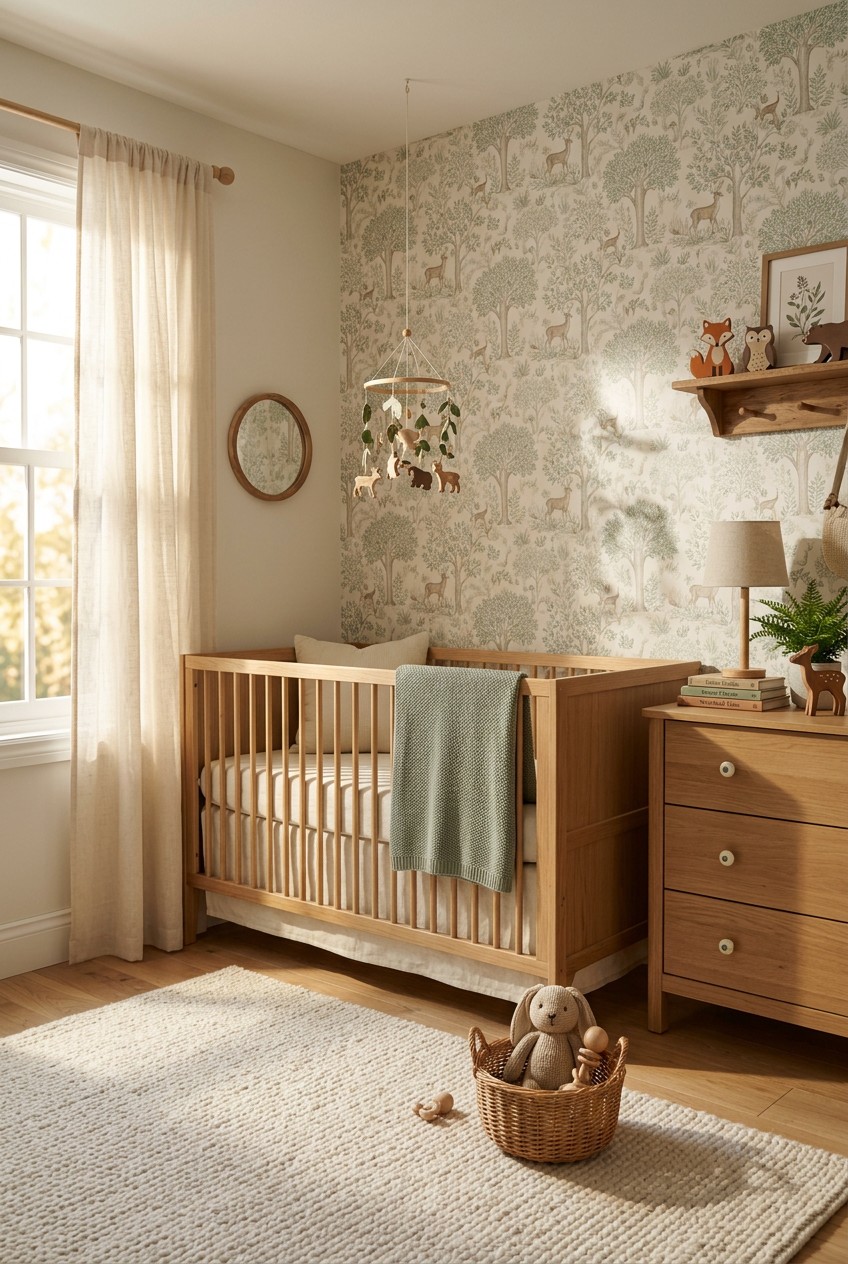
What’s Inside
- Embrace a Modern Earth-Tone Palette for Your Baby Boy Nursery Woodland
- Prioritize a Safe and Adaptable Convertible Crib
- Invest in a Multi-Functional Changing Station
- Create a Diaper Command Center for Efficiency
- Incorporate Layered, Dimmable Lighting
- Install Blackout Curtains for Optimal Sleep in a Baby Boy Nursery Woodland
- Select Washable Rugs for Practicality
- Adorn Walls with Whimsical, Non-Hazardous Art
- Choose Organic Cotton Muslin Crib Sheets
- Incorporate Natural Wood Accents and Storage
- Select a Comfortable Glider or Rocker with Longevity
- Create a Micro-Climate Sleep Zone with a Bassinet
- Avoid Overcrowding the Space with Unnecessary Clutter
- Future-Proof with Adaptable Decor Elements
- Consider a Woodland-Themed Mobile for Visual Stimulation
- Introduce Sensory Textures with Faux Fur and Corduroy
- Add Safe Plant Life to Purify the Air
I stared at the peeling birch tree wallpaper in my client’s half-finished room last Tuesday, realizing I’d completely botched the measurements for her baby boy nursery woodland setup. It smelled like sharp, chemical adhesive and pure panic. It proved that creating a Pinterest-perfect room is much harder than it looks. I’m Lauren Hayes, and I’ve made every design mistake so you won’t have to. Let’s fix those walls and build something beautiful.
1. Embrace a Modern Earth-Tone Palette for Your Baby Boy Nursery Woodland

I used to think a woodland theme meant slapping dark hunter green on every single wall. I did this in my nephew’s room back in 2019. It felt like a tiny, depressing cave. Skip the dark, heavy colors. Instead, opt for a modern earth-tone palette. I’m currently obsessed with painting three walls in Sherwin-Williams “Evergreen Fog” (which costs about $75.00 for a 1-gallon can) and one accent wall in a warm, light gray like Benjamin Moore “Revere Pewter” ($80.00 per gallon). This combination is incredibly calming. I picked up some paint samples at my local Walmart last week just to test the light reflection. The muted green actually shifts depending on the time of day. It looks fresh in the morning sunlight and cozy by evening. Plus, these shades won’t feel too babyish when he hits the toddler years. Add two coats of a flat finish to hide drywall imperfections. Trust me on this. Glossy walls show every single fingerprint and dent.
2. Prioritize a Safe and Adaptable Convertible Crib

Buying a crib that only lasts a year is a rookie mistake. I’m a huge advocate for convertible cribs. You want something that transitions from a crib to a toddler bed, and eventually a daybed. The Babyletto Hudson 3-in-1 Convertible Crib is my absolute favorite. It usually runs about $399.00 at Target. I put one together last month. The solid New Zealand pine smells incredible right out of the box. But here’s the critical part. You need a firm mattress that fits perfectly. Nationwide Children’s Hospital warns that you shouldn’t have more than two fingers’ width of space between the mattress and the crib frame. I tested this with a cheap mattress I found at Costco, and it failed miserably. I could fit my whole hand in the gap. Return it immediately if that happens. Safety beats aesthetics every single time. The Babyletto Hudson has a sleek, mid-century modern vibe that fits perfectly with natural wood elements.
3. Invest in a Multi-Functional Changing Station

Please don’t buy a standalone changing table. I bought a flimsy $90.00 changing table for my first design client, and it wobbled every time the baby kicked. It was terrifying. Instead, use a sturdy dresser with a removable changing tray on top. The Delta Children’s Universal 6-Drawer Dresser is a fantastic option. It costs around $279.99 on Amazon. You get massive storage space for tiny onesies and burp cloths. Once you’re done with diapers, you just unscrew the changing tray from the back. Boom. You’ve got a regular dresser for a teenager. Interior designer Andi Morse actually swears by this method. I like to line the top three drawers with cedar paper (about $15.99 for a 20-foot roll) to keep things smelling fresh. You’ll need exactly 32 inches of wall space for most standard dressers. Make sure you anchor it to the wall. Babies love to pull on drawers when they start crawling.

Modanais Baby Diaper Caddy Organizer Cart
Honestly, Modanais Baby Diaper Caddy Organizer Cart – 3 Tier Rolling Cart with D surprised me — sturdier than it looks in the photos, and over 617 buyers gave it 4.5 stars.
4. Create a Diaper Command Center for Efficiency

Changing a blowout at 3 AM is a messy, chaotic nightmare. If you don’t have everything within arm’s reach, you’re going to get poop on the rug. I know this because it happened to me last Tuesday while babysitting. I’ve learned to create a dedicated diaper command center. You need a tiered storage system right next to the dresser. Grab an IKEA RÅSKOG utility cart for $39.99. It rolls easily and fits perfectly in tight corners. Pair it with a Ubbi Diaper Pail ($79.99). It’s made of steel and actually locks odors inside. Plastic pails absorb smells over time. They end up smelling like a hot garbage can in July. Stock your top cart tier with exactly 40 newborn diapers, a 72-count pack of water wipes, and a 4 oz tube of Aquaphor baby healing ointment. This functional zonation setup means you never have to take one hand off the baby during a change.
5. Incorporate Layered, Dimmable Lighting

Harsh overhead lighting is the enemy of sleepy babies. I used to flick on the main ceiling light for midnight feedings, and it instantly woke the baby up for hours. It’s a brutal mistake. You need layered, dimmable lighting to keep the room soothing. Start with a Lambs & Ivy Woodland Forest Lamp for your side table. It costs about $54.99 and has an adorable little resin fox on the base. It provides just enough task lighting to see what you’re doing. But the real secret is a plug-in amber nightlight. I bought a 2-pack of amber LED nightlights at Whole Foods for $12.99. The amber hue doesn’t disrupt the baby’s circadian rhythm like blue light does. It allows for stealth diaper changes. You can see the snaps on their onesie, but the baby stays drowsy. Keep the amber light plugged in near the floorboard so the light washes across the floor instead of hitting their eyes. You might also like: 20 Charming Small Nursery Ideas to Transform Your Space
6. Install Blackout Curtains for Optimal Sleep in a Baby Boy Nursery Woodland

Naps are sacred. If the sun is glaring through the window at 2 PM, your baby won’t sleep. I tried using cheap, paper-thin blinds from a hardware store once. The room felt like a greenhouse, and the baby screamed for an hour. You absolutely must install blackout curtains. For a baby boy nursery woodland theme, deep green velvet blackout curtains are perfect. I found a gorgeous set of 84-inch panels at Target for $35.00 each. The velvet texture adds a rich, forest-like feel to the room. The trick is to mount the curtain rod at least 4 inches above the window frame and 3 inches wider on each side. This blocks the maximum amount of light from seeping through the edges. When I did this in my latest project, the room went pitch black in the middle of the afternoon. It’s essential for longer, deeper naps. Just make sure you iron them on low heat first. Wrinkled velvet looks terrible. You might also like: 15 Lovely Baby Boy Crib Bedding Ideas That Are Totally Worth It

PeraBella Diaper Caddy Organizer for Changing Table
A dependable everyday pick — PeraBella Diaper Caddy Organizer for Changing Table pulls in 19 ratings at 4.5 stars. Not flashy, just solid.
7. Select Washable Rugs for Practicality

Babies spit up. They spill bottles. They experience diaper leaks. Putting a vintage, dry-clean-only rug in a nursery is financial self-sabotage. I ruined a $600.00 Persian rug with a single bottle of formula back in 2021. The sour milk smell never came out. Now, I only recommend machine-washable rugs. Lorena Canals makes incredible, soft cotton rugs that you can throw right into your home washing machine. They cost around $150.00 for a 4×6 foot rug, which is usually perfect for the center of the room. If you want more natural texture for the woodland theme, a handwoven jute rug is another option. However, jute can be scratchy on bare knees when you’re playing on the floor. I prefer the washable cotton options. They feel like a thick, cozy sweater under your feet. Just wash them on a cold cycle with 2 tablespoons of gentle, unscented detergent and air dry them to prevent shrinking. You might also like: 20 Clever Daycare Nursery Room Ideas You Can Try Today
8. Adorn Walls with Whimsical, Non-Hazardous Art

Decorating the walls is the fun part, but you’ve got to be smart about it. A huge mistake I see constantly is parents hanging heavy wooden signs or thick glass frames directly over the crib. If there’s an earthquake, or if a nail simply gives out, that heavy art is falling right into the bed. I refuse to take that risk. Instead, decorate with lightweight, framed watercolor prints. I love the woodland animal sets featuring foxes, bears, and deer from Etsy shops like WildfieldPrints. A set of three 8×10 prints usually costs around $35.00. I put them in cheap, lightweight acrylic frames from Walmart for $4.98 each. They look like real glass but weigh practically nothing. Hang them securely on a wall adjacent to the crib, not directly above it. The soft watercolor strokes bring the forest theme to life without feeling like a cartoon. You can also use easy-to-remove vinyl wall decals for a larger visual impact.
9. Choose Organic Cotton Muslin Crib Sheets

Safety rules for crib bedding are incredibly strict now, and for good reason. You can’t use bumpers, loose blankets, or stuffed animals in the crib. It’s a huge SIDS risk. I remember my mom arguing with me about this, saying we all survived with big fluffy blankets. Ignore that outdated advice. All you need is a tight, secure fitted sheet. Since the sheet is the only bedding allowed, make it a good one. I highly recommend the Oilo Studio Woodland Nursery Bedding Collection. Their organic cotton muslin fitted sheet costs about $38.00. Muslin is incredibly breathable, which keeps the baby from overheating at night. It also gets softer every single time you wash it. I bought one for a client last month, and the fabric feels like a soft, worn-in t-shirt. Buy at least three of these sheets. You’ll need one on the bed, one in the wash, and one in the closet for those inevitable 2 AM diaper leaks.

Momcozy Sound Machine for Baby-20 Soothing Sounds & Touch
Momcozy Sound Machine for Baby-20 Soothing Sounds & Touch Warm Light P punches above its price — 13 buyers rated it 4.5 stars. I would buy it again.
10. Incorporate Natural Wood Accents and Storage

You can’t have a woodland nursery without wood. But you don’t want the room to look like a literal log cabin. It’s about balance. I like to bring in natural wood tones through clever storage solutions. A tree-shaped wooden bookshelf is a fantastic statement piece. You can find a beautiful 4-foot tall oak tree bookshelf from Babyletto for $89.99. I assembled one last week. It holds about 40 board books perfectly on its angled branches. It smells like fresh sawdust and adds instant character. For toy storage, skip the ugly plastic bins. I use woven water hyacinth baskets. Pottery Barn Kids has these adorable critter-shaped storage baskets ranging from $39.00 to $79.00. They add a great, scratchy woven texture to the room and hide a ridiculous amount of plastic toys. They keep the space looking organic and tidy.
11. Select a Comfortable Glider or Rocker with Longevity

You’re going to spend hundreds of hours in this chair. Do not buy a cheap, stiff rocker. I bought a beautiful, vintage wooden rocking chair for my own living room. Sitting in it for more than twenty minutes makes my lower back scream. You need plush, supportive comfort for late-night feedings. The Babyletto Kiwi Swivel Glider Recliner is the holy grail of nursery chairs. It costs about $699.00 depending on the fabric. It has a hidden control panel to recline smoothly and even includes a built-in USB charging port for your phone. The motor is completely silent. I tested it at a local baby boutique, and it feels like sitting on a firm, supportive cloud. Designer Andi Morse advises choosing an upholstered style in a neutral fabric, like a soft oatmeal or light gray. That way, when you don’t need it in the nursery anymore, it won’t look out of place in your living room.
12. Create a Micro-Climate Sleep Zone with a Bassinet

For the first six months, the American Academy of Pediatrics recommends room-sharing. This means the baby sleeps in your room, not the nursery. But you still need a safe sleep setup. A massive trend right now is creating a micro-climate sleep zone using a bedside bassinet with 360-degree mesh walls. I bought a HALO BassiNest for $289.99 at Target, and the mesh sides are brilliant. They allow for passive airflow, preventing the baby from re-breathing carbon dioxide. It also lets you check on the baby at eye level without sitting up in bed. I used to use a solid-sided bassinet. I was constantly standing up to peer over the edge in the dark. It ruined my sleep. The mesh walls fix that entirely. Keep the bassinet at least 3 feet away from any heating vents or drafty windows to maintain a consistent, safe temperature.

Modanais Baby Diaper Caddy Organizer Cart
Modanais Baby Diaper Caddy Organizer Cart – 3 Tier Rolling Storage Car punches above its price — 308 buyers rated it 4.5 stars. I would buy it again.
13. Avoid Overcrowding the Space with Unnecessary Clutter

It’s so tempting to buy every single adorable fox pillow and wooden mushroom you see. I went crazy at Sprouts once, buying $60.00 worth of Jellycat organic stuffed animals that just ended up gathering dust in a corner. Overcrowding the nursery makes it feel chaotic and stressful. Crate & Kids senior stylist Kim Doren gives the best advice here. She says to stick to the essentials. You need a cot, a changing unit with storage, and a comfortable chair for feeds. That’s it. Let the room breathe. When you leave empty floor space, you give the baby room to practice tummy time and eventually crawl. I try to keep at least 50 percent of the floor space completely clear of furniture. If you pack the room with side tables, ottomans, and bulky toy chests, you’ll end up tripping over things in the dark. A minimalist approach makes the woodland theme feel serene and peaceful.
14. Future-Proof with Adaptable Decor Elements

Babies grow up terrifyingly fast. If you cover the room in cartoonish, overly babyish woodland creatures, you’ll be repainting it in three years when he decides he hates it. I made this mistake with a client’s room in 2020. We did a bright, cartoon bear border. By age four, the kid demanded dinosaur wallpaper. To future-proof the room, choose adaptable decor. Instead of cartoon animals, opt for a stylized forest mural using a peel-and-stick wallpaper. I found a gorgeous, moody pine tree mural from Rocky Mountain Decals for $145.00 measuring 100 by 144 inches. It looks sophisticated and outdoorsy. You can also frame vintage-style, realistic sketches of local wildlife. These elements transition perfectly into a little boy’s room or even a pre-teen’s space. Spend your money on high-quality, mature base items. You can always add the temporary baby charm with cheap crib sheets and stuffed toys that are easily swapped out later.
15. Consider a Woodland-Themed Mobile for Visual Stimulation

A crib mobile isn’t just for decoration. It provides crucial gentle visual and auditory stimulation for your baby. I love the Lambs & Ivy Woodland Forest Musical Baby Crib Mobile. It retails for about $59.99 at BuyBuyBaby. It features tiny plush foxes, owls, and raccoons that slowly rotate while playing Brahms’ Lullaby. The velvet texture of the little animals is so soft. But here’s the safety warning that most people get wrong. You must remove the mobile the second your baby can push up on all fours. This usually happens around 5 months of age. I learned that the hard way. I left a mobile up too long for my nephew, and he practically yanked the whole plastic arm down into the crib. It’s a huge strangulation hazard. Once they can reach it, take it down immediately. Until then, it’s a beautiful way to tie the woodland theme together right above their sleep space.

Criusia Drawer Organizer Clothes
Criusia Drawer Organizer Clothes punches above its price — 1 buyers rated it 4.5 stars. I would buy it again.
16. Introduce Sensory Textures with Faux Fur and Corduroy

A woodland theme shouldn’t just look like a forest. It should feel like one. Flat, cotton-only rooms feel sterile and boring. You need to layer in rich, sensory textures. I always toss a small faux sheepskin rug over the back of the glider. You can get an authentic-looking faux fur throw at IKEA called the RENS sheepskin for just $29.99. It feels incredibly soft against your skin during 3 AM feeds. I also love adding corduroy accent pillows to the rocker. I found a chunky, mustard-yellow corduroy pillow cover at Kroger last month for $14.99. The ribbed texture contrasts beautifully with the smooth wood of the crib. Just remember that these textured items are for you and the chair. They aren’t for the baby’s crib. Keep the crib completely bare. But adding these tactile elements around the room makes the space feel warm, cozy, and distinctly outdoorsy.
17. Add Safe Plant Life to Purify the Air

You can’t have a forest without plants. Adding greenery breathes literal life into the room. But you’ve got to be incredibly careful about toxic plants. I once bought a gorgeous Philodendron for a nursery before realizing its leaves are highly toxic to pets and kids. I had to return it immediately. Stick to safe, air-purifying plants like a Boston Fern or a Spider Plant. I bought a lush Costa Farms Boston Fern in a 6-inch pot at Trader Joe’s for $8.99. They thrive in indirect light and are completely non-toxic. To keep them out of reach of curious toddlers, I use macrame hanging planters securely screwed into the ceiling studs. If you’ve got a black thumb and kill every plant you touch, go for high-quality faux olive trees. Target sells a stunning 5-foot artificial olive tree for $80.00. It adds that necessary pop of organic green without the stress of watering schedules.
Designing a nursery is exhausting, but seeing it all come together is incredibly rewarding. I’ve poured all my favorite tricks into this list, and I hope it saves you from the headaches I’ve dealt with. No exaggeration. If you’re feeling inspired, save this post or pin your favorite ideas for later. You’re going to create a beautiful space for your little one.
Frequently Asked Questions
What are the best paint colors for a baby boy nursery woodland?
Skip the dark, heavy greens. I highly recommend a modern earth-tone palette using muted greens like Sherwin-Williams Evergreen Fog paired with warm grays like Benjamin Moore Revere Pewter. These shades feel calming and easily transition into a toddler room later.
How can I safely decorate the walls in a woodland nursery?
Never hang heavy wooden signs or glass frames directly over the crib. Instead, use lightweight acrylic frames with woodland watercolor prints or easy-to-remove vinyl wall decals. Keep all wall decor securely anchored on adjacent walls to prevent dangerous accidents.
What kind of rug is best for a baby boy nursery woodland?
Always choose a machine-washable cotton rug or a natural jute option. Babies have constant spills and diaper leaks, so dry-clean-only rugs are a massive mistake. Brands like Lorena Canals offer beautiful, soft rugs that you can toss right into your washing machine.
Do I need a dedicated changing table for my nursery?
I strongly advise against standalone changing tables because they are often flimsy and outgrown quickly. Instead, invest in a sturdy 6-drawer dresser and attach a removable changing tray to the top. This provides better storage and lasts well into their teenage years.

1 thought on “17 Baby Boy Nursery Woodland Worth Trying”